01 / Morfologi

Ciri dan struktur

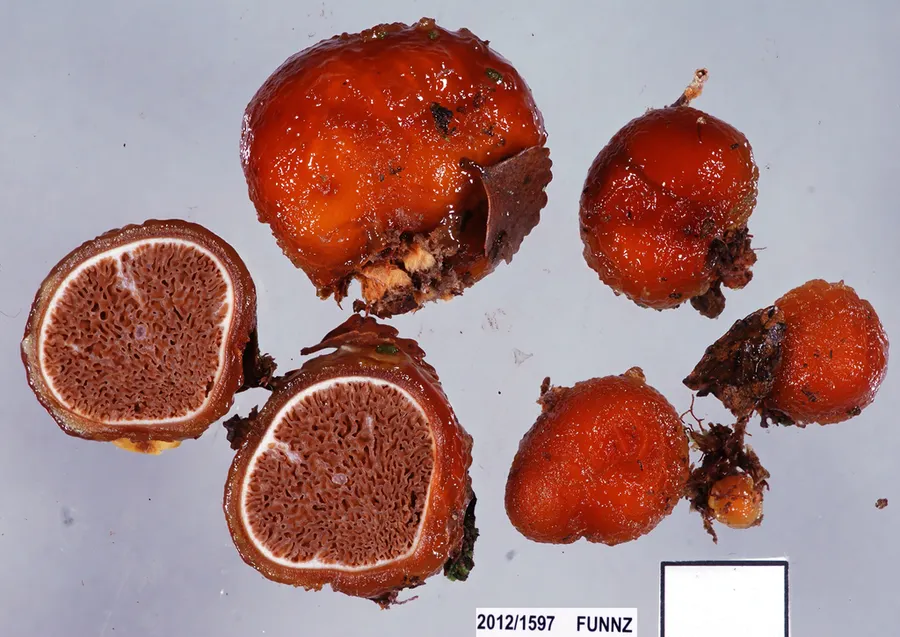
Cortinarius beeverorum produces fruiting bodies slightly above ground, usually found under leaf litter. They appear round-shaped to slightly flattened and have a diameter of 1 to 3 cm across. It has a reduced and often absent stipe and columella. The outer layer of the fungus is gelatinous and smooth, sometimes slightly bumpy, with an outer skin of the fruiting body orange-red. Underneath, there is a brown layer, which might reveal itself as the fungus ages. Inside, the fungus has small chambers (locules) that become rust-brown in mature specimens, separated by white tissue. Under a microscope, its spores appear yellow-brown, almond- to oval-shaped, and measure on average 17×10 μm. The spores have a rough surface with bumps and ridges. Its basidia, the structures that produce spores, are 42–69 μm long and are usually club-shaped and carry four spores each.

Sebagian uraian ditampilkan dalam bahasa sumber; terjemahannya belum tersedia atau belum lolos pemeriksaan.

Rujukan: [1]

Pengukuran mengikuti objek, spesimen atau kultur, dan metode yang disebutkan sumber. Baca uraian asli untuk konteks lengkap.

02 / Kehidupan

Habitat dan peran ekologis

Cortinarius beeverorum is ectomycorrhizal, typically associated with southern beech (Nothofagus). This fungus typically appears in autumn. Although it prefers southern beech forests, it has sometimes been found near tea trees (Leptospermum). It has been recorded 26 times across eight different locations, with an estimated range of about 196,000 km2 and an occupied area of roughly 76 km2. Its occurrence spans both the North and South Island.

Sebagian uraian ditampilkan dalam bahasa sumber; terjemahannya belum tersedia atau belum lolos pemeriksaan.

Rujukan: [1]

Habitat atau konteks temuan
hutan
Substrat
Informasi belum tersedia pada sumber rilis ini.
Peran atau konteks
Mitra tumbuhan
Temukan hubungan serupa
03 / Siklus hidup

Reproduksi

Under a microscope, its spores appear yellow-brown, almond- to oval-shaped, and measure on average 17×10 μm. The spores have a rough surface with bumps and ridges. Its basidia, the structures that produce spores, are 42–69 μm long and are usually club-shaped and carry four spores each.

Sebagian uraian ditampilkan dalam bahasa sumber; terjemahannya belum tersedia atau belum lolos pemeriksaan.

Rujukan: [1]

04 / Batas informasi

Catatan identitas dan cakupan

  • Nama diterima mengikuti Catalogue of Life Base2026-09-11; uraian mempertahankan konsep dan nama sumber aslinya.
  • Original geographic, specimen and life-cycle scope retained; source import awaits individual editorial review.
  • Impor dan terjemahan otomatis belum diperiksa editorial per profil. Struktur reproduktif yang disebutkan tidak membuktikan seluruh siklus hidup diketahui.
  • Pengukuran pada uraian mengikuti spesimen, kultur, dan metode sumber; angka tidak diperluas ke semua populasi.

Catatan distribusi dalam narasi mengikuti sumbernya. Dokumentasi spesimen atau foto mengikuti catatan sumber. Bukti wilayah Indonesia dan penilaian konservasi tidak disimpulkan dari gambar.

05 / Dokumentasi

Melihat dengan konteks

Dokumentasi Cortinarius beeverorum menurut asosiasi foto pada record takson iNaturalist. Kredit: Jerry Cooper. Identitas mengikuti sumber; bukan penentuan spesimen independen.

Jenis
Fotografi
Kredit
(c) Jerry Cooper, some rights reserved (CC BY), uploaded by Jerry Cooper
Lisensi
CC BY 4.0
Sumber media
Buka entri sumber

Gambar menunjukkan objek menurut identifikasi sumber, bukan verifikasi independen spesimen oleh Fungi. Tidak ada skala baru yang ditambahkan.

06 / Rujukan

Sumber profil

  1. [1] Cortinarius beeverorum — Wikipedia (en)Bagian sumber: Frozen revision 1357999137
    Tanggal penghimpunan sumber: 2026-10-12
    Teks sumber: CC BY-SA4.0 · Wikipedia contributors
  2. [2] Catalogue of Life Base2026-09-11 — Cortinarius beeverorumBagian sumber: ColDP NameUsage.tsv ID YK6H; accepted species; source 2073
    Tanggal penghimpunan sumber: 2026-10-12
  3. [3] Dokumentasi visual — Cortinarius beeverorumBagian sumber: Individual media record; identification follows the source, not independent determination
    Tanggal penghimpunan sumber: 2026-10-12
    Media sumber: CC BY 4.0 · (c) Jerry Cooper, some rights reserved (CC BY), uploaded by Jerry Cooper

Adaptasi teks: CC BY-SA 4.0. Wikipedia contributors — Cortinarius beeverorum — Wikipedia (en)

Uraian asli dan riwayat sumber

Riwayat atau halaman sumber

Ringkasan sumber

Cortinarius beeverorum produces fruiting bodies slightly above ground, usually found under leaf litter. They appear round-shaped to slightly flattened and have a diameter of 1 to 3 cm across. It has a reduced and often absent stipe and columella. The outer layer of the fungus is gelatinous and smooth, sometimes slightly bumpy, with an outer skin of the fruiting body orange-red. Underneath, there is a brown layer, which might reveal itself as the fungus ages. Inside, the fungus has small chambers (locules) that become rust-brown in mature specimens, separated by white tissue.

Revisi sumber

Morfologi sumber

Cortinarius beeverorum produces fruiting bodies slightly above ground, usually found under leaf litter. They appear round-shaped to slightly flattened and have a diameter of 1 to 3 cm across. It has a reduced and often absent stipe and columella. The outer layer of the fungus is gelatinous and smooth, sometimes slightly bumpy, with an outer skin of the fruiting body orange-red. Underneath, there is a brown layer, which might reveal itself as the fungus ages. Inside, the fungus has small chambers (locules) that become rust-brown in mature specimens, separated by white tissue. Under a microscope, its spores appear yellow-brown, almond- to oval-shaped, and measure on average 17×10 μm. The spores have a rough surface with bumps and ridges. Its basidia, the structures that produce spores, are 42–69 μm long and are usually club-shaped and carry four spores each.

Revisi sumber

Ekologi sumber

Cortinarius beeverorum is ectomycorrhizal, typically associated with southern beech (Nothofagus). This fungus typically appears in autumn. Although it prefers southern beech forests, it has sometimes been found near tea trees (Leptospermum). It has been recorded 26 times across eight different locations, with an estimated range of about 196,000 km2 and an occupied area of roughly 76 km2. Its occurrence spans both the North and South Island.

Revisi sumber

Struktur reproduksi sumber

Under a microscope, its spores appear yellow-brown, almond- to oval-shaped, and measure on average 17×10 μm. The spores have a rough surface with bumps and ridges. Its basidia, the structures that produce spores, are 42–69 μm long and are usually club-shaped and carry four spores each.

Revisi sumber

Rujukan halaman ini

Fungi. Cortinarius beeverorum. Rilis data fungi-2026-10-12-expansion-2. https://fungi-atlas.mgadib.chatgpt.site/jamur/cortinarius-beeverorum/.

Status: impor sumber; pemeriksaan editorial per profil belum selesai. Untuk klaim biologis, gunakan rujukan pada bagian terkait dan periksa konteks sumber aslinya.