01 / Morfologi

Ciri dan struktur

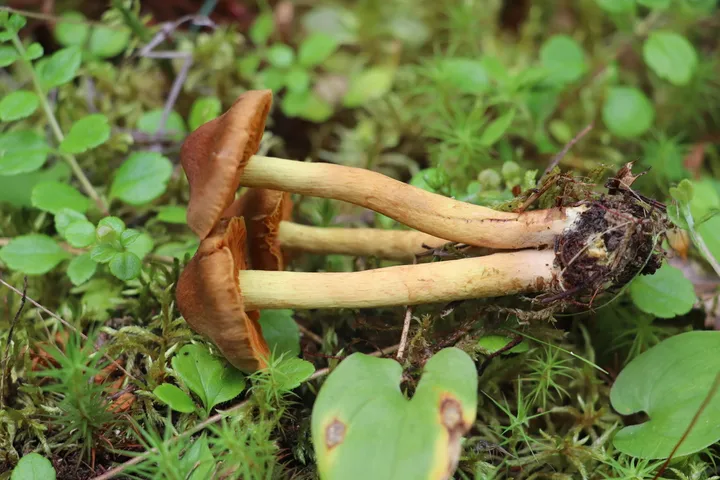
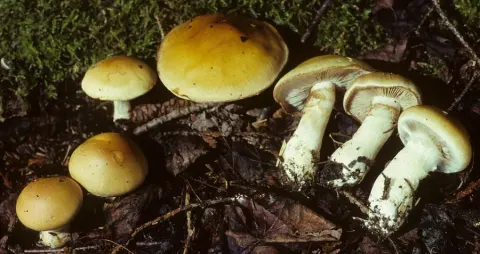
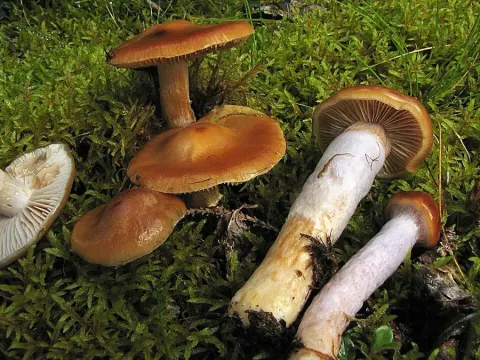
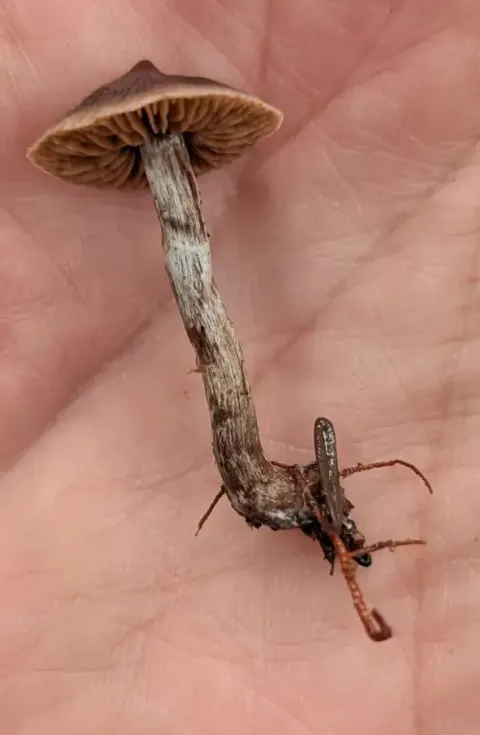
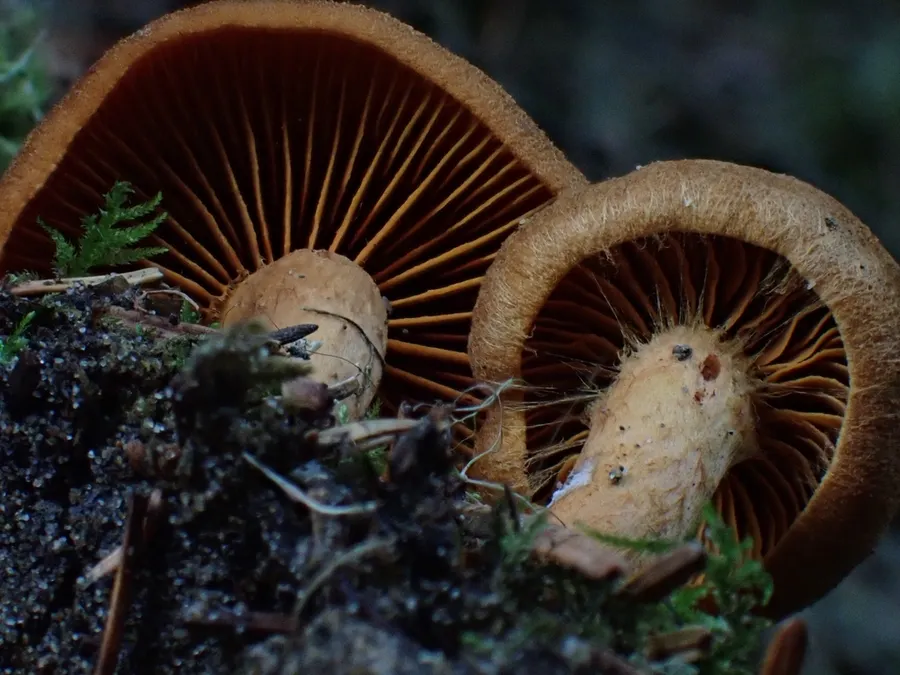
The cap is quite thinly fleshy, 3–6 cm in diameter, initially quite spherical, later bluntly convex to bell-shaped, usually with an umbo, and often irregular and bent or wavy towards the margin. The margin is initially curved inward, then straight, sometimes at the margin itself slightly flexuosely rugose or even briefly fimbriate. The cap surface is dry and opaque, fibrillosely squamulose, tomentose, at first vivid yellow ochre to yellow or copper olivaceous, later glabrescent or quite glabrous and when mature brownish olive or light olive, often with a saffron tint at the margin, and with numerous fibrils from the universal veil when young; later the margin is mostly concolorous. The gills are crowded closely together, 3–5 mm broad, emarginate (notched), adnate by a tooth. The color is vivid yellow when young, then brownish-olive, rarely with saffron tint, and finally brownish-olive to rusty cinnamon, with denticulate (finely toothed) edge, which is either the same color as the gill or paler. Young specimens have a yellow cortina of fine fibers that extend from the cap to the stem. The stem is 8–12 cm tall and 0.5–1 cm wide, cylindrical, often slightly wavy, solid, then hollow, fibrillose and quite fragile. At first it is almost the same color as the gills, vivid yellow or yellow later with a more or less olive tone, and in some places turning brown. It is covered with fibrils from the veil, which forms one or two incomplete, oblique, and usually fugacious zones. The flesh is thin, in the cap pale yellow or yellow with olive tones, a little darker in the stem, yellow to olive, with a faint slightly radishy smell and mild taste.

Sebagian uraian ditampilkan dalam bahasa sumber; terjemahannya belum tersedia atau belum lolos pemeriksaan.

Rujukan: [1]

Pengukuran mengikuti objek, spesimen atau kultur, dan metode yang disebutkan sumber. Baca uraian asli untuk konteks lengkap.

02 / Kehidupan

Habitat dan peran ekologis

The fruit bodies of are common in damp places in coniferous forests, growing not only in Europe but apparently throughout the temperate zone of the Northern Hemisphere. Ia juga telah dikumpulkan dari Provinsi Yunnan, Cina. Spesies ini mengkolonisasi sistem akar sedges Carex flacca dan Carex pilulifera, membentuk struktur seperti ektomikoriza yang tidak memiliki jaringan Hartig net ⁇ a hifa yang menembus antara sel epidermal dan kortis akar. Struktur yang terbentuk antara C. cinnamomeus dan sedges memiliki mantel jamur yang berbeda (85–100 μm tebal), hifa infeksi pada sel-sel epidermal, rizomorf dan ekstramatrik hifa. Struktur ectomycorrhiza ini terbentuk pada akar lateral urutan pertama tetapi secara morfologis dan anatomis berbeda dari akar dauciform (akar lateral berbulu berbangkit pendek).

Sebagian uraian ditampilkan dalam bahasa sumber; terjemahannya belum tersedia atau belum lolos pemeriksaan.

Rujukan: [1]

Habitat atau konteks temuan
Informasi belum tersedia pada sumber rilis ini.
Substrat
Informasi belum tersedia pada sumber rilis ini.
Peran atau konteks
Mitra tumbuhan
Temukan hubungan serupa
03 / Siklus hidup

Reproduksi

The basidia (spore-bearing cells) are 20–30 by 5–8 μm. The spores are elliptical with a slightly roughened surface, measuring 6–9.5 by 4–5 μm and producing a rusty-brown spore print.

Sebagian uraian ditampilkan dalam bahasa sumber; terjemahannya belum tersedia atau belum lolos pemeriksaan.

Rujukan: [1]

Sinonim menurut acuan taksonomi rilis: Agaricus cinnamomeus f. conformis; Agaricus cinnamomeus f. paludosus; Agaricus cinnamomeus var. luteolus; Agaricus fucatophyllus; Cortinarius cinnamomeus f. fucatophyllus; Cortinarius cinnamomeus var. aurantiaca; Cortinarius cinnamomeus var. luteomarginatus; Cortinarius fucatophyllus; Dermocybe cinnamomea; Dermocybe cinnamomea f. elata; Dermocybe cinnamomea f. nana; Dermocybe cinnamomea f. praemorsa; Dermocybe cinnamomea f. squarrosa; Dermocybe cinnamomea var. aurantiaca; Dermocybe fucatophylla; Flammula cinnamomea; Flammula cinnamomea var. conformis; Flammula cinnamomea var. luteola; Gomphos cinnamomeus; Gomphos fucatophyllus
04 / Batas informasi

Catatan identitas dan cakupan

  • Nama diterima mengikuti Catalogue of Life Base2026-09-11; uraian mempertahankan konsep dan nama sumber aslinya.
  • Original geographic, specimen and life-cycle scope retained; source import awaits individual editorial review.
  • Impor dan terjemahan otomatis belum diperiksa editorial per profil. Struktur reproduktif yang disebutkan tidak membuktikan seluruh siklus hidup diketahui.
  • Pengukuran pada uraian mengikuti spesimen, kultur, dan metode sumber; angka tidak diperluas ke semua populasi.

Catatan distribusi dalam narasi mengikuti sumbernya. Dokumentasi spesimen atau foto mengikuti catatan sumber. Bukti wilayah Indonesia dan penilaian konservasi tidak disimpulkan dari gambar.

05 / Dokumentasi

Melihat dengan konteks

Dokumentasi Cortinarius cinnamomeus menurut asosiasi foto pada record takson iNaturalist. Kredit: Mandy Hackney. Identitas mengikuti sumber; bukan penentuan spesimen independen.

Jenis
Fotografi
Kredit
(c) Mandy Hackney, some rights reserved (CC BY), uploaded by Mandy Hackney
Lisensi
CC BY 4.0
Sumber media
Buka entri sumber

Gambar menunjukkan objek menurut identifikasi sumber, bukan verifikasi independen spesimen oleh Fungi. Tidak ada skala baru yang ditambahkan.

Dokumentasi tambahan

06 / Rujukan

Sumber profil

  1. [1] Cortinarius cinnamomeus — Wikipedia (en)Bagian sumber: Frozen revision 1314289961
    Tanggal penghimpunan sumber: 2026-10-12
    Teks sumber: CC BY-SA4.0 · Wikipedia contributors
  2. [2] Catalogue of Life Base2026-09-11 — Cortinarius cinnamomeusBagian sumber: ColDP NameUsage.tsv ID YKF7; accepted species; source 2073
    Tanggal penghimpunan sumber: 2026-10-12
  3. [3] Dokumentasi visual — Cortinarius cinnamomeusBagian sumber: Identitas mengikuti sumber dokumentasi; bukan penentuan spesimen independen.
    Tanggal penghimpunan sumber: 2026-10-17
    Media sumber: CC BY 4.0 · (c) Mandy Hackney, some rights reserved (CC BY), uploaded by Mandy Hackney
  4. [4] Dokumentasi visual — Cortinarius cinnamomeusBagian sumber: Identitas mengikuti sumber dokumentasi; bukan penentuan spesimen independen.
    Tanggal penghimpunan sumber: 2026-10-17
    Teks sumber: CC BY 4.0 · (c) Nina Filippova, some rights reserved (CC BY), uploaded by Nina Filippova

Adaptasi teks: CC BY-SA 4.0. Wikipedia contributors — Cortinarius cinnamomeus — Wikipedia (en)

Uraian asli dan riwayat sumber

Riwayat atau halaman sumber

Ringkasan sumber

Cortinarius cinnamomeus, also known as the cinnamon webcap, is a basidiomycete mushroom of the genus Cortinarius. The fungus produces brown fruit bodies with caps up to 6 cm wide and stems up to 12 cm long. The closely crowded gills underside the cap are initially yellow before turning brown. The species is common in damp places in coniferous forests. It is distributed throughout the temperate zone of the Northern Hemisphere.

Revisi sumber

Morfologi sumber

The cap is quite thinly fleshy, 3–6 cm in diameter, initially quite spherical, later bluntly convex to bell-shaped, usually with an umbo, and often irregular and bent or wavy towards the margin. The margin is initially curved inward, then straight, sometimes at the margin itself slightly flexuosely rugose or even briefly fimbriate. The cap surface is dry and opaque, fibrillosely squamulose, tomentose, at first vivid yellow ochre to yellow or copper olivaceous, later glabrescent or quite glabrous and when mature brownish olive or light olive, often with a saffron tint at the margin, and with numerous fibrils from the universal veil when young; later the margin is mostly concolorous. The gills are crowded closely together, 3–5 mm broad, emarginate (notched), adnate by a tooth. The color is vivid yellow when young, then brownish-olive, rarely with saffron tint, and finally brownish-olive to rusty cinnamon, with denticulate (finely toothed) edge, which is either the same color as the gill or paler. Young specimens have a yellow cortina of fine fibers that extend from the cap to the stem. The stem is 8–12 cm tall and 0.5–1 cm wide, cylindrical, often slightly wavy, solid, then hollow, fibrillose and quite fragile. At first it is almost the same color as the gills, vivid yellow or yellow later with a more or less olive tone, and in some places turning brown. It is covered with fibrils from the veil, which forms one or two incomplete, oblique, and usually fugacious zones. The flesh is thin, in the cap pale yellow or yellow with olive tones, a little darker in the stem, yellow to olive, with a faint slightly radishy smell and mild taste.

Revisi sumber

Ekologi sumber

The fruit bodies of are common in damp places in coniferous forests, growing not only in Europe but apparently throughout the temperate zone of the Northern Hemisphere. It has also been collected from Yunnan Province, China. The species colonizes the root systems of the sedges Carex flacca and Carex pilulifera, forming ectomycorrhizal-like structures lacking a Hartig net—a network of hyphae that penetrate between the epidermal and cortical cells of the root. The structures formed between C. cinnamomeus and the sedges possess a distinct fungal mantle (85–100 μm thick), hyphal infection in epidermal cells, rhizomorphs and extramatrical hyphae. These ectomycorrhiza-like structures are formed on first-order lateral roots but are morphologically and anatomically distinct from dauciform roots (short swollen hairy lateral roots).

Revisi sumber

Struktur reproduksi sumber

The basidia (spore-bearing cells) are 20–30 by 5–8 μm. The spores are elliptical with a slightly roughened surface, measuring 6–9.5 by 4–5 μm and producing a rusty-brown spore print.

Revisi sumber

Rujukan halaman ini

Fungi. Cortinarius cinnamomeus. Rilis data fungi-2026-10-12-expansion-2. https://fungi-atlas.mgadib.chatgpt.site/jamur/cortinarius-cinnamomeus/.

Status: impor sumber; pemeriksaan editorial per profil belum selesai. Untuk klaim biologis, gunakan rujukan pada bagian terkait dan periksa konteks sumber aslinya.