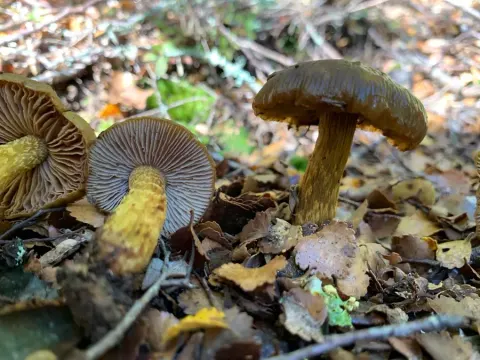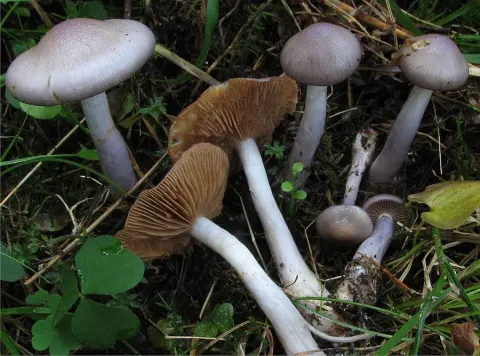
Ciri dan struktur
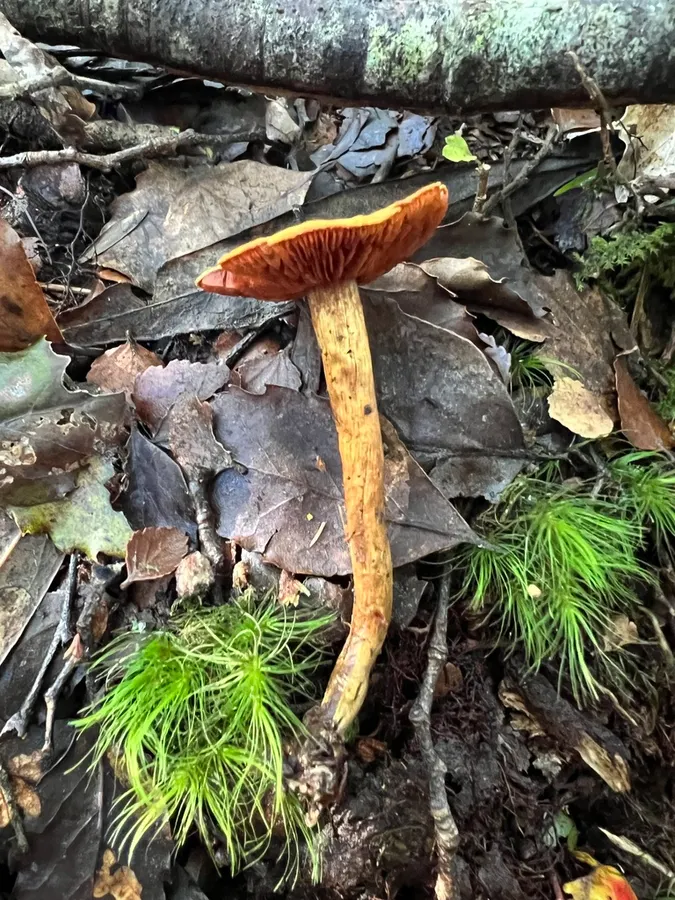
Pileus -25 mm, hemispherical to convex, sometimes umbonate or flat at centre; black to fuscous with chestnut brown tinge, brilliant yellow-orange at margin, conspicuous veil remnants absent; dry, coarsely fibrillose to minutely squamulose, neither hygrophanous nor striate near margin. - Lamellae 16-22, -7, broadly adnate, -4 mm wide; bright orange becoming orange-brown with rust brown tint, edges paler, fimbriate from cheilocystidia. - Stipe -50 x -5 mm, cylindrical or gradually tapering towards base, single; fuscous with red-brown tinge, below fragmentary cortina densely covered with pale orange or yellow fibrils from veil (but without distinct zones or belts); fibrillose, dry, hollow. - Context black or fuscous in pileus, date brown with purplish tint in stipe. - Odour raphanoid. - Taste raphanoid, bitter. - Chemical reactions on pileus: KOH-black with wine red to lilac tint. Spore print rust brown. - Spores 5.5-6 X 4.5-5 µm, subglobose to ovoid, verrucose, rust brown. - Basidia 20-28 x 6-7 µm, 4-spored, often with wine red plasmatic pigment. - Cheilocystidia conspicuous, composed of cell-chains, terminal cells (15-25 x -10 µm) cylindrical to subclavate, membranes thin-walled, with wine red plasmatic pigment. - Pileipellis a cutis or trichoderm of cylindrical hyphae (5-14 µm diam.), terminal cells cylindrical or subconical, membranes not gelatinized, with wine red to lilac (later turning brown) plasmatic pigment dissolving in KOH. - Clamp connections present.
Habitat dan peran ekologis
On soil under Leptospermum scoparium (pure stand). - New Zealand. D. egmontiana represents another outstanding species of New Zealand’s Dermocybe. The minutely squamulose and dry pilei are black or fuscous at the centre but this colour turns bright yellow near the margin. The orange lamellae are in conspicuous contrast to the dark brown stipe which is densely covered with orange-yellow fibrillose veil remnants. In addition D. egmontiana is characterized by the black-lilac KOH reaction on the surface of the pileus. The fimbriate edges of the lamellae bear large articulate cheilocystidia which, together with the subglobose-ovoid verrucose spores, yield a reliable feature for its safe identification. The type locality of D. egmontiana is situated in a small remote pure stand of Leptospermum scoparium on the southern slopes of Mt. Egmont. This myrtaceous tree obviously represents the mutual ectomycorrhizal partner for this striking Dermocybe. Finally pigment analysis demonstrated that physcion, emodin and dermocybin (and some of their derivatives) are the most distinctive pigments of D. egmontiana recorded only once with numerous carpophores (KELLER & al., 1988).
- Habitat atau konteks temuan
- Informasi belum tersedia pada sumber rilis ini.
- Substrat
- tanah
- Peran atau konteks
- Mitra tumbuhan
Reproduksi
Pileus -25 mm, hemispherical to convex, sometimes umbonate or flat at centre; black to fuscous with chestnut brown tinge, brilliant yellow-orange at margin, conspicuous veil remnants absent; dry, coarsely fibrillose to minutely squamulose, neither hygrophanous nor striate near margin. - Lamellae 16-22, -7, broadly adnate, -4 mm wide; bright orange becoming orange-brown with rust brown tint, edges paler, fimbriate from cheilocystidia. - Stipe -50 x -5 mm, cylindrical or gradually tapering towards base, single; fuscous with red-brown tinge, below fragmentary cortina densely covered with pale orange or yellow fibrils from veil (but without distinct zones or belts); fibrillose, dry, hollow. - Context black or fuscous in pileus, date brown with purplish tint in stipe. - Odour raphanoid. - Taste raphanoid, bitter. - Chemical reactions on pileus: KOH-black with wine red to lilac tint.
Catatan identitas dan cakupan
- Nama diterima mengikuti Catalogue of Life Base2026-09-11; uraian mempertahankan konsep dan nama sumber aslinya.
- Historical description as cited by BiotaNZ. Preserve explicit New Zealand/locality, host and specimen qualifiers. Distribution is the cited source scope, not a current global range.
- Impor dan terjemahan otomatis belum diperiksa editorial per profil. Struktur reproduktif yang disebutkan tidak membuktikan seluruh siklus hidup diketahui.
- Pengukuran pada uraian mengikuti spesimen, kultur, dan metode sumber; angka tidak diperluas ke semua populasi.
Catatan distribusi dalam narasi mengikuti sumbernya. Dokumentasi spesimen atau foto mengikuti catatan sumber. Bukti wilayah Indonesia dan penilaian konservasi tidak disimpulkan dari gambar.
Melihat dengan konteks
Dokumentasi Cortinarius egmontianus menurut asosiasi foto pada record takson iNaturalist. Kredit: David Orlovich. Identitas mengikuti sumber; bukan penentuan spesimen independen.
- Jenis
- Fotografi
- Kredit
- (c) David Orlovich, some rights reserved (CC BY)
- Lisensi
- CC BY 4.0
- Sumber media
- Buka entri sumber
Dokumentasi tambahan
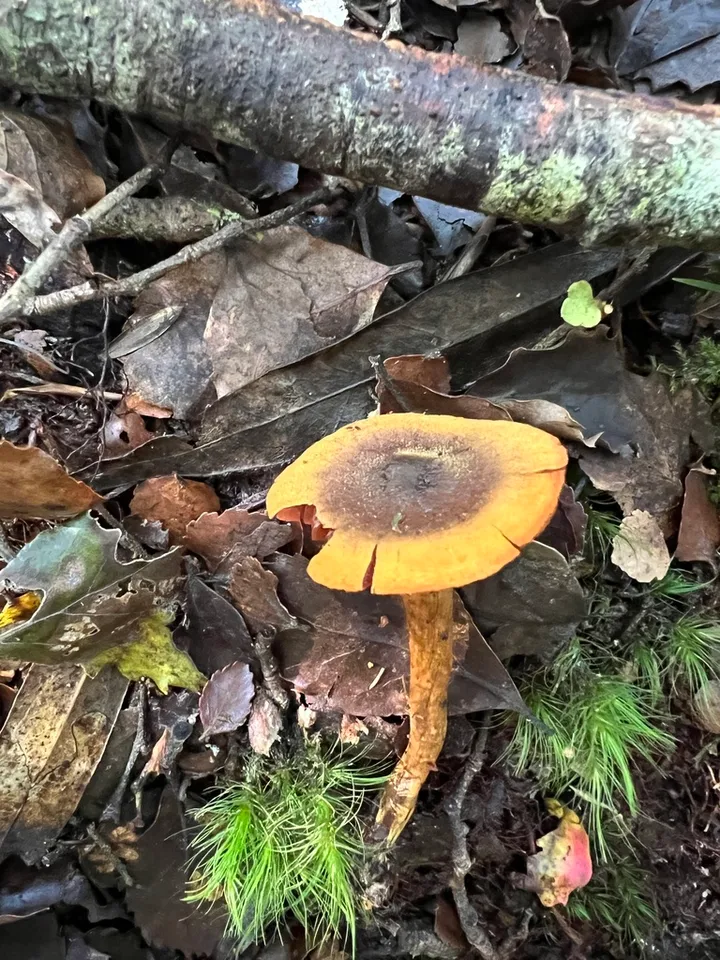
Foto yang diasosiasikan dengan Cortinarius egmontianus pada iNaturalist. Identifikasi mengikuti sumber; bukan penentuan spesimen independen.
Kredit dan penggunaan
(c) David Orlovich, some rights reserved (CC BY)
Ukuran dan format gambar disesuaikan tanpa pemotongan, retus, atau penambahan skala. Lisensi sumber dipertahankan.
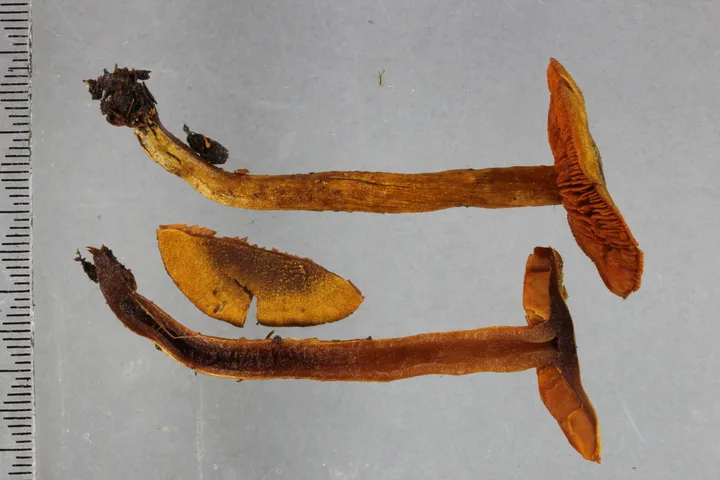
Foto yang diasosiasikan dengan Cortinarius egmontianus pada iNaturalist. Identifikasi mengikuti sumber; bukan penentuan spesimen independen.
Kredit dan penggunaan
(c) David Orlovich, some rights reserved (CC BY)
Ukuran dan format gambar disesuaikan tanpa pemotongan, retus, atau penambahan skala. Lisensi sumber dipertahankan.
Sumber profil
- [1] Horak, E. 1988: New species of Dermocybe (Agaricales) from New Zealand. Sydowia 40: 81-112. — Dermocybe egmontiana
- [2] Catalogue of Life Base2026-09-11 — Cortinarius egmontianus
- [3] Dokumentasi visual — Cortinarius egmontianus
- [4] Dokumentasi visual — Cortinarius egmontianus
- [5] Dokumentasi visual — Cortinarius egmontianus
Rujukan halaman ini
Fungi. Cortinarius egmontianus. Rilis data fungi-2026-10-12-expansion-2. https://fungi-atlas.mgadib.chatgpt.site/jamur/cortinarius-egmontianus/.
Status: impor sumber; pemeriksaan editorial per profil belum selesai. Untuk klaim biologis, gunakan rujukan pada bagian terkait dan periksa konteks sumber aslinya.