01 / Morfologi

Ciri dan struktur

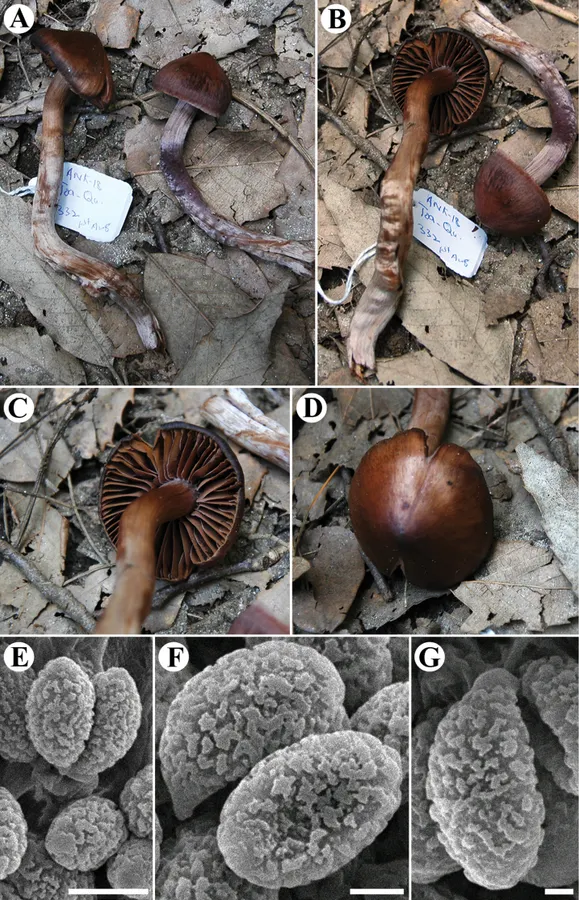
Cortinarius pakistanicus is an oak-associated species that forms small basidiomata, with campanulate to obtusely umbonate, slightly hygrophanous, dark reddish to brownish pilei with margins first incurved and with whitish veil traces; lamellae are fairly distant, first pale brown and later dark brown, with edges lighter and fimbriate; stipes slender, cylindrical to slightly fusiform, hollow, with a barely fibrillose surface, lilaceous towards the apex and whitish-tomentose towards the base, the remaining brown to dark brown with age and without annular traces; it produces amygdaliform, profusely and coarsely verrucose basidiospores measuring 8.6 × 5.5 µm, and shows cylindrical to narrowly utriform marginal cells. Basidiomata small sized. Pilei campanulate to umbonate, 2 to 3.3 cm in diameter, with margins first incurved, and then involute when mature, slightly hygrophanous; cuticle dark reddish to brownish (7.6 YR 3.6/5.8) with lighter brown tinges (1.6Y 6.6/3) towards the margin, fibrillose, and margins fimbriate. Lamellae medium spaced to fairly distant, emarginate, serrate to undulate, broad, first pale brown and later dark brown (4.7 YR 1.8/2.7). Stipe clavate to cylindrical, straight to curved, 5–9 cm long, 0.5–1 cm thick, slightly tapering towards the apex, which is about 0.3–0.7 cm, hollow; surface longitudinally striate, lilaceous towards the apex, and brown (1.8Y 6.6/2.7) to dark brown (7.6 YR 3.6/5.8) with age, base whitish (7.2GY 8.4/0.7). Context of pileus and stipe the same color as the cuticle. Smell distinct, earth-like and taste not recorded. Basidiospores thin-walled, ellipsoid, [90/6/3] (7.8–) 7.9–9.4 (–9.8) × (4.7–) 4.9–6.3 (–6.2) μm in size, avl × avw = 8.62 × 5.56 μm, non-amyloid.

Sebagian uraian ditampilkan dalam bahasa sumber; terjemahannya belum tersedia atau belum lolos pemeriksaan.

Rujukan: [1]

Pengukuran mengikuti objek, spesimen atau kultur, dan metode yang disebutkan sumber. Baca uraian asli untuk konteks lengkap.

02 / Kehidupan

Habitat dan peran ekologis

Gregarious; growing in mountainous pure oak forests of Quercus oblongata at an altitude greater than 2000 m a.s.l. The soil pH ranged between 6–8.4.

Sebagian uraian ditampilkan dalam bahasa sumber; terjemahannya belum tersedia atau belum lolos pemeriksaan.

Rujukan: [1]

Habitat atau konteks temuan
hutan
Substrat
Informasi belum tersedia pada sumber rilis ini.
Peran atau konteks
Belum dikategorikan pada rilis ini.
Temukan hubungan serupa
03 / Siklus hidup

Reproduksi

Cortinarius pakistanicus is an oak-associated species that forms small basidiomata, with campanulate to obtusely umbonate, slightly hygrophanous, dark reddish to brownish pilei with margins first incurved and with whitish veil traces; lamellae are fairly distant, first pale brown and later dark brown, with edges lighter and fimbriate; stipes slender, cylindrical to slightly fusiform, hollow, with a barely fibrillose surface, lilaceous towards the apex and whitish-tomentose towards the base, the remaining brown to dark brown with age and without annular traces; it produces amygdaliform, profusely and coarsely verrucose basidiospores measuring 8.6 × 5.5 µm, and shows cylindrical to narrowly utriform marginal cells.

Sebagian uraian ditampilkan dalam bahasa sumber; terjemahannya belum tersedia atau belum lolos pemeriksaan.

Rujukan: [1]

04 / Batas informasi

Catatan identitas dan cakupan

  • Nama diterima mengikuti Catalogue of Life Base2026-09-11; uraian mempertahankan konsep dan nama sumber aslinya.
  • Preserve original treatment localities, hosts and substrate scope. Materials examined describe documented specimens, not the full global range.
  • Impor dan terjemahan otomatis belum diperiksa editorial per profil. Struktur reproduktif yang disebutkan tidak membuktikan seluruh siklus hidup diketahui.
  • Pengukuran pada uraian mengikuti spesimen, kultur, dan metode sumber; angka tidak diperluas ke semua populasi.

Catatan distribusi dalam narasi mengikuti sumbernya. Dokumentasi spesimen atau foto mengikuti catatan sumber. Bukti wilayah Indonesia dan penilaian konservasi tidak disimpulkan dari gambar.

05 / Dokumentasi

Melihat dengan konteks

The new species Cortinarius pakistanicus, AST332 (LAH36366, holotype). A–D Basidiomata E–G Basidiospores observed with the SEM technique. Photo: A. Naseer (A–D).Scale bars: 5 µm (E), 2 µm (F), 1 µm (G).

Jenis
Pelat ilmiah
Kredit
Arooj Naseer, Isaac Garrido-Benavent, Junaid Khan, Josep Ballarà, Rafael Mahiques, Abdul Nasir Khalid, Hassan Sher
Lisensi
CC BY 4.0
Sumber media
Buka entri sumber

Gambar menunjukkan objek menurut identifikasi sumber, bukan verifikasi independen spesimen oleh Fungi. Tidak ada skala baru yang ditambahkan.

06 / Rujukan

Sumber profil

  1. [1] Cortinarius pakistanicus and C. pseudotorvus: two new species in oak forests in the Pakistan Himalayas — Cortinarius pakistanicusBagian sumber: PMC7648052_section_7
    Tanggal penghimpunan sumber: 2026-10-12
    Teks sumber: CC BY 4.0 · Naseer A, Garrido-Benavent I, Khan J, Ballarà J, Mahiques R, Khalid AN, Sher H.
  2. [2] Catalogue of Life Base2026-09-11 — Cortinarius pakistanicusBagian sumber: ColDP NameUsage.tsv ID 9Z4ZN; accepted species; source 2073
    Tanggal penghimpunan sumber: 2026-10-12
  3. [3] Dokumentasi visual — Cortinarius pakistanicusBagian sumber: Individual media record; identification follows the source, not independent determination
    Tanggal penghimpunan sumber: 2026-10-12
    Media sumber: CC BY 4.0 · Arooj Naseer, Isaac Garrido-Benavent, Junaid Khan, Josep Ballarà, Rafael Mahiques, Abdul Nasir Khalid, Hassan Sher

Adaptasi teks: CC BY 4.0. Naseer A, Garrido-Benavent I, Khan J, Ballarà J, Mahiques R, Khalid AN, Sher H. — Cortinarius pakistanicus and C. pseudotorvus: two new species in oak forests in the Pakistan Himalayas — Cortinarius pakistanicus

Uraian asli dan riwayat sumber

Riwayat atau halaman sumber

Ringkasan sumber

Cortinarius pakistanicus is an oak-associated species that forms small basidiomata, with campanulate to obtusely umbonate, slightly hygrophanous, dark reddish to brownish pilei with margins first incurved and with whitish veil traces; lamellae are fairly distant, first pale brown and later dark brown, with edges lighter and fimbriate; stipes slender, cylindrical to slightly fusiform, hollow, with a barely fibrillose surface, lilaceous towards the apex and whitish-tomentose towards the base, the remaining brown to dark brown with age and without annular traces; it produces amygdaliform, profusely and coarsely verrucose basidiospores measuring 8.6 × 5.5 µm, and shows cylindrical to narrowly utriform marginal cells.

Revisi sumber

Morfologi sumber

Cortinarius pakistanicus is an oak-associated species that forms small basidiomata, with campanulate to obtusely umbonate, slightly hygrophanous, dark reddish to brownish pilei with margins first incurved and with whitish veil traces; lamellae are fairly distant, first pale brown and later dark brown, with edges lighter and fimbriate; stipes slender, cylindrical to slightly fusiform, hollow, with a barely fibrillose surface, lilaceous towards the apex and whitish-tomentose towards the base, the remaining brown to dark brown with age and without annular traces; it produces amygdaliform, profusely and coarsely verrucose basidiospores measuring 8.6 × 5.5 µm, and shows cylindrical to narrowly utriform marginal cells. Basidiomata small sized. Pilei campanulate to umbonate, 2 to 3.3 cm in diameter, with margins first incurved, and then involute when mature, slightly hygrophanous; cuticle dark reddish to brownish (7.6 YR 3.6/5.8) with lighter brown tinges (1.6Y 6.6/3) towards the margin, fibrillose, and margins fimbriate. Lamellae medium spaced to fairly distant, emarginate, serrate to undulate, broad, first pale brown and later dark brown (4.7 YR 1.8/2.7). Stipe clavate to cylindrical, straight to curved, 5–9 cm long, 0.5–1 cm thick, slightly tapering towards the apex, which is about 0.3–0.7 cm, hollow; surface longitudinally striate, lilaceous towards the apex, and brown (1.8Y 6.6/2.7) to dark brown (7.6 YR 3.6/5.8) with age, base whitish (7.2GY 8.4/0.7). Context of pileus and stipe the same color as the cuticle. Smell distinct, earth-like and taste not recorded. Basidiospores thin-walled, ellipsoid, [90/6/3] (7.8–) 7.9–9.4 (–9.8) × (4.7–) 4.9–6.3 (–6.2) μm in size, avl × avw = 8.62 × 5.56 μm, non-amyloid.

Revisi sumber

Ekologi sumber

Gregarious; growing in mountainous pure oak forests of Quercus oblongata at an altitude greater than 2000 m a.s.l. The soil pH ranged between 6–8.4.

Revisi sumber

Struktur reproduksi sumber

Cortinarius pakistanicus is an oak-associated species that forms small basidiomata, with campanulate to obtusely umbonate, slightly hygrophanous, dark reddish to brownish pilei with margins first incurved and with whitish veil traces; lamellae are fairly distant, first pale brown and later dark brown, with edges lighter and fimbriate; stipes slender, cylindrical to slightly fusiform, hollow, with a barely fibrillose surface, lilaceous towards the apex and whitish-tomentose towards the base, the remaining brown to dark brown with age and without annular traces; it produces amygdaliform, profusely and coarsely verrucose basidiospores measuring 8.6 × 5.5 µm, and shows cylindrical to narrowly utriform marginal cells.

Revisi sumber

Rujukan halaman ini

Fungi. Cortinarius pakistanicus. Rilis data fungi-2026-10-12-expansion-2. https://fungi-atlas.mgadib.chatgpt.site/jamur/cortinarius-pakistanicus/.

Status: impor sumber; pemeriksaan editorial per profil belum selesai. Untuk klaim biologis, gunakan rujukan pada bagian terkait dan periksa konteks sumber aslinya.