01 / Morfologi

Ciri dan struktur

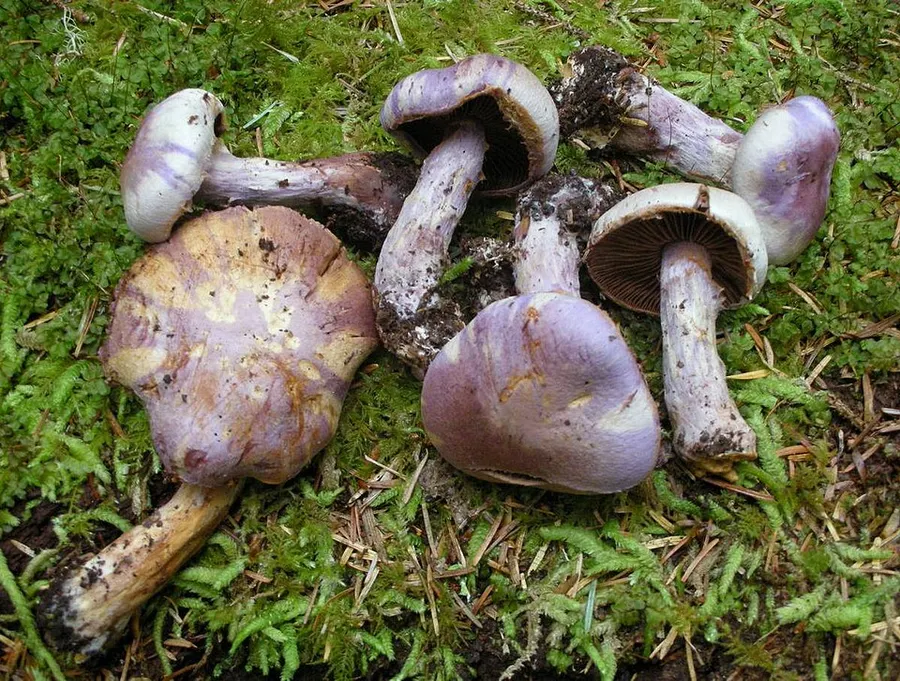
The cap is 4–13 cm in diameter, initially spherical to convex, with the margin rolled inward, then flattened, sometimes with large, broad, central umbo. The margin often cracks star-like, particularly in dry weather. The mushroom is a pale azure violet to pale lilac color, soon bleaching and fading to tan brown or rusty brown. The cap is dry, silkily shiny or tomentose at the margin with membranaceous bronze fragments of the veil, the white fragments of which often adhere to the surface like scabs. Later the surface becomes cracked into small scales. The gills are sub-crowded, quite thick, broadly adnate, and often slightly emarginate (notched). The spores are ellipsoid, covered with fine warts or dots, and measure 8–9 by 5–5.5 μm.

Sebagian uraian ditampilkan dalam bahasa sumber; terjemahannya belum tersedia atau belum lolos pemeriksaan.

Rujukan: [1]

Pengukuran mengikuti objek, spesimen atau kultur, dan metode yang disebutkan sumber. Baca uraian asli untuk konteks lengkap.

02 / Kehidupan

Habitat dan peran ekologis

Cortinarius traganus ditemukan di hutan konifer di seluruh dunia. Tampaknya lebih memilih tanah yang lebih miskin, baik yang silikon maupun yang tidak kalkar. Ini tersebar luas di seluruh zona tempuh di Belahan Bumi Utara. Hal ini cukup umum di Amerika Utara, umumnya muncul dari August to September, atau agak kemudian di Pantai Barat.

Rujukan: [1]

Habitat atau konteks temuan
hutan
Substrat
Informasi belum tersedia pada sumber rilis ini.
Peran atau konteks
Belum dikategorikan pada rilis ini.
Temukan hubungan serupa
03 / Siklus hidup

Reproduksi

The cap is 4–13 cm in diameter, initially spherical to convex, with the margin rolled inward, then flattened, sometimes with large, broad, central umbo. The margin often cracks star-like, particularly in dry weather. The mushroom is a pale azure violet to pale lilac color, soon bleaching and fading to tan brown or rusty brown. The cap is dry, silkily shiny or tomentose at the margin with membranaceous bronze fragments of the veil, the white fragments of which often adhere to the surface like scabs. Later the surface becomes cracked into small scales. The gills are sub-crowded, quite thick, broadly adnate, and often slightly emarginate (notched). The spores are ellipsoid, covered with fine warts or dots, and measure 8–9 by 5–5.5 μm.

Sebagian uraian ditampilkan dalam bahasa sumber; terjemahannya belum tersedia atau belum lolos pemeriksaan.

Rujukan: [1]

Sinonim menurut acuan taksonomi rilis: Agaricus traganus; Cortinarius pyriodorus; Cortinarius traganus f. formica-olens; Gomphos traganus; Inoloma traganum
04 / Batas informasi

Catatan identitas dan cakupan

  • Nama diterima mengikuti Catalogue of Life Base2026-09-11; uraian mempertahankan konsep dan nama sumber aslinya.
  • Original geographic, specimen and life-cycle scope retained; source import awaits individual editorial review.
  • Impor dan terjemahan otomatis belum diperiksa editorial per profil. Struktur reproduktif yang disebutkan tidak membuktikan seluruh siklus hidup diketahui.
  • Pengukuran pada uraian mengikuti spesimen, kultur, dan metode sumber; angka tidak diperluas ke semua populasi.

Catatan distribusi dalam narasi mengikuti sumbernya. Dokumentasi spesimen atau foto mengikuti catatan sumber. Bukti wilayah Indonesia dan penilaian konservasi tidak disimpulkan dari gambar.

05 / Dokumentasi

Melihat dengan konteks

Dokumentasi Cortinarius traganus dari Wikimedia Commons. Cortinarius traganus (Fr.) Fr. Identifikasi mengikuti record berkas sumber.

Jenis
Fotografi
Kredit
This image was created by user Ron Pastorino (Ronpast) at Mushroom Observer , a source for mycological images. You can contact this user here .
Sumber media
Buka entri sumber

Gambar menunjukkan objek menurut identifikasi sumber, bukan verifikasi independen spesimen oleh Fungi. Tidak ada skala baru yang ditambahkan.

06 / Rujukan

Sumber profil

  1. [1] Cortinarius traganus — Wikipedia (en)Bagian sumber: Frozen revision 1320856297
    Tanggal penghimpunan sumber: 2026-10-12
    Teks sumber: CC BY-SA4.0 · Wikipedia contributors
  2. [2] Catalogue of Life Base2026-09-11 — Cortinarius traganusBagian sumber: ColDP NameUsage.tsv ID 6B5QK; accepted species; source 2073
    Tanggal penghimpunan sumber: 2026-10-12
  3. [3] Dokumentasi visual — Cortinarius traganusBagian sumber: Individual media record; identification follows the source, not independent determination
    Tanggal penghimpunan sumber: 2026-10-12
    Media sumber: CC BY-SA 3.0 · This image was created by user Ron Pastorino (Ronpast) at Mushroom Observer , a source for mycological images. You can contact this user here .

Adaptasi teks: CC BY-SA 4.0. Wikipedia contributors — Cortinarius traganus — Wikipedia (en)

Uraian asli dan riwayat sumber

Riwayat atau halaman sumber

Ringkasan sumber

The cap is 4–13 cm in diameter, initially spherical to convex, with the margin rolled inward, then flattened, sometimes with large, broad, central umbo. The margin often cracks star-like, particularly in dry weather. The mushroom is a pale azure violet to pale lilac color, soon bleaching and fading to tan brown or rusty brown. The cap is dry, silkily shiny or tomentose at the margin with membranaceous bronze fragments of the veil, the white fragments of which often adhere to the surface like scabs.

Revisi sumber

Morfologi sumber

The cap is 4–13 cm in diameter, initially spherical to convex, with the margin rolled inward, then flattened, sometimes with large, broad, central umbo. The margin often cracks star-like, particularly in dry weather. The mushroom is a pale azure violet to pale lilac color, soon bleaching and fading to tan brown or rusty brown. The cap is dry, silkily shiny or tomentose at the margin with membranaceous bronze fragments of the veil, the white fragments of which often adhere to the surface like scabs. Later the surface becomes cracked into small scales. The gills are sub-crowded, quite thick, broadly adnate, and often slightly emarginate (notched). The spores are ellipsoid, covered with fine warts or dots, and measure 8–9 by 5–5.5 μm.

Revisi sumber

Ekologi sumber

Cortinarius traganus is found in coniferous forests worldwide. It seems to prefer poorer soils, both siliceous and non-calcareous. It is widespread throughout the temperate zone of the Northern Hemisphere. It is fairly common in North America, generally appearing from August to September, or somewhat later on the West Coast.

Revisi sumber

Struktur reproduksi sumber

The cap is 4–13 cm in diameter, initially spherical to convex, with the margin rolled inward, then flattened, sometimes with large, broad, central umbo. The margin often cracks star-like, particularly in dry weather. The mushroom is a pale azure violet to pale lilac color, soon bleaching and fading to tan brown or rusty brown. The cap is dry, silkily shiny or tomentose at the margin with membranaceous bronze fragments of the veil, the white fragments of which often adhere to the surface like scabs. Later the surface becomes cracked into small scales. The gills are sub-crowded, quite thick, broadly adnate, and often slightly emarginate (notched). The spores are ellipsoid, covered with fine warts or dots, and measure 8–9 by 5–5.5 μm.

Revisi sumber

Rujukan halaman ini

Fungi. Cortinarius traganus. Rilis data fungi-2026-10-12-expansion-2. https://fungi-atlas.mgadib.chatgpt.site/jamur/cortinarius-traganus/.

Status: impor sumber; pemeriksaan editorial per profil belum selesai. Untuk klaim biologis, gunakan rujukan pada bagian terkait dan periksa konteks sumber aslinya.