01 / Morfologi

Ciri dan struktur

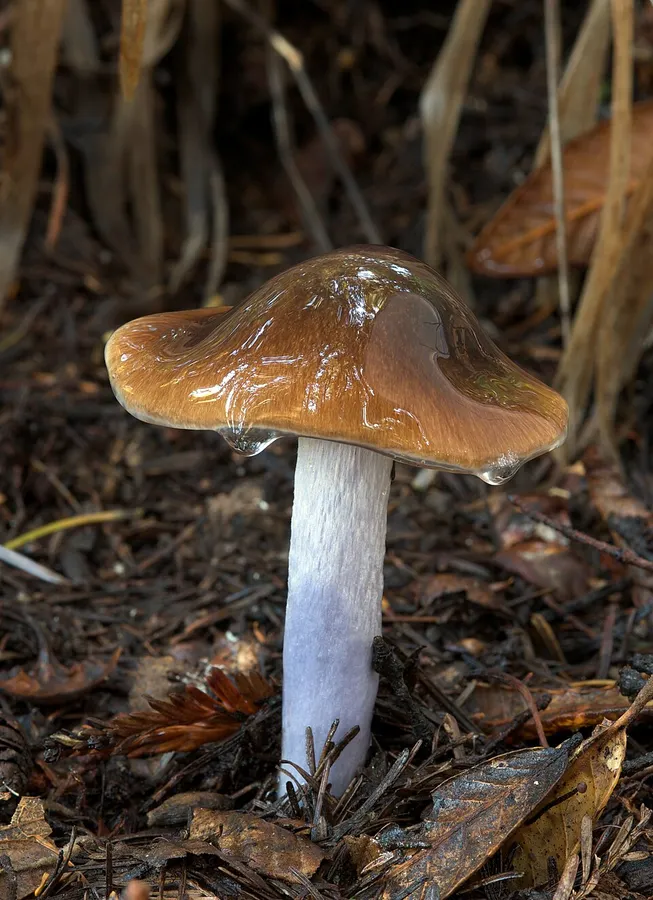
Young fruit bodies of C. vanduzerensis are covered with a slimy universal veil; The cap color is initially chestnut-brown to black, but becomes paler brown as it matures. The surface is radially wrinkled or corrugated, especially near the margin. The flesh is pallid but soon pale cinnamon-buff. The odor and taste are not distinctive. A drop of FeSO4 solution (a reagent commonly used in mushroom identification) applied to the surface of the cap will turn olive-green. 1–2 cm thick, narrowed slightly to the base. It is pallid within but slowly cinnamon buff at least near the base. The stem surface has a thick slime-veil, and is lavender to light purple on the upper portion, but darker on the lower portion. Sometimes the universal veil breaks up into concentric zones over the lower third of the stem. The edibility of the mushroom is not known. David Arora notes that it is "much too slippery to be of value". It is also not recommended due to its similarity to deadly poisonous species. The spore print is a rusty-brown color. In face view, the spores are broadly elliptic to ovate (egg-shaped), while in profile they appear broadly inequilateral; they have dimensions of 12–14 by 7–8 μm. The spore surface is roughened with warts, and they lack an apical pore. The spores contain two nuclei. The basidia (spore-bearing cells in the hymenium) are four-spored, broadly club-shaped, and have contents that are often in the form of yellow masses or granules when stained in Melzer's reagent. The cheilocystida (cystidia on the gill edge) are club-shaped, sometimes with an abruptly tapering point, and measure 17–26 by 9–15 μm.

Sebagian uraian ditampilkan dalam bahasa sumber; terjemahannya belum tersedia atau belum lolos pemeriksaan.

Rujukan: [1]

Pengukuran mengikuti objek, spesimen atau kultur, dan metode yang disebutkan sumber. Baca uraian asli untuk konteks lengkap.

02 / Kehidupan

Habitat dan peran ekologis

Cortinarius vanduzerensis adalah jamur mikoriza yang tumbuh bersama dengan pohon konifer. Tubuh buah tumbuh secara sepi, berkeliaran, dalam cincin atau dalam kelompok di bawah pohon semak, hemlock, dan Douglas-fir. Jamur ini hanya dikenal dari Pasifik Northwest region Amerika Utara, termasuk Ratu Charlotte Islands on di utara Coast of British Columbia, Kanada. Buahnya berbuah pada musim gugur dan awal musim dingin, atau pada akhir musim panas di Kanada barat. Frekuensi terjadinya telah dijelaskan secara berbeda sebagai "sangat umum", untuk "sangat umum", atau "jarang" di mana-mana kecuali Oregon.

Rujukan: [1]

Habitat atau konteks temuan
Informasi belum tersedia pada sumber rilis ini.
Substrat
Informasi belum tersedia pada sumber rilis ini.
Peran atau konteks
Mitra tumbuhan
Temukan hubungan serupa
03 / Siklus hidup

Reproduksi

The spore print is a rusty-brown color. In face view, the spores are broadly elliptic to ovate (egg-shaped), while in profile they appear broadly inequilateral; they have dimensions of 12–14 by 7–8 μm. The spore surface is roughened with warts, and they lack an apical pore. The spores contain two nuclei. The basidia (spore-bearing cells in the hymenium) are four-spored, broadly club-shaped, and have contents that are often in the form of yellow masses or granules when stained in Melzer's reagent. The cheilocystida (cystidia on the gill edge) are club-shaped, sometimes with an abruptly tapering point, and measure 17–26 by 9–15 μm. There are no pleurocystidia (cystidia on the gill face). The gill tissue is made of hyphae that are arranged in a roughly parallel fashion (subparallel); there are also brownish to orange-brown fat-containing hyphae present.

Sebagian uraian ditampilkan dalam bahasa sumber; terjemahannya belum tersedia atau belum lolos pemeriksaan.

Rujukan: [1]

04 / Batas informasi

Catatan identitas dan cakupan

  • Nama diterima mengikuti Catalogue of Life Base2026-09-11; uraian mempertahankan konsep dan nama sumber aslinya.
  • Original geographic, specimen and life-cycle scope retained; source import awaits individual editorial review.
  • Impor dan terjemahan otomatis belum diperiksa editorial per profil. Struktur reproduktif yang disebutkan tidak membuktikan seluruh siklus hidup diketahui.
  • Pengukuran pada uraian mengikuti spesimen, kultur, dan metode sumber; angka tidak diperluas ke semua populasi.

Catatan distribusi dalam narasi mengikuti sumbernya. Dokumentasi spesimen atau foto mengikuti catatan sumber. Bukti wilayah Indonesia dan penilaian konservasi tidak disimpulkan dari gambar.

05 / Dokumentasi

Melihat dengan konteks

Dokumentasi Cortinarius vanduzerensis dari Wikimedia Commons. A fruit body of the North American mushroom Cortinarius vanduzerensis − A.H. Sm. & Trappe. Specimen photographed in Salt Point State Park , Sonoma County, northern California, U.S. Identifikasi mengikuti record berkas sumber.

Jenis
Fotografi
Kredit
John Kirkpatrick (natashadak)
Sumber media
Buka entri sumber

Gambar menunjukkan objek menurut identifikasi sumber, bukan verifikasi independen spesimen oleh Fungi. Tidak ada skala baru yang ditambahkan.

06 / Rujukan

Sumber profil

  1. [1] Cortinarius vanduzerensis — Wikipedia (en)Bagian sumber: Frozen revision 1301040026
    Tanggal penghimpunan sumber: 2026-10-12
    Teks sumber: CC BY-SA4.0 · Wikipedia contributors
  2. [2] Catalogue of Life Base2026-09-11 — Cortinarius vanduzerensisBagian sumber: ColDP NameUsage.tsv ID YMXV; accepted species; source 2073
    Tanggal penghimpunan sumber: 2026-10-12
  3. [3] Dokumentasi visual — Cortinarius vanduzerensisBagian sumber: Individual media record; identification follows the source, not independent determination
    Tanggal penghimpunan sumber: 2026-10-12
    Media sumber: CC BY-SA 3.0 · John Kirkpatrick (natashadak)

Adaptasi teks: CC BY-SA 4.0. Wikipedia contributors — Cortinarius vanduzerensis — Wikipedia (en)

Uraian asli dan riwayat sumber

Riwayat atau halaman sumber

Ringkasan sumber

Cortinarius vanduzerensis is a species of fungus described as new to science in 1972. The fruit bodies of the fungus, or mushrooms, have a slimy dark chestnut-brown cap that becomes deeply radially grooved or corrugated in maturity, and reaches diameters of up to 8 cm. The gills on the underside of the cap are initially pinkish-buff before becoming pale brown when the spores mature. The stem is lavender, measuring 10–18 cm long and 1–2 cm thick. The mushroom produces a rusty-brown spore print, with individual spores measuring 12–14 by 7–8 μm.

Revisi sumber

Morfologi sumber

Young fruit bodies of C. vanduzerensis are covered with a slimy universal veil; The cap color is initially chestnut-brown to black, but becomes paler brown as it matures. The surface is radially wrinkled or corrugated, especially near the margin. The flesh is pallid but soon pale cinnamon-buff. The odor and taste are not distinctive. A drop of FeSO4 solution (a reagent commonly used in mushroom identification) applied to the surface of the cap will turn olive-green. 1–2 cm thick, narrowed slightly to the base. It is pallid within but slowly cinnamon buff at least near the base. The stem surface has a thick slime-veil, and is lavender to light purple on the upper portion, but darker on the lower portion. Sometimes the universal veil breaks up into concentric zones over the lower third of the stem. The edibility of the mushroom is not known. David Arora notes that it is "much too slippery to be of value". It is also not recommended due to its similarity to deadly poisonous species. The spore print is a rusty-brown color. In face view, the spores are broadly elliptic to ovate (egg-shaped), while in profile they appear broadly inequilateral; they have dimensions of 12–14 by 7–8 μm. The spore surface is roughened with warts, and they lack an apical pore. The spores contain two nuclei. The basidia (spore-bearing cells in the hymenium) are four-spored, broadly club-shaped, and have contents that are often in the form of yellow masses or granules when stained in Melzer's reagent. The cheilocystida (cystidia on the gill edge) are club-shaped, sometimes with an abruptly tapering point, and measure 17–26 by 9–15 μm.

Revisi sumber

Ekologi sumber

Cortinarius vanduzerensis is a mycorrhizal mushroom that grows in association with conifer trees. The fruit bodies grow solitarily, scattered, in rings or in groups under spruce, hemlock, and Douglas-fir. The mushroom is known only from the Pacific Northwest region of North America, including the Queen Charlotte Islands on the north Coast of British Columbia, Canada. It fruits in the autumn and early winter, or in the late summer in western Canada. Its frequency of occurrence has been described variously as "very common", to "fairly common", or "rare" everywhere except Oregon".

Revisi sumber

Struktur reproduksi sumber

The spore print is a rusty-brown color. In face view, the spores are broadly elliptic to ovate (egg-shaped), while in profile they appear broadly inequilateral; they have dimensions of 12–14 by 7–8 μm. The spore surface is roughened with warts, and they lack an apical pore. The spores contain two nuclei. The basidia (spore-bearing cells in the hymenium) are four-spored, broadly club-shaped, and have contents that are often in the form of yellow masses or granules when stained in Melzer's reagent. The cheilocystida (cystidia on the gill edge) are club-shaped, sometimes with an abruptly tapering point, and measure 17–26 by 9–15 μm. There are no pleurocystidia (cystidia on the gill face). The gill tissue is made of hyphae that are arranged in a roughly parallel fashion (subparallel); there are also brownish to orange-brown fat-containing hyphae present.

Revisi sumber

Rujukan halaman ini

Fungi. Cortinarius vanduzerensis. Rilis data fungi-2026-10-12-expansion-2. https://fungi-atlas.mgadib.chatgpt.site/jamur/cortinarius-vanduzerensis/.

Status: impor sumber; pemeriksaan editorial per profil belum selesai. Untuk klaim biologis, gunakan rujukan pada bagian terkait dan periksa konteks sumber aslinya.