Ciri dan struktur
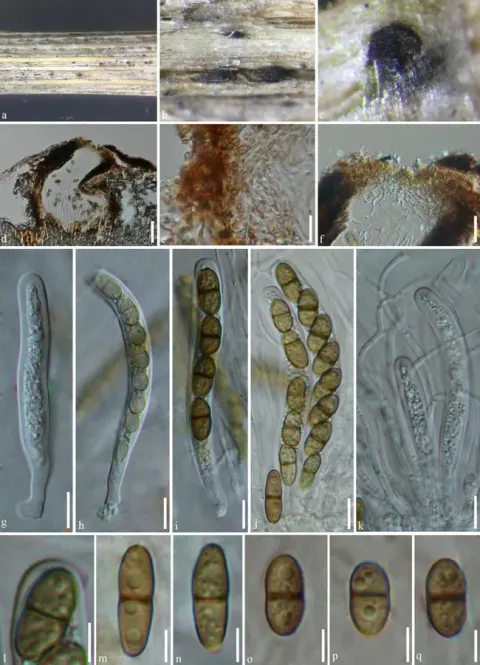
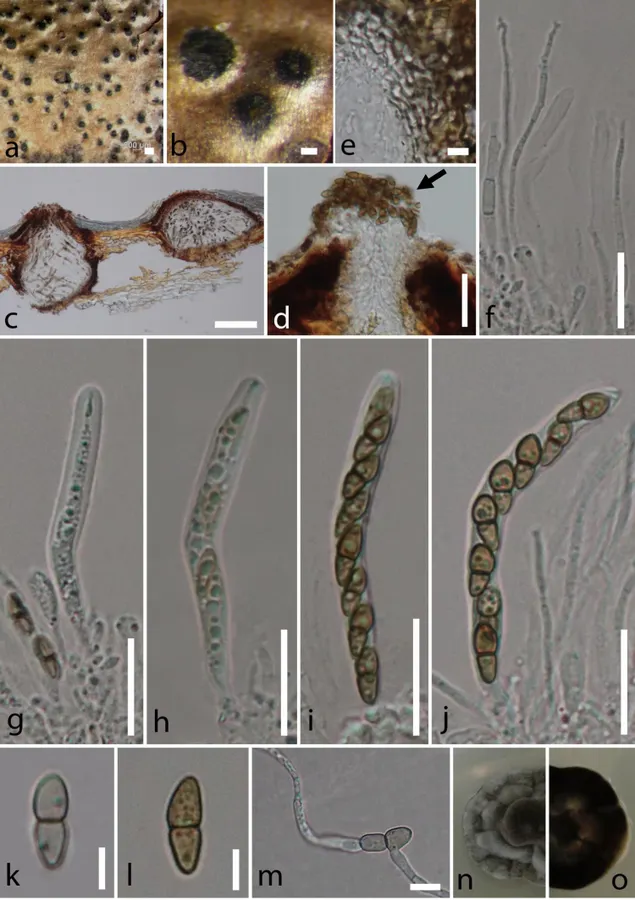
Saprobic on a dead, hanging branch of Corylus avellana L. Sexual morph: (Fig. 2), Ascomata 210–300 high, 200–260 µm diam. (x̄ = 261 × 227 µm), solitary, scattered, immersed, erumpent at maturity, raised as dark spots on the substrate, sessile, globose to subglobose, coriaceous, uni-loculate with an ostiole. Ostiole 50–65 µm long, 30–35 µm wide, central, papillate, lined with hyaline periphyses. Peridium composed of two layers, unequally thickened, 15–30 µm wide at the apex and 10–25 µm wide at the base, outermost layer comprising blackish to dark brown cells of textura angularis fused with host tissues, inner layer comprising hyaline cells of textura prismatica. Hamathecium comprising numerous pseudoparaphyses, which are 1–2 µm wide (x̄ = 2 µm, n =10), dense, filamentous, cellular, with distinct septa, not constricted at the septa, branching and anastomosing above the asci. Asci 55–65 × 6–8 µm (x̄ = 61 × 7 µm, n =20), 8-spored, bitunicate, fissitunicate, cylindrical, short distinct pedicel with furcate ends, apically rounded, well-developed ocular chamber. Ascospores 10–15 × 3–4 µm (x̄ = 12 × 3.5 µm, n =40), overlapping, uni-seriate, fusiform to ellipsoidal, straight, yellowish when young, becoming pale brown at maturity, single-septate, constricted at the septum, rounded at the apices, upper cell is wider than the lower cell (2–5 vs. 2–4 µm (x̄ = 4 vs. 3.25 µm, n =40), echinulate, guttulate. Asexual morph: (Fig. 3), Coelomycetous forming naturally on PDA media after 12 weeks. Conidiomata 175–200 high 150–170 µm diam. (x̄ = 183 × 161 µm) pycnidial, solitary to gregarious, scattered, semi-immersed to superficial, visible as black spore mass surrounded by cellular vegetative hyphae (1–2 µm width), globose to subglobose, glabrous, uni-loculate to multi-loculate, ostiolate.
Habitat dan peran ekologis
Saprobic on a dead, hanging branch of Corylus avellana L. Sexual morph: (Fig. 2), Ascomata 210–300 high, 200–260 µm diam. (x̄ = 261 × 227 µm), solitary, scattered, immersed, erumpent at maturity, raised as dark spots on the substrate, sessile, globose to subglobose, coriaceous, uni-loculate with an ostiole. Ostiole 50–65 µm long, 30–35 µm wide, central, papillate, lined with hyaline periphyses. Peridium composed of two layers, unequally thickened, 15–30 µm wide at the apex and 10–25 µm wide at the base, outermost layer comprising blackish to dark brown cells of textura angularis fused with host tissues, inner layer comprising hyaline cells of textura prismatica. Hamathecium comprising numerous pseudoparaphyses, which are 1–2 µm wide (x̄ = 2 µm, n =10), dense, filamentous, cellular, with distinct septa, not constricted at the septa, branching and anastomosing above the asci. Asci 55–65 × 6–8 µm (x̄ = 61 × 7 µm, n =20), 8-spored, bitunicate, fissitunicate, cylindrical, short distinct pedicel with furcate ends, apically rounded, well-developed ocular chamber. Ascospores 10–15 × 3–4 µm (x̄ = 12 × 3.5 µm, n =40), overlapping, uni-seriate, fusiform to ellipsoidal, straight, yellowish when young, becoming pale brown at maturity, single-septate, constricted at the septum, rounded at the apices, upper cell is wider than the lower cell (2–5 vs. 2–4 µm (x̄ = 4 vs. 3.25 µm, n =40), echinulate, guttulate.
- Habitat atau konteks temuan
- Informasi belum tersedia pada sumber rilis ini.
- Substrat
- Informasi belum tersedia pada sumber rilis ini.
- Peran atau konteks
- Pengurai
Reproduksi
Saprobic on a dead, hanging branch of Corylus avellana L. Sexual morph: (Fig. 2), Ascomata 210–300 high, 200–260 µm diam. (x̄ = 261 × 227 µm), solitary, scattered, immersed, erumpent at maturity, raised as dark spots on the substrate, sessile, globose to subglobose, coriaceous, uni-loculate with an ostiole. Ostiole 50–65 µm long, 30–35 µm wide, central, papillate, lined with hyaline periphyses. Peridium composed of two layers, unequally thickened, 15–30 µm wide at the apex and 10–25 µm wide at the base, outermost layer comprising blackish to dark brown cells of textura angularis fused with host tissues, inner layer comprising hyaline cells of textura prismatica. Hamathecium comprising numerous pseudoparaphyses, which are 1–2 µm wide (x̄ = 2 µm, n =10), dense, filamentous, cellular, with distinct septa, not constricted at the septa, branching and anastomosing above the asci.
Catatan identitas dan cakupan
- Nama diterima mengikuti Catalogue of Life Base2026-09-11; uraian mempertahankan konsep dan nama sumber aslinya.
- Preserve original treatment localities, hosts and substrate scope. Materials examined describe documented specimens, not the full global range.
- Impor dan terjemahan otomatis belum diperiksa editorial per profil. Struktur reproduktif yang disebutkan tidak membuktikan seluruh siklus hidup diketahui.
- Pengukuran pada uraian mengikuti spesimen, kultur, dan metode sumber; angka tidak diperluas ke semua populasi.
Catatan distribusi dalam narasi mengikuti sumbernya. Dokumentasi spesimen atau foto mengikuti catatan sumber. Bukti wilayah Indonesia dan penilaian konservasi tidak disimpulkan dari gambar.
Melihat dengan konteks
Corylicola italica sp. nov. (MFLU 19–0500, holotype). a–b. appearance of ascomata on a twig of Corylus avellana; c. Longitudinal section of ascomata; d. ascoma neck and ascospore mass (arrowed); e peridium wall; f pseudoparaphyses; g–j. asci; k–l. ascospores; m. germinated ascospore; n–o. culture characteristics on PDA (n = from above, o = from below) Scale bars: a = 200 μm, b–c = 100 μm, d, f–j = 20 μm, e, k–m = 5 μm.
- Jenis
- Pelat ilmiah
- Kredit
- Subodini Nuwanthika Wijesinghe, Yong Wang, Erio Camporesi, Dhanushka Nadeeshan Wanasinghe, Saranyaphat Boonmee, Kevin David Hyde
- Lisensi
- CC BY 4.0
- Sumber media
- Buka entri sumber
Dokumentasi tambahan
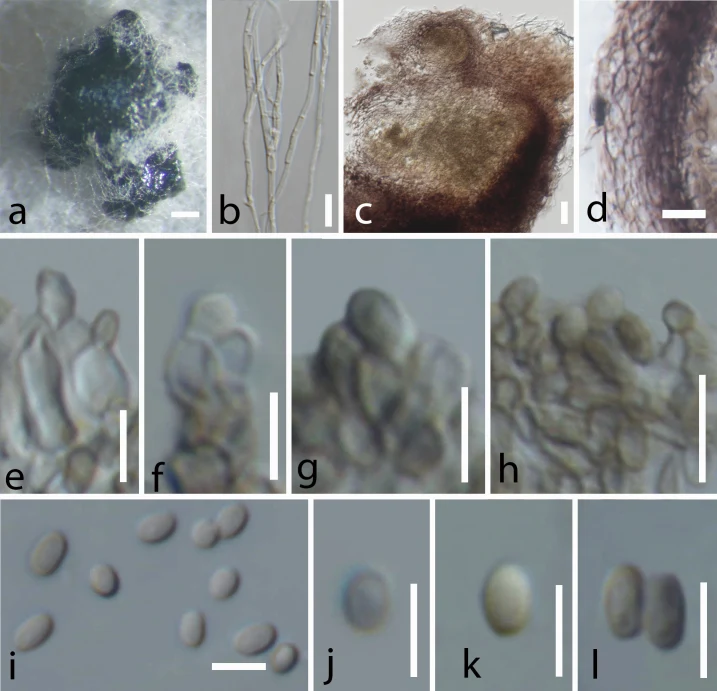
Asexual morph of Corylicola italica sp. nov. on PDA (MFLUCC 20–0111, ex-type). a. conidiomata on PDA; b. vegetative hyphae on agar media; c. longitudinal section of conidiomata; d. conidioma wall; e–h. conidiogenous cells; i–l. conidia. Scale bars: a = 200 μm, b–c = 20 μm, d = 10 μm, e–l = 5 μm.
Kredit dan penggunaan
Subodini Nuwanthika Wijesinghe, Yong Wang, Erio Camporesi, Dhanushka Nadeeshan Wanasinghe, Saranyaphat Boonmee, Kevin David Hyde
Ukuran dan format gambar disesuaikan tanpa pemotongan, retus, atau penambahan skala. Lisensi sumber dipertahankan.
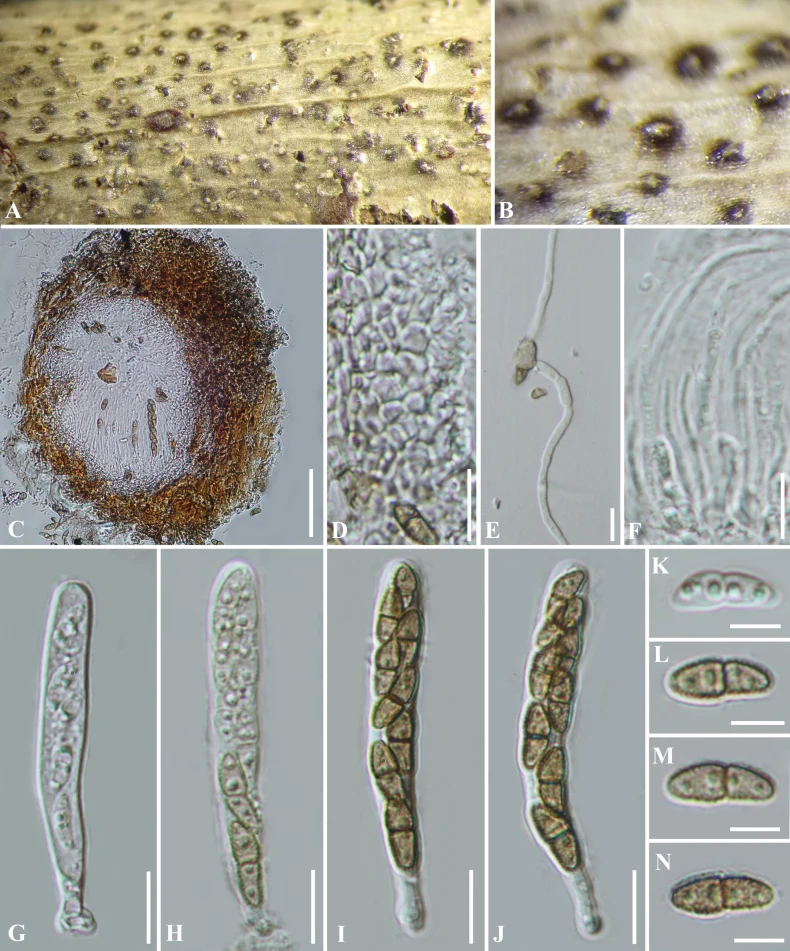
Corylicola italica (GZAAS 21-0243) A, B appearance of ascomata on host C vertical section of an ascoma D peridium E germinated ascospore F pseudoparaphyses G−J asci K−N ascospores. Scale bars: 50 µm (C); 10 µm (D−J); 5 µm (K−N).
Kredit dan penggunaan
Yao Feng, Ya-Ya Chen, Chuan-Gen Lin, Zuo-Yi Liu, Xiao-Fang Chen, Guo-Shun Pei, Jian-Kui Liu
Ukuran dan format gambar disesuaikan tanpa pemotongan, retus, atau penambahan skala. Lisensi sumber dipertahankan.
Sumber profil
- [1] A new genus of Bambusicolaceae (Pleosporales) on Corylus avellana (Fagales) from Italy — Corylicola italica
- [2] Catalogue of Life Base2026-09-11 — Corylicola italica
- [3] Dokumentasi visual — Corylicola italica
- [4] Dokumentasi visual — Corylicola italica
- [5] Dokumentasi visual — Corylicola italica
Rujukan halaman ini
Fungi. Corylicola italica. Rilis data fungi-2026-10-12-expansion-2. https://fungi-atlas.mgadib.chatgpt.site/jamur/corylicola-italica/.
Status: impor sumber; pemeriksaan editorial per profil belum selesai. Untuk klaim biologis, gunakan rujukan pada bagian terkait dan periksa konteks sumber aslinya.