Ciri dan struktur
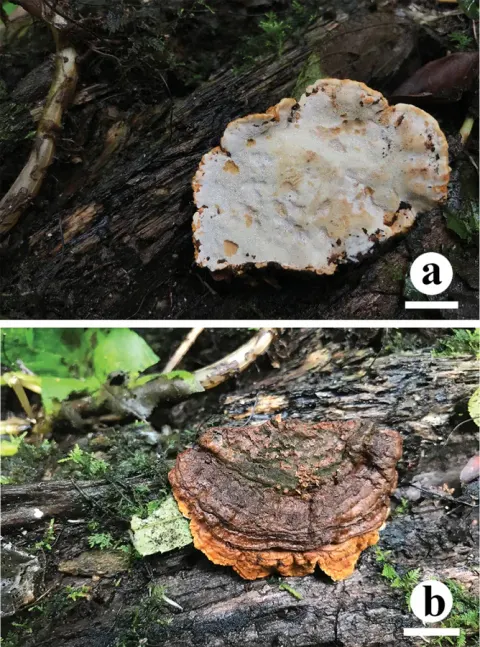
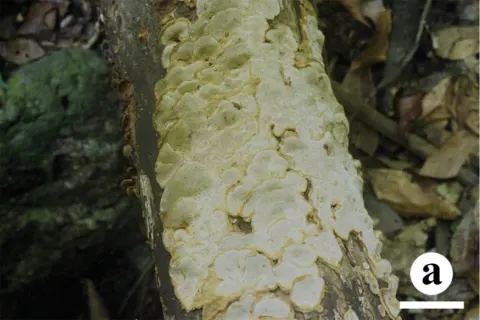
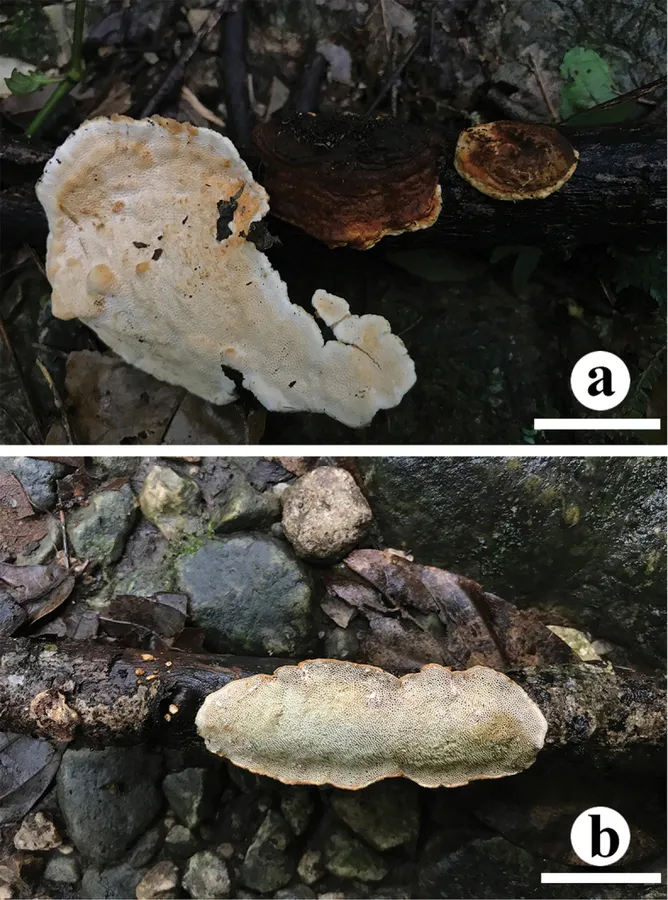
Fruitbody: Basidiocarps annual, effused-reflexed to pileate, corky to leathery, without odor or taste when fresh, soft leathery upon drying. Pilei flabelliform, semicircular or elongated, projecting up to 1.5 cm, 4 cm wide and 5 mm thick at base; resupinate part up to 7 cm long, 4 cm wide, and 5 mm thick at center. Pileal surface buff to yellowish brown when fresh, becoming yellowish brown upon drying, finely velutinate, concentrically sulcate. Pore surface cream, buff to cinnamon-buff when fresh, becoming buff, pale yellowish brown to yellowish brown when dry; sterile margin distinct, buff to pale yellowish brown, up to 2 mm wide; pores round to angular, 2–3 per mm; dissepiments thin, entire to lacerate. Context yellowish brown to pale yellowish brown, leathery, up to 1.5 mm thick. Tubes pale yellowish brown, corky, up to 2 mm long. Hyphal structure: Hyphal system trimitic; generative hyphae bearing clamp connections; skeletal and binding hyphae IKI -, CB +; tissues turning to black in KOH. Context: Generative hyphae infrequent, hyaline, thin-walled, unbranched, 1.5–3.5 μm in diam.; skeletal hyphae dominant, pale yellowish brown, thick-walled with a narrow lumen to subsolid, unbranched, more or less straight, interwoven, occasionally simple-septate, 2–5.5 μm in diam.; binding hyphae hyaline to pale yellowish brown, thick-walled with a narrow lumen to subsolid, flexuous, frequently branched, interwoven, 1–3 μm in diam. Tubes: Generative hyphae infrequent, hyaline, thin-walled, occasionally branched, 1–2 μm in diam.; skeletal hyphae dominant, hyaline to pale yellowish brown, thick-walled with a narrow lumen to subsolid, occasionally branched, more or less straight, strongly interwoven, 1.5–3 μm in diam.; binding hyphae hyaline to pale yellowish brown, thick-walled with a narrow lumen to subsolid, flexuous, frequently branched, interwoven, 0.8–2 μm in diam.
Habitat dan peran ekologis
CHINA. Guangxi Autonomous Region, Huanjiang County, Mulun Nature Reserve, on dead angiosperm tree, 10 July 2017, Cui 14465 (BJFC).
- Habitat atau konteks temuan
- Informasi belum tersedia pada sumber rilis ini.
- Substrat
- Informasi belum tersedia pada sumber rilis ini.
- Peran atau konteks
- Belum dikategorikan pada rilis ini.
Reproduksi
Fruitbody: Basidiocarps annual, effused-reflexed to pileate, corky to leathery, without odor or taste when fresh, soft leathery upon drying. Pilei flabelliform, semicircular or elongated, projecting up to 1.5 cm, 4 cm wide and 5 mm thick at base; resupinate part up to 7 cm long, 4 cm wide, and 5 mm thick at center. Pileal surface buff to yellowish brown when fresh, becoming yellowish brown upon drying, finely velutinate, concentrically sulcate. Pore surface cream, buff to cinnamon-buff when fresh, becoming buff, pale yellowish brown to yellowish brown when dry; sterile margin distinct, buff to pale yellowish brown, up to 2 mm wide; pores round to angular, 2–3 per mm; dissepiments thin, entire to lacerate.
Catatan identitas dan cakupan
- Nama diterima mengikuti Catalogue of Life Base2026-09-11; uraian mempertahankan konsep dan nama sumber aslinya.
- Preserve original treatment localities, hosts and substrate scope. Materials examined describe documented specimens, not the full global range.
- Impor dan terjemahan otomatis belum diperiksa editorial per profil. Struktur reproduktif yang disebutkan tidak membuktikan seluruh siklus hidup diketahui.
- Pengukuran pada uraian mengikuti spesimen, kultur, dan metode sumber; angka tidak diperluas ke semua populasi.
Catatan distribusi dalam narasi mengikuti sumbernya. Dokumentasi spesimen atau foto mengikuti catatan sumber. Bukti wilayah Indonesia dan penilaian konservasi tidak disimpulkan dari gambar.
Melihat dengan konteks
Basidiocarps of Crassisporus macroporus. Scale bars: 2 cm.
- Jenis
- Pelat ilmiah
- Kredit
- Xing Ji, Dong-Mei Wu, Shun Liu, Jing Si, Bao-Kai Cui
- Lisensi
- CC BY 4.0
- Sumber media
- Buka entri sumber
Dokumentasi tambahan
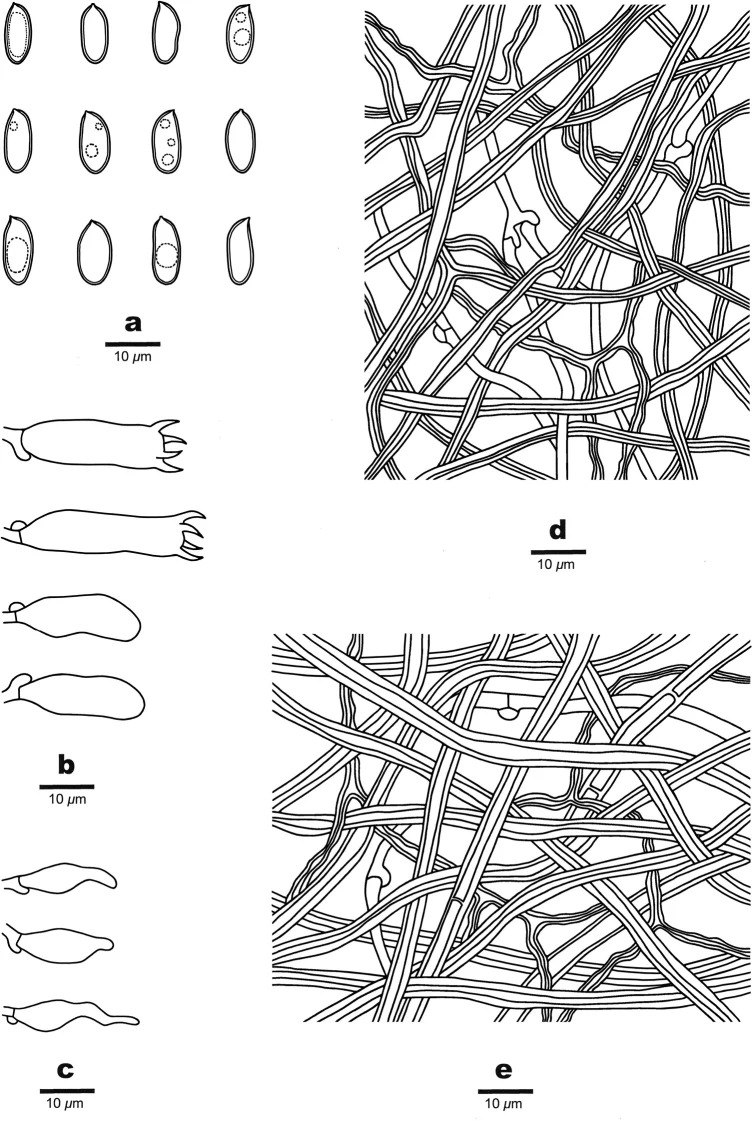
Microscopic structures of Crassisporus macroporus (drawn from the holotype) A basidiospores B basidia and basidioles C cystidioles D hyphae from trama e hyphae from context.
Kredit dan penggunaan
Xing Ji, Dong-Mei Wu, Shun Liu, Jing Si, Bao-Kai Cui
Ukuran dan format gambar disesuaikan tanpa pemotongan, retus, atau penambahan skala. Lisensi sumber dipertahankan.
Sumber profil
- [1] Crassisporus gen. nov. (Polyporaceae, Basidiomycota) evidenced by morphological characters and phylogenetic analyses with descriptions of four new species — Crassisporus macroporus
- [2] Catalogue of Life Base2026-09-11 — Crassisporus macroporus
- [3] Dokumentasi visual — Crassisporus macroporus
- [4] Dokumentasi visual — Crassisporus macroporus
Rujukan halaman ini
Fungi. Crassisporus macroporus. Rilis data fungi-2026-10-12-expansion-2. https://fungi-atlas.mgadib.chatgpt.site/jamur/crassisporus-macroporus/.
Status: impor sumber; pemeriksaan editorial per profil belum selesai. Untuk klaim biologis, gunakan rujukan pada bagian terkait dan periksa konteks sumber aslinya.