Ciri dan struktur
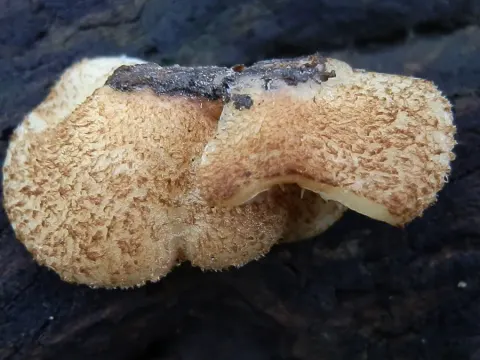
Description: Basidiomata pileate, sessile (laterally or dorsally attached to the substrate) or with a rudimentary lateral stipe, gregarious in sparse to dense groups, often imbricate. Pileus spathuliform, flabelliform, rounded flabelliform, rarely reniform; convex, plano-convex to applanate; flat, sometimes umbonate or depressed near the point of attachment; 5–40 mm wide, 5–50 mm in diameter; hygrophanous; margin usually involute, becoming inflexed; entire, undulate or lobate, translucently striate (up to one-fifth to one-half of the pileus diameter); surface of young and fresh basidiomata white, when mature becomes pale yellow (3A3) or pale orange (5B3), when dried sometimes becomes lighter (3A2–yellowish white); sericeous or velutinous, smooth; at the point of attachment white mycelial tomentum extending up to one-fifth of the pileus diameter. Stipe (if present) cylindrical, 2–7 × 2–4 mm, whitish, pubescent. Lamellae l = (3) 7(15); L = 12–26, 2–4 mm wide, ventricose, adnexed to decurrent; when young whitish to cream (4A3), when mature more orange and gray (5B3–pale orange, 5B4–grayish orange) to golden blond (5C4), the oldest coloured up to brown (5D6–oak brown or 5E7–linoleum brown); lamellae edges concolorous when young and paler (whitish) than lamellae sides when mature; entire or irregularly serrulate. Spore print brown (5E7–linoleum brown, 6E6–cacao brown). Context up to 2 mm thick, whitish to ivory (4B3), smell and taste indistinct.
Habitat dan peran ekologis
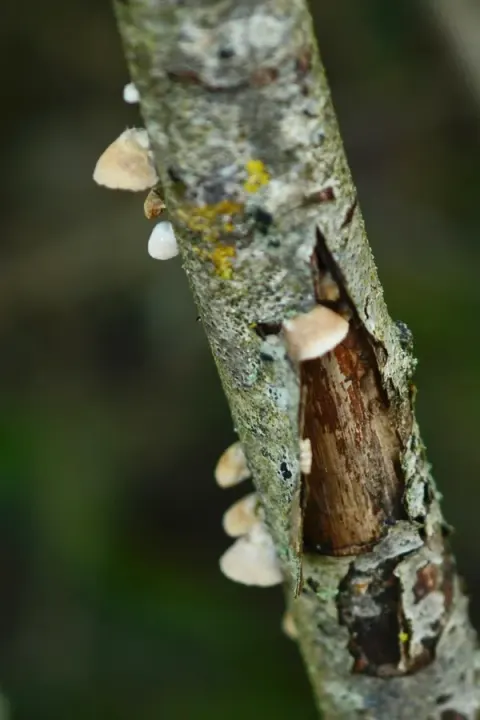
Ecology: Most of our collections of C. applanatus were from the wood of fallen trunks, fewer were from fallen branches, and one collection was from a standing trunk. The most common host tree was Fagus sylvatica, and less common was Acer pseudoplatanus, Quercus sp., and Salix sp.; that it grew on Picea abies is questionable. The fallen trunks and branches were usually 20 to 40 cm thick, in full contact with the soil and basidiomata grew mainly on their lateral side; basidiomata on a standing trunk grew to a height of about 150 cm. The substrates of the 3rd to 5th decay stages were often overgrown with mosses. The findings were from the months of July, September, and October. Most of our collections were from old-growth forests protected as nature reserves in Slovakia, few collections were from managed forests. Of the habitats, the species was most common in beech and fir-beech forests (Fagus sylvatica dominates the tree layer, along with admixed Abies alba, Acer pseudoplatanus, Picea abies, and others); one collection was from oak-hornbeam woods (tree layer is predominantly occupied by Carpinus betulus, Quercus petraea, and Q. robur); another one was from a former pasture having gradually been covered with wood trees of Betula pendula, Populus tremula, and Salix caprea; and one Norwegian collection was from a boreal Picea abies forest.
- Habitat atau konteks temuan
- hutan; padang rumput
- Substrat
- Informasi belum tersedia pada sumber rilis ini.
- Peran atau konteks
- Belum dikategorikan pada rilis ini.
Reproduksi
Description: Basidiomata pileate, sessile (laterally or dorsally attached to the substrate) or with a rudimentary lateral stipe, gregarious in sparse to dense groups, often imbricate. Pileus spathuliform, flabelliform, rounded flabelliform, rarely reniform; convex, plano-convex to applanate; flat, sometimes umbonate or depressed near the point of attachment; 5–40 mm wide, 5–50 mm in diameter; hygrophanous; margin usually involute, becoming inflexed; entire, undulate or lobate, translucently striate (up to one-fifth to one-half of the pileus diameter); surface of young and fresh basidiomata white, when mature becomes pale yellow (3A3) or pale orange (5B3), when dried sometimes becomes lighter (3A2–yellowish white); sericeous or velutinous, smooth; at the point of attachment white mycelial tomentum extending up to one-fifth of the pileus diameter.
Catatan identitas dan cakupan
- Nama diterima mengikuti Catalogue of Life Base2026-09-11; uraian mempertahankan konsep dan nama sumber aslinya.
- Preserve original treatment localities, hosts and substrate scope. Materials examined describe documented specimens, not the full global range.
- Impor dan terjemahan otomatis belum diperiksa editorial per profil. Struktur reproduktif yang disebutkan tidak membuktikan seluruh siklus hidup diketahui.
- Pengukuran pada uraian mengikuti spesimen, kultur, dan metode sumber; angka tidak diperluas ke semua populasi.
Catatan distribusi dalam narasi mengikuti sumbernya. Dokumentasi spesimen atau foto mengikuti catatan sumber. Bukti wilayah Indonesia dan penilaian konservasi tidak disimpulkan dari gambar.
Melihat dengan konteks
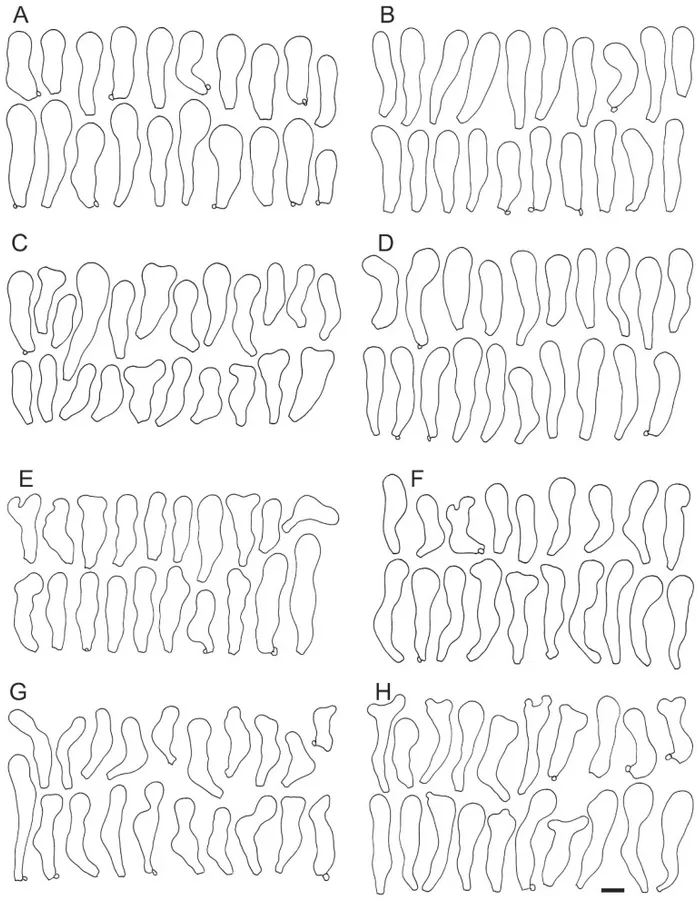
Cheilocystidia variability of Crepidotus applanatus. (A) SLO 1821, (B) SLO 2528, (C) SLO 1492, (D) SLO 2547, (E) SLO 2533, (F) SLO 2534, (G) SLO 2539, (H) SLO 2537. Scale bar = 10× μm.
- Jenis
- Pelat ilmiah
- Kredit
- © 2022 by the authors.
- Lisensi
- CC BY 4.0
- Sumber media
- Buka entri sumber
Dokumentasi tambahan
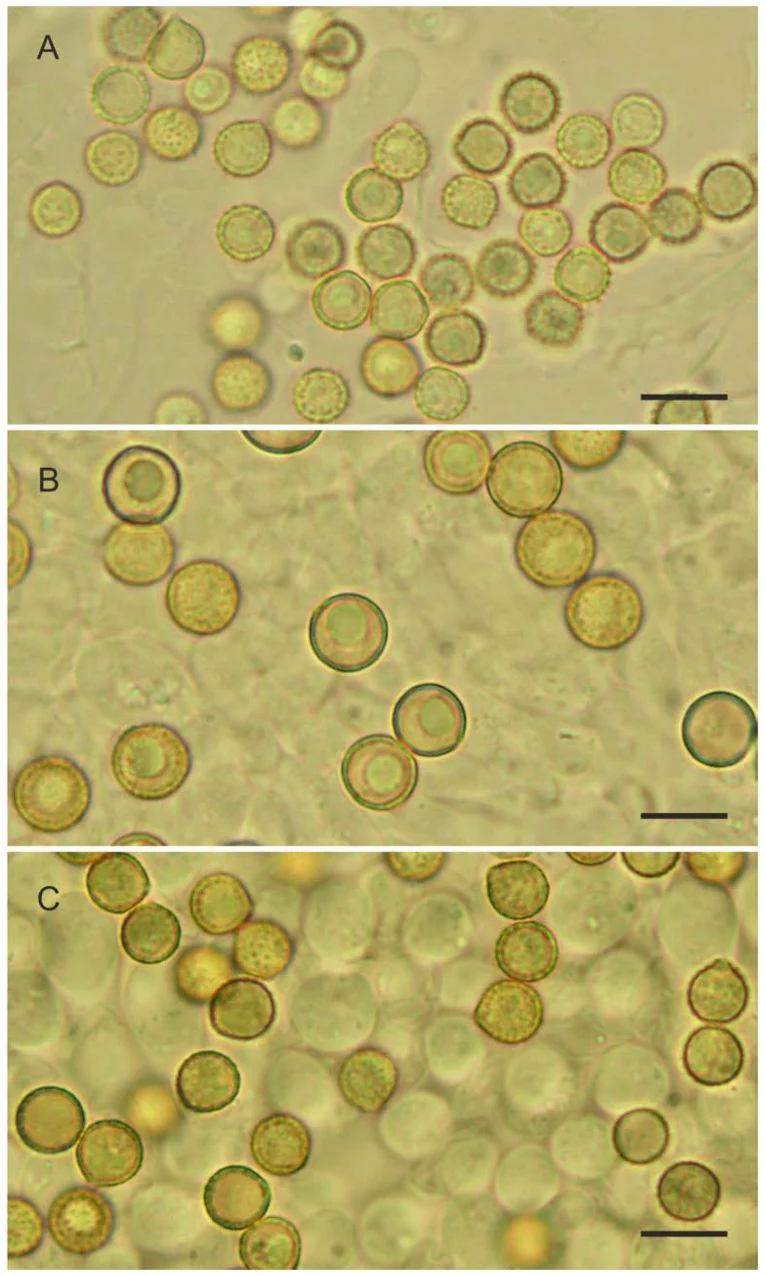
Light microscopic photos of basidiospores. (A) Crepidotus applanatus (SLO 2573), (B) C. malachius (SLO 479), (C) C. pini (SLO 2579). Scale bar = 10 μm.
Kredit dan penggunaan
© 2022 by the authors.
Ukuran dan format gambar disesuaikan tanpa pemotongan, retus, atau penambahan skala. Lisensi sumber dipertahankan.
Sumber profil
- [1] Phylogeny of Crepidotus applanatus Look-Alikes Reveals a Convergent Morphology Evolution and a New Species C. pini — Crepidotus applanatus
- [2] Catalogue of Life Base2026-09-11 — Crepidotus applanatus
- [3] Dokumentasi visual — Crepidotus applanatus
- [4] Dokumentasi visual — Crepidotus applanatus
Rujukan halaman ini
Fungi. Crepidotus applanatus. Rilis data fungi-2026-10-12-expansion-2. https://fungi-atlas.mgadib.chatgpt.site/jamur/crepidotus-applanatus/.
Status: impor sumber; pemeriksaan editorial per profil belum selesai. Untuk klaim biologis, gunakan rujukan pada bagian terkait dan periksa konteks sumber aslinya.