01 / Morfologi

Ciri dan struktur

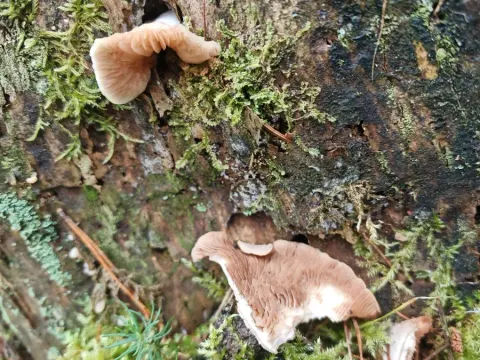
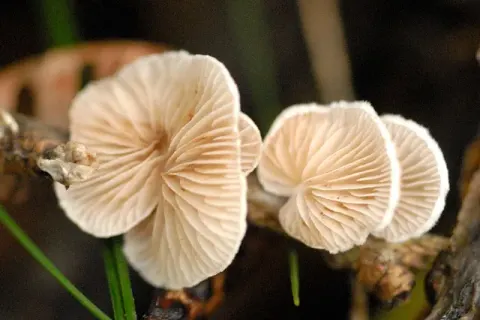
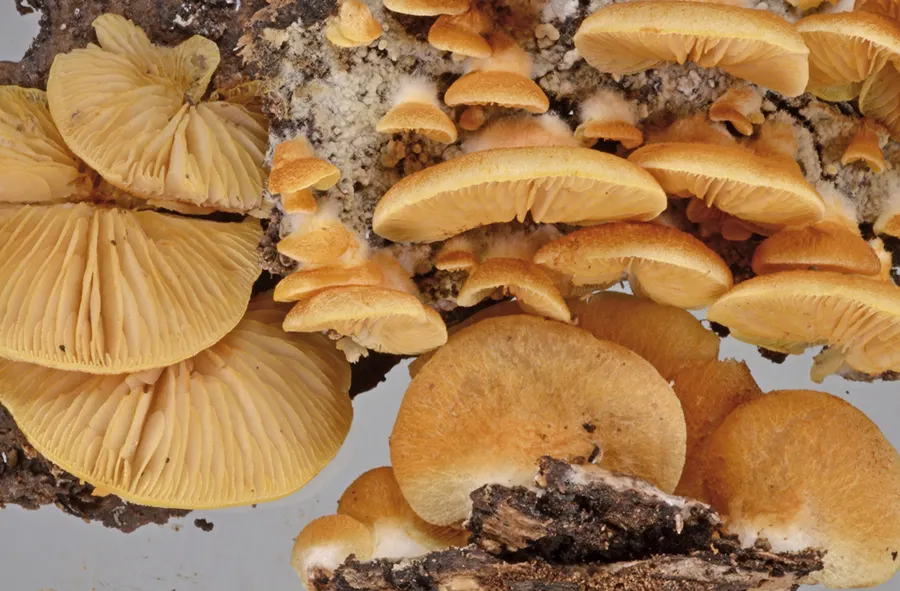
Cap: The cap (pileus) of C. praecipuus is generally about 1–7 cm in diameter and is convex in shape with an even margin that curls inwards. The cap can range from flabelliform to semicircular, to kidney-shaped depending on the surface from which they grow. If they grow on a vertical surface, they are more likely to form a typical shelf-like structure, appearing in the commonly described ‘kidney’ shape while visually remaining semicircular from above. This shape is different if they protrude from underneath their substrate material, usually a log, appearing instead more circular and as if the point of attachment is directly on top of the cap surface. Gills: On the underside, the gills (lamellae) appear somewhat fringed and are classified as free (see description box) with no stipe to connect to. The colour of the gills depends on the maturity of the spores ranging from off-white when young to yellow-brown/rusty-brown as the spores mature. Spores: The spore print is yellow-brown, reflecting the colour of the gills. The ellipsoid-shaped basidiospore of C. praecipuus are 6.3-7.8 by 5.1-6.6 µm in size and are described as having smooth exteriors to their thick walls. The top of the basidiospore (apex) can be blunt, depressed or periodically pointed. (See figure 2.) Basidium: The basidia of C. praecipuus is 26-65 by 4-14 μm in size, club-shaped, cylindrical with four spores attached to the top of each basidium top. Basidiomata: C. praecipuus can have a basidiomata that is relatively larger than other species (see similar species), ranging from 1 –7 cm in length. Being a defining characteristic, it helps set C. praecipuus apart from other species.

Sebagian uraian ditampilkan dalam bahasa sumber; terjemahannya belum tersedia atau belum lolos pemeriksaan.

Rujukan: [1]

Pengukuran mengikuti objek, spesimen atau kultur, dan metode yang disebutkan sumber. Baca uraian asli untuk konteks lengkap.

02 / Kehidupan

Habitat dan peran ekologis

C. praecipuus has been recorded in 3 countries as of 2022: New Zealand, Australia, and South Korea. In New Zealand, Landcare Research has declared the species as indigenous but non-endemic because C. praecipuus is also present in Australia. In 2021, the Ministry of Environment of South Korea reported this species was found on the island of Daecheongdo which is 210 km northwest from land in the Yellow Sea. This island was completely cleared through bombing in the Korean War in 1950. Because there has been no artificial reforestation since the 1970s, all that is currently there has been naturally established. In the southern hemisphere C. praecipuus is generally found in southern beech forests on dead woody material. The forests in which C. praecipuus is found in Korea are primarily made up of Carpinus turczaninoxii, Camellia japonica and Quercus sp. with a high distribution of pine trees (Pinus densiflora) throughout these forests. However, in these sorts of forests in Korea, C. praecipuus has only been found on dead deciduous branches. Despite being found on woody material, C. praecipuus is not parasitic as the spores only establish themselves on dead material, not when the organism is alive.

Sebagian uraian ditampilkan dalam bahasa sumber; terjemahannya belum tersedia atau belum lolos pemeriksaan.

Rujukan: [1]

Habitat atau konteks temuan
hutan
Substrat
Informasi belum tersedia pada sumber rilis ini.
Peran atau konteks
Belum dikategorikan pada rilis ini.
Temukan hubungan serupa
03 / Siklus hidup

Reproduksi

Cap: The cap (pileus) of C. praecipuus is generally about 1–7 cm in diameter and is convex in shape with an even margin that curls inwards. The cap can range from flabelliform to semicircular, to kidney-shaped depending on the surface from which they grow. If they grow on a vertical surface, they are more likely to form a typical shelf-like structure, appearing in the commonly described ‘kidney’ shape while visually remaining semicircular from above. This shape is different if they protrude from underneath their substrate material, usually a log, appearing instead more circular and as if the point of attachment is directly on top of the cap surface. Gills: On the underside, the gills (lamellae) appear somewhat fringed and are classified as free (see description box) with no stipe to connect to.

Sebagian uraian ditampilkan dalam bahasa sumber; terjemahannya belum tersedia atau belum lolos pemeriksaan.

Rujukan: [1]

04 / Batas informasi

Catatan identitas dan cakupan

  • Nama diterima mengikuti Catalogue of Life Base2026-09-11; uraian mempertahankan konsep dan nama sumber aslinya.
  • Original geographic, specimen and life-cycle scope retained; source import awaits individual editorial review.
  • Impor dan terjemahan otomatis belum diperiksa editorial per profil. Struktur reproduktif yang disebutkan tidak membuktikan seluruh siklus hidup diketahui.
  • Pengukuran pada uraian mengikuti spesimen, kultur, dan metode sumber; angka tidak diperluas ke semua populasi.

Catatan distribusi dalam narasi mengikuti sumbernya. Dokumentasi spesimen atau foto mengikuti catatan sumber. Bukti wilayah Indonesia dan penilaian konservasi tidak disimpulkan dari gambar.

05 / Dokumentasi

Melihat dengan konteks

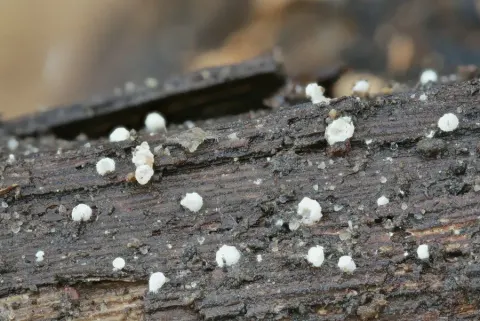
Dokumentasi Crepidotus praecipuus menurut asosiasi foto pada record takson iNaturalist. Kredit: Jerry Cooper. Identitas mengikuti sumber; bukan penentuan spesimen independen.

Jenis
Fotografi
Kredit
(c) Jerry Cooper, some rights reserved (CC BY), uploaded by Jerry Cooper
Lisensi
CC BY 4.0
Sumber media
Buka entri sumber

Gambar menunjukkan objek menurut identifikasi sumber, bukan verifikasi independen spesimen oleh Fungi. Tidak ada skala baru yang ditambahkan.

06 / Rujukan

Sumber profil

  1. [1] Crepidotus praecipuus — Wikipedia (en)Bagian sumber: Frozen revision 1368438066
    Tanggal penghimpunan sumber: 2026-10-12
    Teks sumber: CC BY-SA4.0 · Wikipedia contributors
  2. [2] Catalogue of Life Base2026-09-11 — Crepidotus praecipuusBagian sumber: ColDP NameUsage.tsv ID 6BDZJ; accepted species; source 2073
    Tanggal penghimpunan sumber: 2026-10-12
  3. [3] Dokumentasi visual — Crepidotus praecipuusBagian sumber: Individual media record; identification follows the source, not independent determination
    Tanggal penghimpunan sumber: 2026-10-12
    Media sumber: CC BY 4.0 · (c) Jerry Cooper, some rights reserved (CC BY), uploaded by Jerry Cooper

Adaptasi teks: CC BY-SA 4.0. Wikipedia contributors — Crepidotus praecipuus — Wikipedia (en)

Uraian asli dan riwayat sumber

Riwayat atau halaman sumber

Ringkasan sumber

Crepidotus praecipuus is a species of fungus in the family Crepidotaceae first described in 2018. It is commonly known as a rusty-gilled conch, along with other kidney shaped, rusty-brown spored species of Crepidotus. It is saprobic on wood, like other Crepidotus species. It is present in Australia, New Zealand, and Korea.

Revisi sumber

Morfologi sumber

Cap: The cap (pileus) of C. praecipuus is generally about 1–7 cm in diameter and is convex in shape with an even margin that curls inwards. The cap can range from flabelliform to semicircular, to kidney-shaped depending on the surface from which they grow. If they grow on a vertical surface, they are more likely to form a typical shelf-like structure, appearing in the commonly described ‘kidney’ shape while visually remaining semicircular from above. This shape is different if they protrude from underneath their substrate material, usually a log, appearing instead more circular and as if the point of attachment is directly on top of the cap surface. Gills: On the underside, the gills (lamellae) appear somewhat fringed and are classified as free (see description box) with no stipe to connect to. The colour of the gills depends on the maturity of the spores ranging from off-white when young to yellow-brown/rusty-brown as the spores mature. Spores: The spore print is yellow-brown, reflecting the colour of the gills. The ellipsoid-shaped basidiospore of C. praecipuus are 6.3-7.8 by 5.1-6.6 µm in size and are described as having smooth exteriors to their thick walls. The top of the basidiospore (apex) can be blunt, depressed or periodically pointed. (See figure 2.) Basidium: The basidia of C. praecipuus is 26-65 by 4-14 μm in size, club-shaped, cylindrical with four spores attached to the top of each basidium top. Basidiomata: C. praecipuus can have a basidiomata that is relatively larger than other species (see similar species), ranging from 1 –7 cm in length. Being a defining characteristic, it helps set C. praecipuus apart from other species.

Revisi sumber

Ekologi sumber

C. praecipuus has been recorded in 3 countries as of 2022: New Zealand, Australia, and South Korea. In New Zealand, Landcare Research has declared the species as indigenous but non-endemic because C. praecipuus is also present in Australia. In 2021, the Ministry of Environment of South Korea reported this species was found on the island of Daecheongdo which is 210 km northwest from land in the Yellow Sea. This island was completely cleared through bombing in the Korean War in 1950. Because there has been no artificial reforestation since the 1970s, all that is currently there has been naturally established. In the southern hemisphere C. praecipuus is generally found in southern beech forests on dead woody material. The forests in which C. praecipuus is found in Korea are primarily made up of Carpinus turczaninoxii, Camellia japonica and Quercus sp. with a high distribution of pine trees (Pinus densiflora) throughout these forests. However, in these sorts of forests in Korea, C. praecipuus has only been found on dead deciduous branches. Despite being found on woody material, C. praecipuus is not parasitic as the spores only establish themselves on dead material, not when the organism is alive.

Revisi sumber

Struktur reproduksi sumber

Cap: The cap (pileus) of C. praecipuus is generally about 1–7 cm in diameter and is convex in shape with an even margin that curls inwards. The cap can range from flabelliform to semicircular, to kidney-shaped depending on the surface from which they grow. If they grow on a vertical surface, they are more likely to form a typical shelf-like structure, appearing in the commonly described ‘kidney’ shape while visually remaining semicircular from above. This shape is different if they protrude from underneath their substrate material, usually a log, appearing instead more circular and as if the point of attachment is directly on top of the cap surface. Gills: On the underside, the gills (lamellae) appear somewhat fringed and are classified as free (see description box) with no stipe to connect to.

Revisi sumber

Rujukan halaman ini

Fungi. Crepidotus praecipuus. Rilis data fungi-2026-10-12-expansion-2. https://fungi-atlas.mgadib.chatgpt.site/jamur/crepidotus-praecipuus/.

Status: impor sumber; pemeriksaan editorial per profil belum selesai. Untuk klaim biologis, gunakan rujukan pada bagian terkait dan periksa konteks sumber aslinya.