Ciri dan struktur
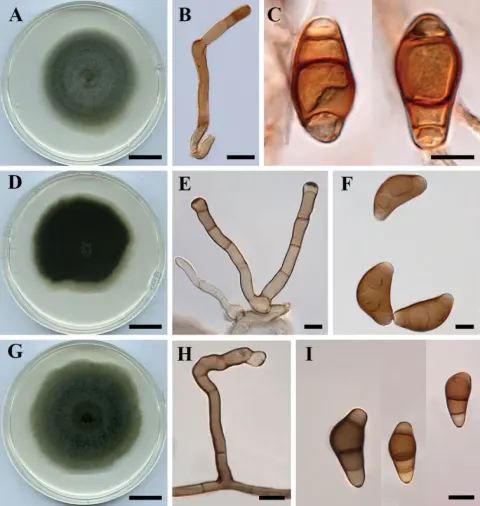
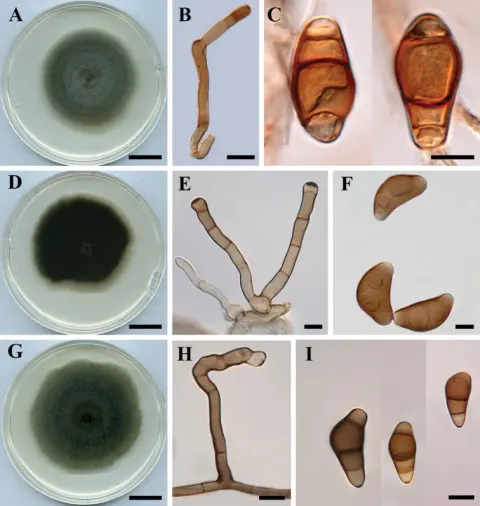
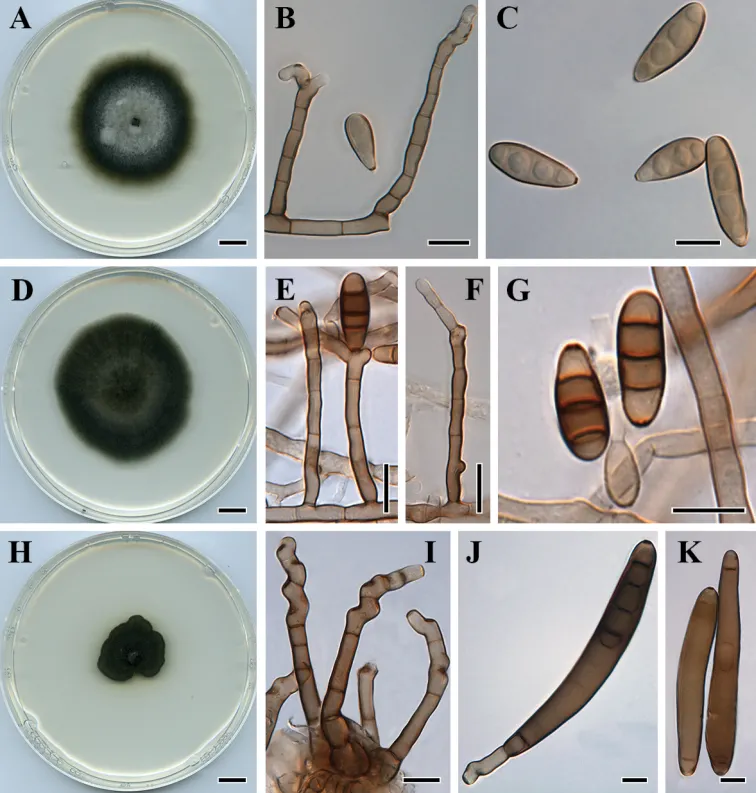
Colonies on PDA approx. 2 cm diam. after 7 d at 25 °C, surface dark olivaceous green. Hyphae subhyaline, smooth, septate, up to 3 µm wide. Conidiophores erect, straight to flexuous, geniculate towards apex, uniformly brown, sometimes pale brown towards apex, septate, up to 75 µm long, 5–6 µm wide, swollen at base, 8–10 µm. Conidiogenous cells integrated, terminal or intercalary, with sympodial proliferation, pale brown to brown, smooth, mono- or polytretic, with darkened scars. Conidia fusiform to narrowly clavate, brown, end cells sometimes paler, (65–) 94–105 (–115) × (11–) 12.5–13.5 (–14) µm, 9–13-distoseptate; hila non-protuberant, thickened and darkened.
Habitat dan peran ekologis
Colonies on PDA approx. 2 cm diam. after 7 d at 25 °C, surface dark olivaceous green. Hyphae subhyaline, smooth, septate, up to 3 µm wide. Conidiophores erect, straight to flexuous, geniculate towards apex, uniformly brown, sometimes pale brown towards apex, septate, up to 75 µm long, 5–6 µm wide, swollen at base, 8–10 µm. Conidiogenous cells integrated, terminal or intercalary, with sympodial proliferation, pale brown to brown, smooth, mono- or polytretic, with darkened scars. Conidia fusiform to narrowly clavate, brown, end cells sometimes paler, (65–) 94–105 (–115) × (11–) 12.5–13.5 (–14) µm, 9–13-distoseptate; hila non-protuberant, thickened and darkened.
- Habitat atau konteks temuan
- kultur yang didokumentasikan
- Substrat
- Informasi belum tersedia pada sumber rilis ini.
- Peran atau konteks
- Belum dikategorikan pada rilis ini.
Reproduksi
Colonies on PDA approx. 2 cm diam. after 7 d at 25 °C, surface dark olivaceous green. Hyphae subhyaline, smooth, septate, up to 3 µm wide. Conidiophores erect, straight to flexuous, geniculate towards apex, uniformly brown, sometimes pale brown towards apex, septate, up to 75 µm long, 5–6 µm wide, swollen at base, 8–10 µm. Conidiogenous cells integrated, terminal or intercalary, with sympodial proliferation, pale brown to brown, smooth, mono- or polytretic, with darkened scars. Conidia fusiform to narrowly clavate, brown, end cells sometimes paler, (65–) 94–105 (–115) × (11–) 12.5–13.5 (–14) µm, 9–13-distoseptate; hila non-protuberant, thickened and darkened.
Catatan identitas dan cakupan
- Nama diterima mengikuti Catalogue of Life Base2026-09-11; uraian mempertahankan konsep dan nama sumber aslinya.
- Preserve original treatment localities, hosts and substrate scope. Materials examined describe documented specimens, not the full global range.
- Impor dan terjemahan otomatis belum diperiksa editorial per profil. Struktur reproduktif yang disebutkan tidak membuktikan seluruh siklus hidup diketahui.
- Pengukuran pada uraian mengikuti spesimen, kultur, dan metode sumber; angka tidak diperluas ke semua populasi.
Catatan distribusi dalam narasi mengikuti sumbernya. Dokumentasi spesimen atau foto mengikuti catatan sumber. Bukti wilayah Indonesia dan penilaian konservasi tidak disimpulkan dari gambar.
Melihat dengan konteks
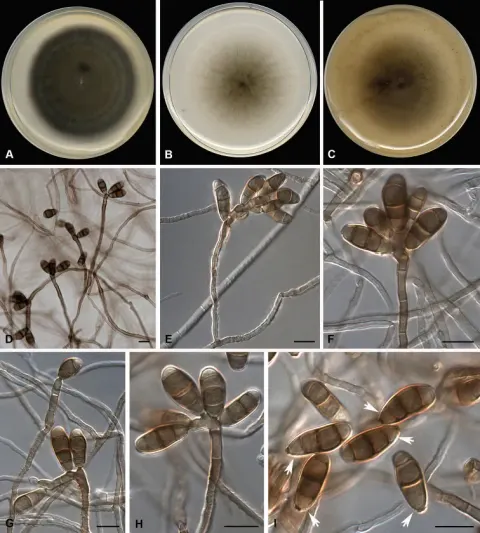
Curvularia mebaldsii (BRIP 12900): A colony on PDA B conidiophores and conidium C conidia. Curvularia petersonii (BRIP 14642) D colony on PDA E–F conidiophores and conidium G conidia. Curvularia platzii (BRIP 27703b) H colony on PDA I conidiophores J–K conidia. Scale bars: 1 cm (A, D, H); all others – 10 µm.
- Jenis
- Pelat ilmiah
- Kredit
- Yu Pei Tan, Pedro W. Crous, Roger G. Shivas
- Lisensi
- CC BY 4.0
- Sumber media
- Buka entri sumber
Sumber profil
- [1] Cryptic species of Curvularia in the culture collection of the Queensland Plant Pathology Herbarium — Curvularia platzii
- [2] Catalogue of Life Base2026-09-11 — Curvularia platzii
- [3] Dokumentasi visual — Curvularia platzii
Rujukan halaman ini
Fungi. Curvularia platzii. Rilis data fungi-2026-10-12-expansion-2. https://fungi-atlas.mgadib.chatgpt.site/jamur/curvularia-platzii/.
Status: impor sumber; pemeriksaan editorial per profil belum selesai. Untuk klaim biologis, gunakan rujukan pada bagian terkait dan periksa konteks sumber aslinya.