01 / Morfologi

Ciri dan struktur

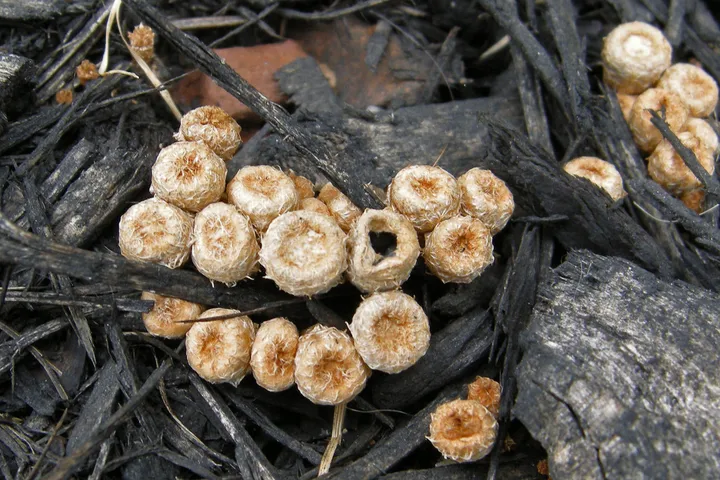
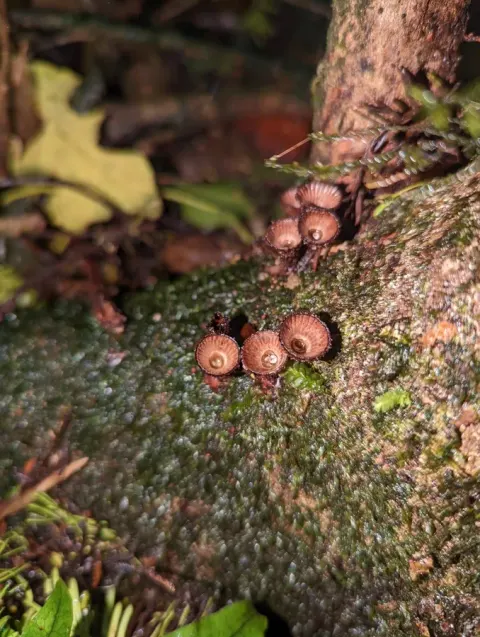
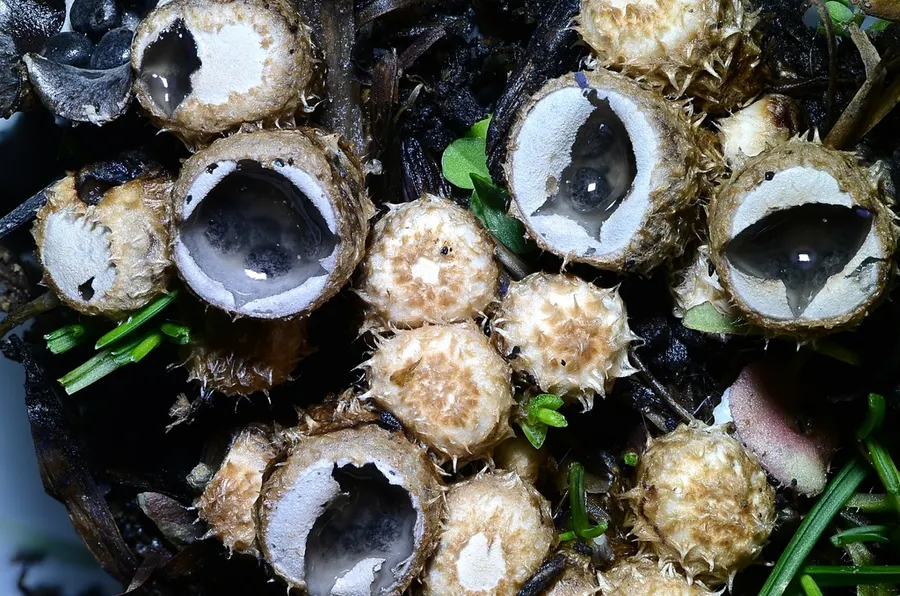
The fruiting bodies, or perida, are funnel- or barrel-shaped, 6–15 mm tall, 4–8 mm wide at the mouth, sometimes short-stalked, golden brown to blackish brown in age. The outside wall of the peridium, the ectoperidium, is covered with tufts of fungal hyphae that resembles shaggy, untidy hair. However, in older specimens this outer layer of hair (technically a tomentum) may be completely worn off. The internal wall of the cup, the endoperidium, is smooth and grey to bluish-black. The 'eggs' of the bird's nest – the peridioles – are blackish, 1–2 mm in diameter,]] The spores of C. stercoreus are roughly spherical and relatively large, with typical dimensions of 20–35 × 20–25 μm, The spores are sessile (growing directly from the surface of the basidium, without attachment via a sterigmata), and are separated from the basidia after it collapses and gelatinizes. This is accompanied by the gelatinization of the inner walls of the peridiole.

Sebagian uraian ditampilkan dalam bahasa sumber; terjemahannya belum tersedia atau belum lolos pemeriksaan.

Rujukan: [1]

Pengukuran mengikuti objek, spesimen atau kultur, dan metode yang disebutkan sumber. Baca uraian asli untuk konteks lengkap.

02 / Kehidupan

Habitat dan peran ekologis

Being coprophilous, C. stercoreus tumbuh di atas pupuk, di tanah dengan pupuk, dan tempat api; juga telah tercatat tumbuh di dunes pasir.

Rujukan: [1]

Habitat atau konteks temuan
Informasi belum tersedia pada sumber rilis ini.
Substrat
tanah; kotoran hewan
Peran atau konteks
Belum dikategorikan pada rilis ini.
Temukan hubungan serupa
03 / Siklus hidup

Reproduksi

The spores of C. stercoreus are roughly spherical and relatively large, with typical dimensions of 20–35 × 20–25 μm, The spores are sessile (growing directly from the surface of the basidium, without attachment via a sterigmata), and are separated from the basidia after it collapses and gelatinizes. This is accompanied by the gelatinization of the inner walls of the peridiole.

Sebagian uraian ditampilkan dalam bahasa sumber; terjemahannya belum tersedia atau belum lolos pemeriksaan.

Rujukan: [1]

Sinonim menurut acuan taksonomi rilis: Cyathia stercorea; Cyathodes lesueurii; Cyathodes stercoreum; Cyathus lesueurii; Cyathus stercoreus f. ephedrae; Cyathus stercoreus f. lesueurii; Cyathus stercoreus var. lesueurii; Nidularia stercorea
04 / Batas informasi

Catatan identitas dan cakupan

  • Nama diterima mengikuti Catalogue of Life Base2026-09-11; uraian mempertahankan konsep dan nama sumber aslinya.
  • Original geographic, specimen and life-cycle scope retained; source import awaits individual editorial review.
  • Impor dan terjemahan otomatis belum diperiksa editorial per profil. Struktur reproduktif yang disebutkan tidak membuktikan seluruh siklus hidup diketahui.
  • Pengukuran pada uraian mengikuti spesimen, kultur, dan metode sumber; angka tidak diperluas ke semua populasi.

Catatan distribusi dalam narasi mengikuti sumbernya. Dokumentasi spesimen atau foto mengikuti catatan sumber. Bukti wilayah Indonesia dan penilaian konservasi tidak disimpulkan dari gambar.

05 / Dokumentasi

Melihat dengan konteks

Dokumentasi Cyathus stercoreus menurut asosiasi foto pada record takson iNaturalist. Kredit: Don Loarie. Identitas mengikuti sumber; bukan penentuan spesimen independen.

Jenis
Fotografi
Kredit
(c) Don Loarie, some rights reserved (CC BY)
Lisensi
CC BY 4.0
Sumber media
Buka entri sumber

Gambar menunjukkan objek menurut identifikasi sumber, bukan verifikasi independen spesimen oleh Fungi. Tidak ada skala baru yang ditambahkan.

Dokumentasi tambahan

06 / Rujukan

Sumber profil

  1. [1] Cyathus stercoreus — Wikipedia (en)Bagian sumber: Frozen revision 1378661175
    Tanggal penghimpunan sumber: 2026-10-12
    Teks sumber: CC BY-SA4.0 · Wikipedia contributors
  2. [2] Catalogue of Life Base2026-09-11 — Cyathus stercoreusBagian sumber: ColDP NameUsage.tsv ID 32RB8; accepted species; source 2073
    Tanggal penghimpunan sumber: 2026-10-12
  3. [3] Dokumentasi visual — Cyathus stercoreusBagian sumber: Identitas mengikuti sumber dokumentasi; bukan penentuan spesimen independen.
    Tanggal penghimpunan sumber: 2026-10-17
    Media sumber: CC BY 4.0 · (c) Don Loarie, some rights reserved (CC BY)
  4. [4] Dokumentasi visual — Cyathus stercoreusBagian sumber: Identitas mengikuti sumber dokumentasi; bukan penentuan spesimen independen.
    Tanggal penghimpunan sumber: 2026-10-17
    Teks sumber: CC BY 4.0 · (c) Bill Keim, some rights reserved (CC BY)

Adaptasi teks: CC BY-SA 4.0. Wikipedia contributors — Cyathus stercoreus — Wikipedia (en)

Uraian asli dan riwayat sumber

Riwayat atau halaman sumber

Ringkasan sumber

Cyathus stercoreus, commonly known as the dung-loving bird's nest or the dung bird's nest, is a species of fungus in the genus Cyathus, family Nidulariaceae. Like other species in the Nidulariaceae, the fruiting bodies of C. stercoreus resemble tiny bird's nests filled with eggs. The fruiting bodies are referred to as splash cups, because they are developed to use the force of falling drops of water to dislodge and disperse their spores. The species has a worldwide distribution, and prefers growing on dung, or soil containing dung; the specific epithet is derived from the Latin word stercorarius, meaning "of dung".

Revisi sumber

Morfologi sumber

The fruiting bodies, or perida, are funnel- or barrel-shaped, 6–15 mm tall, 4–8 mm wide at the mouth, sometimes short-stalked, golden brown to blackish brown in age. The outside wall of the peridium, the ectoperidium, is covered with tufts of fungal hyphae that resembles shaggy, untidy hair. However, in older specimens this outer layer of hair (technically a tomentum) may be completely worn off. The internal wall of the cup, the endoperidium, is smooth and grey to bluish-black. The 'eggs' of the bird's nest – the peridioles – are blackish, 1–2 mm in diameter,]] The spores of C. stercoreus are roughly spherical and relatively large, with typical dimensions of 20–35 × 20–25 μm, The spores are sessile (growing directly from the surface of the basidium, without attachment via a sterigmata), and are separated from the basidia after it collapses and gelatinizes. This is accompanied by the gelatinization of the inner walls of the peridiole.

Revisi sumber

Ekologi sumber

Being coprophilous, C. stercoreus grows on dung, in soil with dung, and bonfire sites; it has also been recorded growing on sand dunes.

Revisi sumber

Struktur reproduksi sumber

The spores of C. stercoreus are roughly spherical and relatively large, with typical dimensions of 20–35 × 20–25 μm, The spores are sessile (growing directly from the surface of the basidium, without attachment via a sterigmata), and are separated from the basidia after it collapses and gelatinizes. This is accompanied by the gelatinization of the inner walls of the peridiole.

Revisi sumber

Rujukan halaman ini

Fungi. Cyathus stercoreus. Rilis data fungi-2026-10-12-expansion-2. https://fungi-atlas.mgadib.chatgpt.site/jamur/cyathus-stercoreus/.

Status: impor sumber; pemeriksaan editorial per profil belum selesai. Untuk klaim biologis, gunakan rujukan pada bagian terkait dan periksa konteks sumber aslinya.