01 / Morfologi

Ciri dan struktur

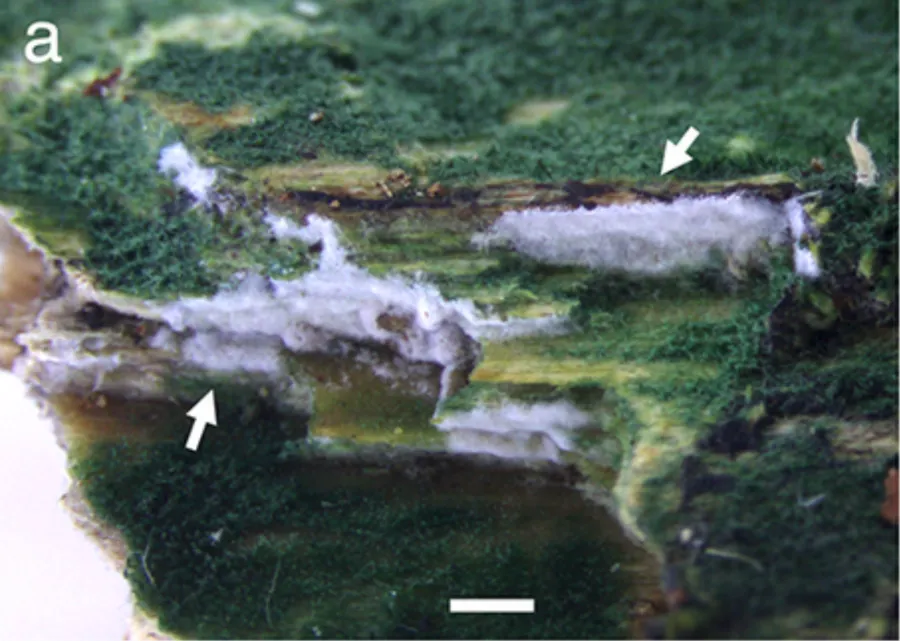
Macroscopically, the lichenised thallus forms a fragile, green to bluish‑green mat of loosely interwoven fungal‑cyanobacterial fibrils on the bark of Cryptomeria japonica. In microscopic section the thallus is up to 80 micrometres (μm) thick, with occasional tufts of compact fibrils projecting to roughly 300 μm. Each Rhizonema filament (about 2.7–3.5 μm diam.) is only partly ensheathed by hyphae, leaving visible interspaces. Under the light microscope and in TEM micrographs, tubular haustoria (about 2.5–3.4 μm diam.) are seen entering the trichome and running through consecutive cells, a feature otherwise associated with the related genus Dictyonema. The basidiomata develop on the wood surface adjacent to the thallus, especially along the margins or on the underside of overhanging bark. They are paper‑thin, membranous and white, rarely exceeding a few millimetres across. The hymenium is ≤ 40 μm thick and composed of hyaline, thin‑walled hyphae 3–4 μm wide; clamp connections and cystidia are absent. Basidia are short‑clavate, 8.6–13.0 × 5.4–6.5 μm, bearing four sterigmata 2.2–3.6 μm long. Basidiospores are ellipsoid to slightly elongate, 5.3–6.3 × 3.4–4.0 μm, smooth, thin‑walled and non‑amyloid. When grown axenically on potato dextrose agar at 20 °C the forms slow‑growing, pale pink to pale brown colonies reaching 4.0–4.5 mm diameter after two months.

Sebagian uraian ditampilkan dalam bahasa sumber; terjemahannya belum tersedia atau belum lolos pemeriksaan.

Rujukan: [1]

Pengukuran mengikuti objek, spesimen atau kultur, dan metode yang disebutkan sumber. Baca uraian asli untuk konteks lengkap.

02 / Kehidupan

Habitat dan peran ekologis

As of its original publication, Cyphellostereum ushima was known to occur only in the type locality, a low‑elevation (15 m) coastal forest in Setouchi town, Amami Ōshima, Kagoshima Prefecture. The climate there is warm and humid year‑round, supporting subtropical evergreen broad‑leaved vegetation in which Cryptomeria japonica plantations are common. The lichen grows epiphytically on the shaded, occasionally rain‑washed trunks and branches of this conifer, where mesic conditions favour cyanobacterial partners. Field observations indicate that the species is locally rare but may be overlooked because its inconspicuous thallus blends into algal films and bryophyte patches, while its basidiomata are minute and transient.

Sebagian uraian ditampilkan dalam bahasa sumber; terjemahannya belum tersedia atau belum lolos pemeriksaan.

Rujukan: [1]

Habitat atau konteks temuan
hutan
Substrat
Informasi belum tersedia pada sumber rilis ini.
Peran atau konteks
Pembentuk liken
Temukan hubungan serupa
03 / Siklus hidup

Reproduksi

The basidiomata develop on the wood surface adjacent to the thallus, especially along the margins or on the underside of overhanging bark. They are paper‑thin, membranous and white, rarely exceeding a few millimetres across. The hymenium is ≤ 40 μm thick and composed of hyaline, thin‑walled hyphae 3–4 μm wide; clamp connections and cystidia are absent. Basidia are short‑clavate, 8.6–13.0 × 5.4–6.5 μm, bearing four sterigmata 2.2–3.6 μm long. Basidiospores are ellipsoid to slightly elongate, 5.3–6.3 × 3.4–4.0 μm, smooth, thin‑walled and non‑amyloid. When grown axenically on potato dextrose agar at 20 °C the forms slow‑growing, pale pink to pale brown colonies reaching 4.0–4.5 mm diameter after two months.

Sebagian uraian ditampilkan dalam bahasa sumber; terjemahannya belum tersedia atau belum lolos pemeriksaan.

Rujukan: [1]

04 / Batas informasi

Catatan identitas dan cakupan

  • Nama diterima mengikuti Catalogue of Life Base2026-09-11; uraian mempertahankan konsep dan nama sumber aslinya.
  • Original geographic, specimen and life-cycle scope retained; source import awaits individual editorial review.
  • Impor dan terjemahan otomatis belum diperiksa editorial per profil. Struktur reproduktif yang disebutkan tidak membuktikan seluruh siklus hidup diketahui.
  • Pengukuran pada uraian mengikuti spesimen, kultur, dan metode sumber; angka tidak diperluas ke semua populasi.

Catatan distribusi dalam narasi mengikuti sumbernya. Dokumentasi spesimen atau foto mengikuti catatan sumber. Bukti wilayah Indonesia dan penilaian konservasi tidak disimpulkan dari gambar.

05 / Dokumentasi

Melihat dengan konteks

Dokumentasi Cyphellostereum ushimanum dari Wikimedia Commons. The cyanobacterial lichen Cyphellostereum ushima , showing its Resupinate basidiomata (white arrows) and fibrous lichenized thallus Identifikasi mengikuti record berkas sumber.

Jenis
Fotografi
Kredit
Unknown author Unknown author
Lisensi
CC BY 4.0
Sumber media
Buka entri sumber

Gambar menunjukkan objek menurut identifikasi sumber, bukan verifikasi independen spesimen oleh Fungi. Tidak ada skala baru yang ditambahkan.

06 / Rujukan

Sumber profil

  1. [1] Cyphellostereum ushimanum — Wikipedia (en)Bagian sumber: Frozen revision 1341958295
    Tanggal penghimpunan sumber: 2026-10-12
    Teks sumber: CC BY-SA4.0 · Wikipedia contributors
  2. [2] Catalogue of Life Base2026-09-11 — Cyphellostereum ushimanumBagian sumber: ColDP NameUsage.tsv ID B2NVJ; accepted species; source 2073
    Tanggal penghimpunan sumber: 2026-10-12
  3. [3] Dokumentasi visual — Cyphellostereum ushimanumBagian sumber: Individual media record; identification follows the source, not independent determination
    Tanggal penghimpunan sumber: 2026-10-12
    Media sumber: CC BY 4.0 · Unknown author Unknown author

Adaptasi teks: CC BY-SA 4.0. Wikipedia contributors — Cyphellostereum ushimanum — Wikipedia (en)

Uraian asli dan riwayat sumber

Riwayat atau halaman sumber

Ringkasan sumber

Cyphellostereum ushimanum is a species of lichen-forming fungus in the family Hygrophoraceae. This basidiolichen was discovered and described in 2022 from a single location on Amami Ōshima island in Japan, where it grows on the bark of Japanese cedar trees. The species has microscopic feeding structures (haustoria) that penetrate its cyanobacterial partner, a feature that required an update to its genus, Cyphellostereum. The lichen produces small, white, paper-thin reproductive structures adjacent to its bluish-green thallus.

Revisi sumber

Morfologi sumber

Macroscopically, the lichenised thallus forms a fragile, green to bluish‑green mat of loosely interwoven fungal‑cyanobacterial fibrils on the bark of Cryptomeria japonica. In microscopic section the thallus is up to 80 micrometres (μm) thick, with occasional tufts of compact fibrils projecting to roughly 300 μm. Each Rhizonema filament (about 2.7–3.5 μm diam.) is only partly ensheathed by hyphae, leaving visible interspaces. Under the light microscope and in TEM micrographs, tubular haustoria (about 2.5–3.4 μm diam.) are seen entering the trichome and running through consecutive cells, a feature otherwise associated with the related genus Dictyonema. The basidiomata develop on the wood surface adjacent to the thallus, especially along the margins or on the underside of overhanging bark. They are paper‑thin, membranous and white, rarely exceeding a few millimetres across. The hymenium is ≤ 40 μm thick and composed of hyaline, thin‑walled hyphae 3–4 μm wide; clamp connections and cystidia are absent. Basidia are short‑clavate, 8.6–13.0 × 5.4–6.5 μm, bearing four sterigmata 2.2–3.6 μm long. Basidiospores are ellipsoid to slightly elongate, 5.3–6.3 × 3.4–4.0 μm, smooth, thin‑walled and non‑amyloid. When grown axenically on potato dextrose agar at 20 °C the forms slow‑growing, pale pink to pale brown colonies reaching 4.0–4.5 mm diameter after two months.

Revisi sumber

Ekologi sumber

As of its original publication, Cyphellostereum ushima was known to occur only in the type locality, a low‑elevation (15 m) coastal forest in Setouchi town, Amami Ōshima, Kagoshima Prefecture. The climate there is warm and humid year‑round, supporting subtropical evergreen broad‑leaved vegetation in which Cryptomeria japonica plantations are common. The lichen grows epiphytically on the shaded, occasionally rain‑washed trunks and branches of this conifer, where mesic conditions favour cyanobacterial partners. Field observations indicate that the species is locally rare but may be overlooked because its inconspicuous thallus blends into algal films and bryophyte patches, while its basidiomata are minute and transient.

Revisi sumber

Struktur reproduksi sumber

The basidiomata develop on the wood surface adjacent to the thallus, especially along the margins or on the underside of overhanging bark. They are paper‑thin, membranous and white, rarely exceeding a few millimetres across. The hymenium is ≤ 40 μm thick and composed of hyaline, thin‑walled hyphae 3–4 μm wide; clamp connections and cystidia are absent. Basidia are short‑clavate, 8.6–13.0 × 5.4–6.5 μm, bearing four sterigmata 2.2–3.6 μm long. Basidiospores are ellipsoid to slightly elongate, 5.3–6.3 × 3.4–4.0 μm, smooth, thin‑walled and non‑amyloid. When grown axenically on potato dextrose agar at 20 °C the forms slow‑growing, pale pink to pale brown colonies reaching 4.0–4.5 mm diameter after two months.

Revisi sumber

Rujukan halaman ini

Fungi. Cyphellostereum ushimanum. Rilis data fungi-2026-10-12-expansion-2. https://fungi-atlas.mgadib.chatgpt.site/jamur/cyphellostereum-ushimanum/.

Status: impor sumber; pemeriksaan editorial per profil belum selesai. Untuk klaim biologis, gunakan rujukan pada bagian terkait dan periksa konteks sumber aslinya.