01 / Morfologi

Ciri dan struktur

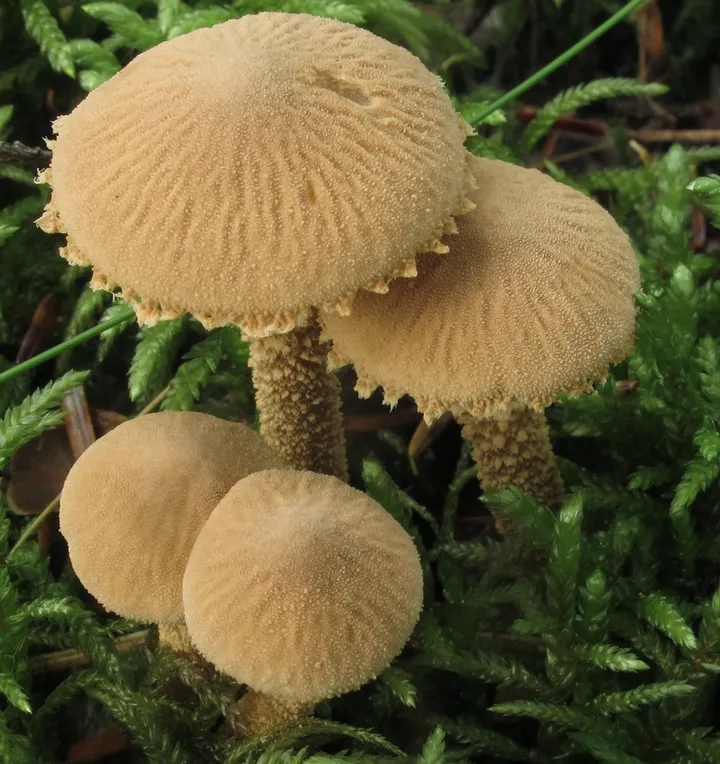
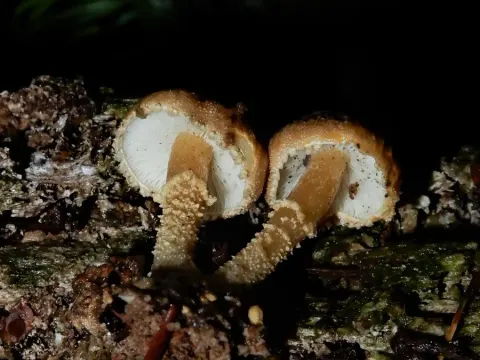
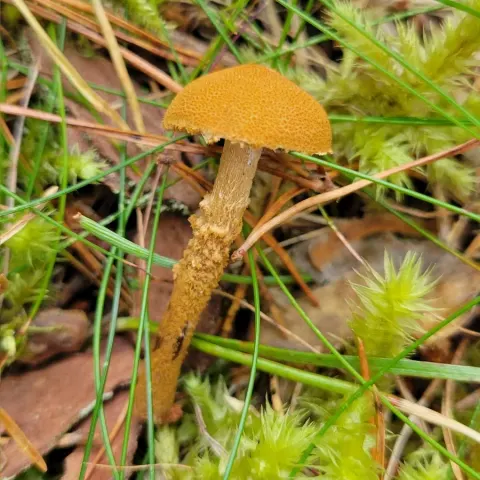
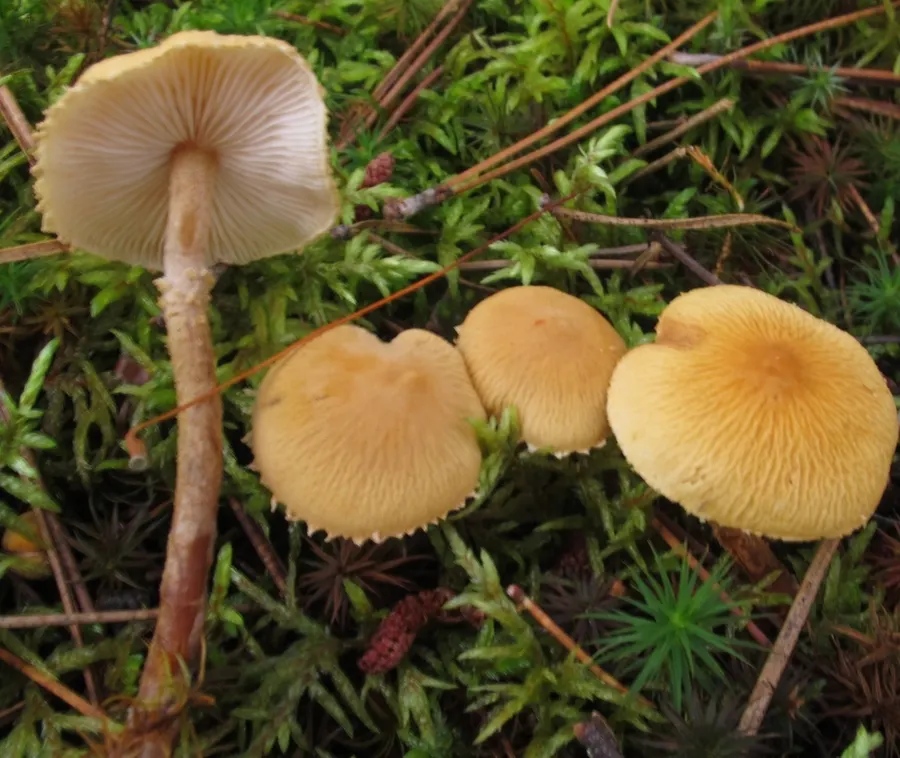
The cap is between 1 and 5 cm in diameter, convex to bell-shaped, and later flat with a slight depression around a low umbo (central boss). It is dry and powdery, often with a shaggy or fringed margin (appendiculate), and is saffron-yellow or orange-ochre. The stem is cylindrical, and has a flaky-granular sheath beneath a fleeting, powdery ring. The gills are white initially, and become creamy later. They are adnexed (narrowly attached to the stem), and initially quite crowded. The spore print is white. The flesh is thin and yellowish, with an odor that is unpleasant or resembles husked corn. A very similar form with a markedly radially wrinkled cap, has been separated by some authors, and given the binomial Cystoderma rugoso-reticulatum. Some forms have a whitish yellow cap. Cystodermella granulosa and Cystodermella cinnabarina are both redder as a rule, and have adnate gills (broadly attached to the stem).

Sebagian uraian ditampilkan dalam bahasa sumber; terjemahannya belum tersedia atau belum lolos pemeriksaan.

Rujukan: [1]

Pengukuran mengikuti objek, spesimen atau kultur, dan metode yang disebutkan sumber. Baca uraian asli untuk konteks lengkap.

02 / Kehidupan

Habitat dan peran ekologis

Cystoderma amianthinum is widespread in Europe and North America, and common in northern temperate zones. Hal ini terjadi di hutan berlumut, di heaths, di antara rumput atau bracken, dan kadang-kadang dengan willow. Hal ini sering ditemukan di tanah asam.

Sebagian uraian ditampilkan dalam bahasa sumber; terjemahannya belum tersedia atau belum lolos pemeriksaan.

Rujukan: [1]

Habitat atau konteks temuan
hutan
Substrat
Informasi belum tersedia pada sumber rilis ini.
Peran atau konteks
Belum dikategorikan pada rilis ini.
Temukan hubungan serupa
03 / Siklus hidup

Reproduksi

The cap is between 1 and 5 cm in diameter, convex to bell-shaped, and later flat with a slight depression around a low umbo (central boss). It is dry and powdery, often with a shaggy or fringed margin (appendiculate), and is saffron-yellow or orange-ochre. The stem is cylindrical, and has a flaky-granular sheath beneath a fleeting, powdery ring. The gills are white initially, and become creamy later. They are adnexed (narrowly attached to the stem), and initially quite crowded. The spore print is white. The flesh is thin and yellowish, with an odor that is unpleasant or resembles husked corn.

Sebagian uraian ditampilkan dalam bahasa sumber; terjemahannya belum tersedia atau belum lolos pemeriksaan.

Rujukan: [1]

Sinonim menurut acuan taksonomi rilis: Agaricus amianthinus; Agaricus amianthinus var. broadwoodiae; Agaricus granulosus var. amianthinum; Agaricus granulosus var. amianthinus; Agaricus rugosoreticulatus; Armillaria amianthina; Armillaria rugosoreticulata; Cystoderma amianthinum f. album; Cystoderma amianthinum f. olivaceum; Cystoderma amianthinum f. rugosoreticulatum; Cystoderma amianthinum var. rugosoreticulatum; Cystoderma rugosoreticulatum; Lepiota amianthina; Lepiota amianthina var. alba; Lepiota amianthina var. broadwoodiae; Lepiota amianthina var. evae; Lepiota granulosa var. amianthina; Lepiota rugosoreticulata
04 / Batas informasi

Catatan identitas dan cakupan

  • Nama diterima mengikuti Catalogue of Life Base2026-09-11; uraian mempertahankan konsep dan nama sumber aslinya.
  • Original geographic, specimen and life-cycle scope retained; source import awaits individual editorial review.
  • Impor dan terjemahan otomatis belum diperiksa editorial per profil. Struktur reproduktif yang disebutkan tidak membuktikan seluruh siklus hidup diketahui.
  • Pengukuran pada uraian mengikuti spesimen, kultur, dan metode sumber; angka tidak diperluas ke semua populasi.

Catatan distribusi dalam narasi mengikuti sumbernya. Dokumentasi spesimen atau foto mengikuti catatan sumber. Bukti wilayah Indonesia dan penilaian konservasi tidak disimpulkan dari gambar.

05 / Dokumentasi

Melihat dengan konteks

Dokumentasi Cystoderma amianthinum menurut asosiasi foto pada record takson iNaturalist. Kredit: mycowalt. Identitas mengikuti sumber; bukan penentuan spesimen independen.

Jenis
Fotografi
Kredit
(c) mycowalt, some rights reserved (CC BY-SA), uploaded by mycowalt
Sumber media
Buka entri sumber

Gambar menunjukkan objek menurut identifikasi sumber, bukan verifikasi independen spesimen oleh Fungi. Tidak ada skala baru yang ditambahkan.

Dokumentasi tambahan

06 / Rujukan

Sumber profil

  1. [1] Cystoderma amianthinum — Wikipedia (en)Bagian sumber: Frozen revision 1301277573
    Tanggal penghimpunan sumber: 2026-10-12
    Teks sumber: CC BY-SA4.0 · Wikipedia contributors
  2. [2] Catalogue of Life Base2026-09-11 — Cystoderma amianthinumBagian sumber: ColDP NameUsage.tsv ID 6BY6D; accepted species; source 2073
    Tanggal penghimpunan sumber: 2026-10-12
  3. [3] Dokumentasi visual — Cystoderma amianthinumBagian sumber: Identitas mengikuti sumber dokumentasi; bukan penentuan spesimen independen.
    Tanggal penghimpunan sumber: 2026-10-17
    Media sumber: CC BY-SA 4.0 · (c) mycowalt, some rights reserved (CC BY-SA), uploaded by mycowalt
  4. [4] Dokumentasi visual — Cystoderma amianthinumBagian sumber: Identitas mengikuti sumber dokumentasi; bukan penentuan spesimen independen.
    Tanggal penghimpunan sumber: 2026-10-17
    Teks sumber: CC BY-SA 4.0 · (c) mycowalt, some rights reserved (CC BY-SA), uploaded by mycowalt

Adaptasi teks: CC BY-SA 4.0. Wikipedia contributors — Cystoderma amianthinum — Wikipedia (en)

Uraian asli dan riwayat sumber

Riwayat atau halaman sumber

Ringkasan sumber

Cystoderma amianthinum, commonly called the common powdercap, saffron parasol, the saffron powder-cap, or the earthy powder-cap, is a small orange-ochre, or yellowish-brown, gilled mushroom. It grows in damp mossy grassland, in coniferous forest clearings, or on wooded heaths. It is probably the most common of the small genus Cystoderma. It is not recommended for consumption due to its resemblance to poisonous species.

Revisi sumber

Morfologi sumber

The cap is between 1 and 5 cm in diameter, convex to bell-shaped, and later flat with a slight depression around a low umbo (central boss). It is dry and powdery, often with a shaggy or fringed margin (appendiculate), and is saffron-yellow or orange-ochre. The stem is cylindrical, and has a flaky-granular sheath beneath a fleeting, powdery ring. The gills are white initially, and become creamy later. They are adnexed (narrowly attached to the stem), and initially quite crowded. The spore print is white. The flesh is thin and yellowish, with an odor that is unpleasant or resembles husked corn. A very similar form with a markedly radially wrinkled cap, has been separated by some authors, and given the binomial Cystoderma rugoso-reticulatum. Some forms have a whitish yellow cap. Cystodermella granulosa and Cystodermella cinnabarina are both redder as a rule, and have adnate gills (broadly attached to the stem).

Revisi sumber

Ekologi sumber

Cystoderma amianthinum is widespread in Europe and North America, and common in northern temperate zones. It occurs in mossy woodland, on heaths, amongst grass or bracken, and sometimes with willow. It is often found on acidic soils.

Revisi sumber

Struktur reproduksi sumber

The cap is between 1 and 5 cm in diameter, convex to bell-shaped, and later flat with a slight depression around a low umbo (central boss). It is dry and powdery, often with a shaggy or fringed margin (appendiculate), and is saffron-yellow or orange-ochre. The stem is cylindrical, and has a flaky-granular sheath beneath a fleeting, powdery ring. The gills are white initially, and become creamy later. They are adnexed (narrowly attached to the stem), and initially quite crowded. The spore print is white. The flesh is thin and yellowish, with an odor that is unpleasant or resembles husked corn.

Revisi sumber

Rujukan halaman ini

Fungi. Cystoderma amianthinum. Rilis data fungi-2026-10-12-expansion-2. https://fungi-atlas.mgadib.chatgpt.site/jamur/cystoderma-amianthinum/.

Status: impor sumber; pemeriksaan editorial per profil belum selesai. Untuk klaim biologis, gunakan rujukan pada bagian terkait dan periksa konteks sumber aslinya.