01 / Morfologi

Ciri dan struktur

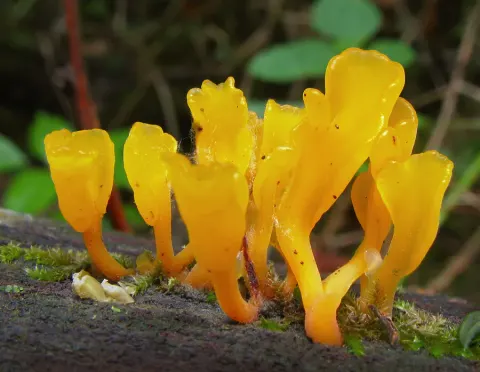
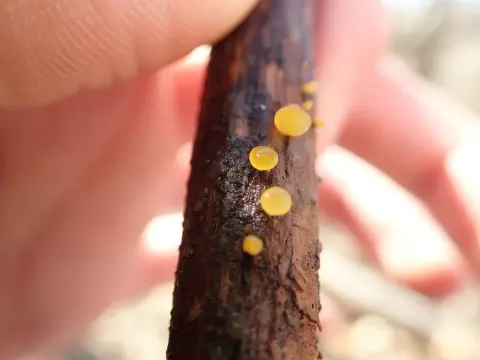
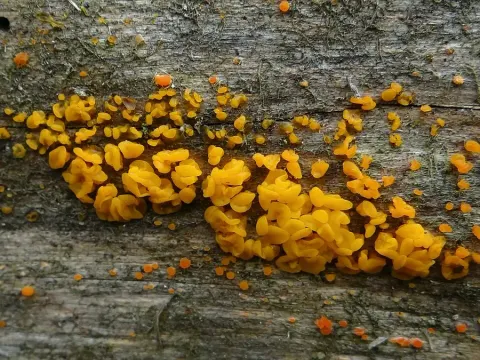
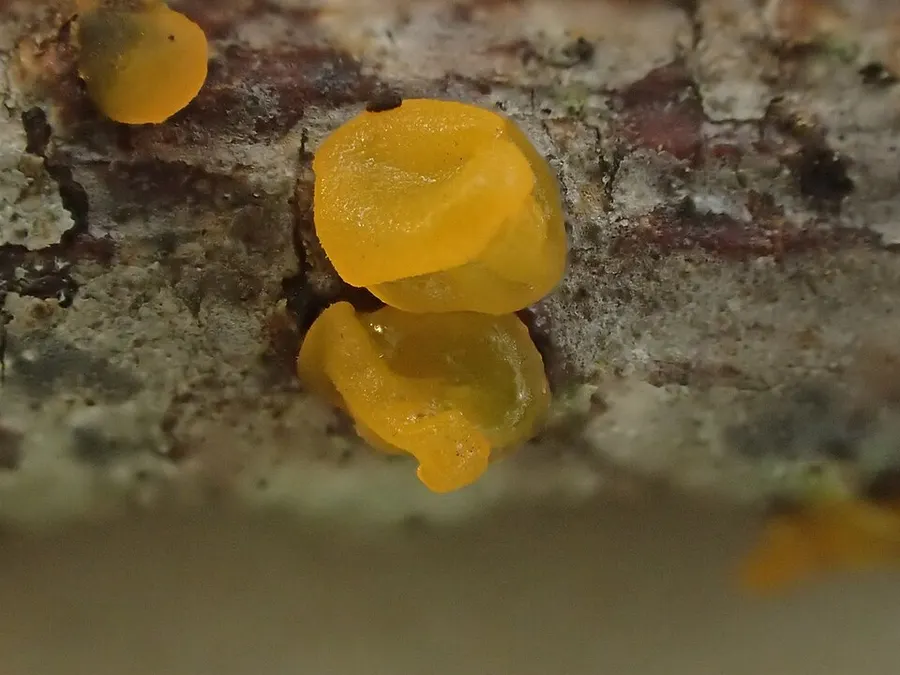
Dacrymyces ovisporus produces small, clustered fruit bodies (basidiocarps) that begin as tiny pustules 2–4 mm across before coalescing into irregular, convoluted masses attached at a single point on the substrate. Fresh basidiocarps are firm-gelatinous and show a bright orange to amber colour, fading to dark amber or brown when dry. Internally, the fungal hyphae are thin-walled, smooth and embedded in a gelatinous matrix, each bearing a clamp connection where septa occur. Under the microscope, the hymenium comprises simple, cylindrical dikaryophyses—sterile supporting cells with thick walls and clamp connections—alongside the spore-bearing basidia. The basidia are cylindrical to slightly club-shaped, measuring 40–70 × 5–10 micrometre (μm), and each carries two long sterigmata. Spores (basidiospores) are relatively large (14–20 × 8–11 μm), more or less spherical (subglobose) to broadly oval, thin-walled and apiculate (with a small pointed scar). They initially possess thin, single septa but mature into spores partitioned by transverse, longitudinal and oblique septa. Germination occurs either by extending a germ tube or by forming asexual conidia.

Sebagian uraian ditampilkan dalam bahasa sumber; terjemahannya belum tersedia atau belum lolos pemeriksaan.

Rujukan: [1]

Pengukuran mengikuti objek, spesimen atau kultur, dan metode yang disebutkan sumber. Baca uraian asli untuk konteks lengkap.

02 / Kehidupan

Habitat dan peran ekologis

Dacrymyces ovisporus is a saprotrophic fungus that forms its gelatinous basidiocarps exclusively on the dead wood of gymnosperms, particularly conifers. It typically fruits on fallen trunks and branches in boreal and temperate forests, where it contributes to the breakdown of woody debris. First described by Julius Oscar Brefeld in Germany at the close of the nineteenth century, D. ovisporus has a transatlantic distribution. In North America, it has been collected in Canada, while European records—though few—span Austria, Bulgaria, the Czech Republic, Estonia, Finland, Norway, Poland, Portugal, Scotland, Spain and Sweden. These scattered reports suggest that, despite a wide range, the species remains uncommon in Europe.

Sebagian uraian ditampilkan dalam bahasa sumber; terjemahannya belum tersedia atau belum lolos pemeriksaan.

Rujukan: [1]

Habitat atau konteks temuan
hutan
Substrat
Informasi belum tersedia pada sumber rilis ini.
Peran atau konteks
Pengurai
Temukan hubungan serupa
03 / Siklus hidup

Reproduksi

Dacrymyces ovisporus produces small, clustered fruit bodies (basidiocarps) that begin as tiny pustules 2–4 mm across before coalescing into irregular, convoluted masses attached at a single point on the substrate. Fresh basidiocarps are firm-gelatinous and show a bright orange to amber colour, fading to dark amber or brown when dry. Internally, the fungal hyphae are thin-walled, smooth and embedded in a gelatinous matrix, each bearing a clamp connection where septa occur. Under the microscope, the hymenium comprises simple, cylindrical dikaryophyses—sterile supporting cells with thick walls and clamp connections—alongside the spore-bearing basidia. The basidia are cylindrical to slightly club-shaped, measuring 40–70 × 5–10 micrometre (μm), and each carries two long sterigmata.

Sebagian uraian ditampilkan dalam bahasa sumber; terjemahannya belum tersedia atau belum lolos pemeriksaan.

Rujukan: [1]

04 / Batas informasi

Catatan identitas dan cakupan

  • Nama diterima mengikuti Catalogue of Life Base2026-09-11; uraian mempertahankan konsep dan nama sumber aslinya.
  • Original geographic, specimen and life-cycle scope retained; source import awaits individual editorial review.
  • Impor dan terjemahan otomatis belum diperiksa editorial per profil. Struktur reproduktif yang disebutkan tidak membuktikan seluruh siklus hidup diketahui.
  • Pengukuran pada uraian mengikuti spesimen, kultur, dan metode sumber; angka tidak diperluas ke semua populasi.

Catatan distribusi dalam narasi mengikuti sumbernya. Dokumentasi spesimen atau foto mengikuti catatan sumber. Bukti wilayah Indonesia dan penilaian konservasi tidak disimpulkan dari gambar.

05 / Dokumentasi

Melihat dengan konteks

Dokumentasi Dacrymyces ovisporus dari Wikimedia Commons. Dacrymyces ovisporus uploaded from GBIF Identifikasi mengikuti record berkas sumber.

Jenis
Fotografi
Kredit
Edvin W. Johannesen|Marit Eriksen|Kristian Seres|Gunn Helen Verwaal Vistad|Roger Andersen
Lisensi
CC BY 4.0
Sumber media
Buka entri sumber

Gambar menunjukkan objek menurut identifikasi sumber, bukan verifikasi independen spesimen oleh Fungi. Tidak ada skala baru yang ditambahkan.

06 / Rujukan

Sumber profil

  1. [1] Dacrymyces ovisporus — Wikipedia (en)Bagian sumber: Frozen revision 1366986523
    Tanggal penghimpunan sumber: 2026-10-12
    Teks sumber: CC BY-SA4.0 · Wikipedia contributors
  2. [2] Catalogue of Life Base2026-09-11 — Dacrymyces ovisporusBagian sumber: ColDP NameUsage.tsv ID 33TDY; accepted species; source 2073
    Tanggal penghimpunan sumber: 2026-10-12
  3. [3] Dokumentasi visual — Dacrymyces ovisporusBagian sumber: Individual media record; identification follows the source, not independent determination
    Tanggal penghimpunan sumber: 2026-10-12
    Media sumber: CC BY 4.0 · Edvin W. Johannesen|Marit Eriksen|Kristian Seres|Gunn Helen Verwaal Vistad|Roger Andersen

Adaptasi teks: CC BY-SA 4.0. Wikipedia contributors — Dacrymyces ovisporus — Wikipedia (en)

Uraian asli dan riwayat sumber

Riwayat atau halaman sumber

Ringkasan sumber

Dacrymyces ovisporus is a species of fungus in the family Dacrymycetaceae. It produces small, gelatinous, bright orange to amber fruit bodies on dead conifer wood. The fungus is characterised by its relatively large, nearly spherical spores that develop multiple internal partitions as they mature. First described in Germany in 1888, D. ovisporus has a widespread but uncommon distribution across North America and Europe, where it contributes to the decomposition of woody debris in boreal and temperate forests.

Revisi sumber

Morfologi sumber

Dacrymyces ovisporus produces small, clustered fruit bodies (basidiocarps) that begin as tiny pustules 2–4 mm across before coalescing into irregular, convoluted masses attached at a single point on the substrate. Fresh basidiocarps are firm-gelatinous and show a bright orange to amber colour, fading to dark amber or brown when dry. Internally, the fungal hyphae are thin-walled, smooth and embedded in a gelatinous matrix, each bearing a clamp connection where septa occur. Under the microscope, the hymenium comprises simple, cylindrical dikaryophyses—sterile supporting cells with thick walls and clamp connections—alongside the spore-bearing basidia. The basidia are cylindrical to slightly club-shaped, measuring 40–70 × 5–10 micrometre (μm), and each carries two long sterigmata. Spores (basidiospores) are relatively large (14–20 × 8–11 μm), more or less spherical (subglobose) to broadly oval, thin-walled and apiculate (with a small pointed scar). They initially possess thin, single septa but mature into spores partitioned by transverse, longitudinal and oblique septa. Germination occurs either by extending a germ tube or by forming asexual conidia.

Revisi sumber

Ekologi sumber

Dacrymyces ovisporus is a saprotrophic fungus that forms its gelatinous basidiocarps exclusively on the dead wood of gymnosperms, particularly conifers. It typically fruits on fallen trunks and branches in boreal and temperate forests, where it contributes to the breakdown of woody debris. First described by Julius Oscar Brefeld in Germany at the close of the nineteenth century, D. ovisporus has a transatlantic distribution. In North America, it has been collected in Canada, while European records—though few—span Austria, Bulgaria, the Czech Republic, Estonia, Finland, Norway, Poland, Portugal, Scotland, Spain and Sweden. These scattered reports suggest that, despite a wide range, the species remains uncommon in Europe.

Revisi sumber

Struktur reproduksi sumber

Dacrymyces ovisporus produces small, clustered fruit bodies (basidiocarps) that begin as tiny pustules 2–4 mm across before coalescing into irregular, convoluted masses attached at a single point on the substrate. Fresh basidiocarps are firm-gelatinous and show a bright orange to amber colour, fading to dark amber or brown when dry. Internally, the fungal hyphae are thin-walled, smooth and embedded in a gelatinous matrix, each bearing a clamp connection where septa occur. Under the microscope, the hymenium comprises simple, cylindrical dikaryophyses—sterile supporting cells with thick walls and clamp connections—alongside the spore-bearing basidia. The basidia are cylindrical to slightly club-shaped, measuring 40–70 × 5–10 micrometre (μm), and each carries two long sterigmata.

Revisi sumber

Rujukan halaman ini

Fungi. Dacrymyces ovisporus. Rilis data fungi-2026-10-12-expansion-2. https://fungi-atlas.mgadib.chatgpt.site/jamur/dacrymyces-ovisporus/.

Status: impor sumber; pemeriksaan editorial per profil belum selesai. Untuk klaim biologis, gunakan rujukan pada bagian terkait dan periksa konteks sumber aslinya.