01 / Morfologi

Ciri dan struktur

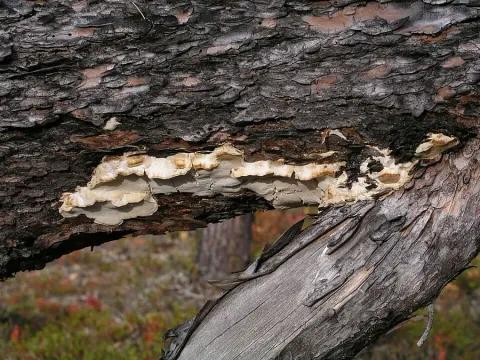
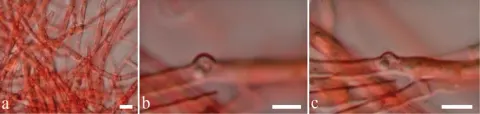
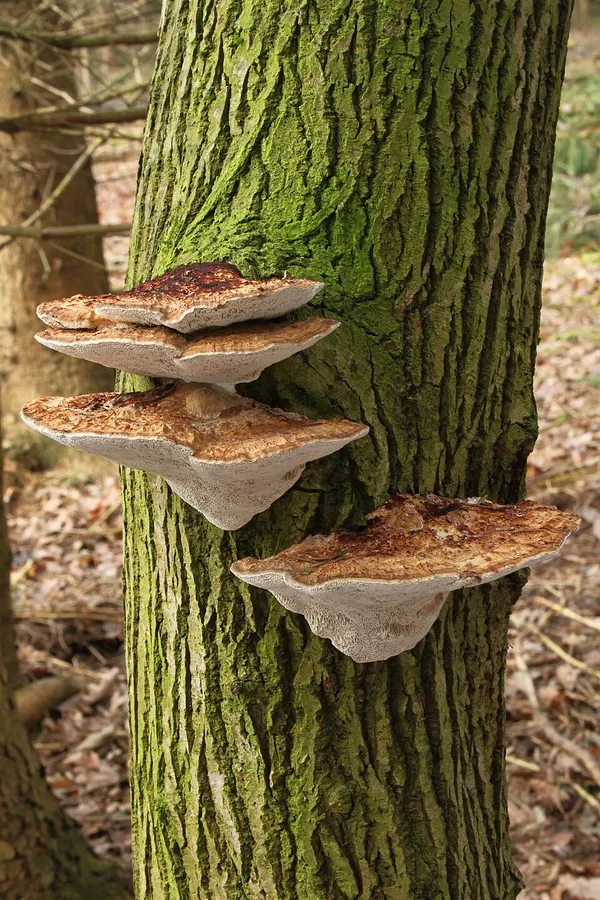
The shelflike or bracketlike fruit body is fan-shaped to semicircular, and typically measures 5–15 cm in diameter, and up to 2 cm thick. Its upper surface is broadly convex to flat, dry, smooth to somewhat hairy, and usually has concentric zone lines. Its color ranges from reddish brown to brown to grayish, sometimes becoming blackish in maturity. The cap surface may have an umbo at the point of attachment to the substrate. Fruit bodies are leathery to corky when moist, but become hard and rigid when dry. The flesh is white to pinkish to brownish and tough. The underside of the fruit bodies features tiny pores measuring about 0.5–1.5 mm in diameter. They are white to tan to brown, but will develop pinkish or reddish tones if bruised. Pore shape is highly variable, ranging from circular to elongated, to mazelike, to gill-like. The tubes are up to 1.5 cm long. The fruit body lacks a stalk, as the shelf attaches directly to the substrate. The fruit bodies have no distinctive odor and a slightly bitter taste. The spore print is white; spores are cylindrical, smooth, and measure 7–11 by 2–3 μm. The basidia (spore-bearing cells) have a shape ranging from cylindrical to club-shaped, and dimensions of 20–40 by 3–5 μm. The hymenium features numerous hyphidia (modified terminal hyphae), which measure 2–3 μm. The hyphal system of Daedaleopsis confragrosa is trimitic, meaning that there are three types of hyphae in the fruit body: skeletal hyphae, which provide structural support, are thick walled, measuring 3–7 μm in diameter; generative hyphae, responsible for new growth, can be either thin- or thick-walled, may contain clamps, and measure 2–6 μm; binding hyphae, thick-walled and much branched, are 2–5 μm.

Sebagian uraian ditampilkan dalam bahasa sumber; terjemahannya belum tersedia atau belum lolos pemeriksaan.

Rujukan: [1]

Pengukuran mengikuti objek, spesimen atau kultur, dan metode yang disebutkan sumber. Baca uraian asli untuk konteks lengkap.

02 / Kehidupan

Habitat dan peran ekologis

Daedaleopsis confragosa adalah jamur lignicolous yang menghasilkan kerusakan sapwood. Hal ini menyebabkan kutu putih, jenis kerusakan kayu di mana lignin terdegradasi dan selulosa tetap sebagai sisa berwarna terang. Tubuh buah tumbuh secara individual atau dalam kelompok, kadang-kadang bertingkat, di luka-luka pohon hidup. Tuan rumah yang disukai adalah willow, tetapi juga telah ditemukan pada birch dan kayu keras lainnya. Fruiting usually terjadi dari June to Desember, tetapi rak keras dapat bertahan sepanjang tahun. Di Amerika Utara, spesies ini paling umum di daerah timur, tetapi jarang di wilayah barat. It is common in Europe, and is one of the 100 most common fungi in the United Kingdom. European rangenya membentang ke timur ke Ural. Dalam Asia it banyak didistribusikan, karena telah direkam dari Cina, Maharashtra barat (India), Iran, dan Jepang. Tubuh buah ini populer di antara kumbang yang menyukai jamur. Pada Russian study, 54 spesies dari keluarga 16 di Coleoptera complex tercatat menggunakan jamur; yang paling umum adalah Cis comptus, Sillcacis affinis (Ciidae), Tritoma subbasalis, Dacne bipustulata (Erotylidae), Mycetophagus multipunctatus, M. piceus (Mycetophagidae), dan Thymalus oblongus (Trogossitidae).

Sebagian uraian ditampilkan dalam bahasa sumber; terjemahannya belum tersedia atau belum lolos pemeriksaan.

Rujukan: [1]

Habitat atau konteks temuan
Informasi belum tersedia pada sumber rilis ini.
Substrat
Informasi belum tersedia pada sumber rilis ini.
Peran atau konteks
Pengurai
Temukan hubungan serupa
03 / Siklus hidup

Reproduksi

The spore print is white; spores are cylindrical, smooth, and measure 7–11 by 2–3 μm. The basidia (spore-bearing cells) have a shape ranging from cylindrical to club-shaped, and dimensions of 20–40 by 3–5 μm. The hymenium features numerous hyphidia (modified terminal hyphae), which measure 2–3 μm. The hyphal system of Daedaleopsis confragrosa is trimitic, meaning that there are three types of hyphae in the fruit body: skeletal hyphae, which provide structural support, are thick walled, measuring 3–7 μm in diameter; generative hyphae, responsible for new growth, can be either thin- or thick-walled, may contain clamps, and measure 2–6 μm; binding hyphae, thick-walled and much branched, are 2–5 μm.

Sebagian uraian ditampilkan dalam bahasa sumber; terjemahannya belum tersedia atau belum lolos pemeriksaan.

Rujukan: [1]

Sinonim menurut acuan taksonomi rilis: Amauroderma confragosum; Boletus angustatus; Boletus confragosus; Daedalea angustata; Daedalea candicans; Daedalea confragosa; Daedalea confragosa f. anceps; Daedalea confragosa f. rubescens; Daedalea confragosa subsp. angustata; Daedalea confragosa var. anceps; Daedalea confragosa var. angustata; Daedalea intermedia; Daedalea rubescens; Daedalea rubescens var. anceps; Daedaleopsis confragosa f. sibirica; Daedaleopsis rubescens; Ischnoderma confragosum; Lenzites confragosus; Lenzites sibiricus; Lenzites sibiricus var. unizonatus; Lenzites tricolor var. rubescens; Polyporus confragosus; Polyporus rubescens; Striglia confragosa; Striglia intermedia; Trametes confragosa; Trametes confragosa f. rubescens; Trametes rubescens
04 / Batas informasi

Catatan identitas dan cakupan

  • Nama diterima mengikuti Catalogue of Life Base2026-09-11; uraian mempertahankan konsep dan nama sumber aslinya.
  • Original geographic, specimen and life-cycle scope retained; source import awaits individual editorial review.
  • Impor dan terjemahan otomatis belum diperiksa editorial per profil. Struktur reproduktif yang disebutkan tidak membuktikan seluruh siklus hidup diketahui.
  • Pengukuran pada uraian mengikuti spesimen, kultur, dan metode sumber; angka tidak diperluas ke semua populasi.

Catatan distribusi dalam narasi mengikuti sumbernya. Dokumentasi spesimen atau foto mengikuti catatan sumber. Bukti wilayah Indonesia dan penilaian konservasi tidak disimpulkan dari gambar.

05 / Dokumentasi

Melihat dengan konteks

Dokumentasi Daedaleopsis confragosa dari Wikimedia Commons. Thin Walled Maze Polypore or Blushing Bracket, Daedaleopsis confragosa , Family: Polyporaceae, Location: Germany, Erbach, Ringingen Identifikasi mengikuti record berkas sumber.

Jenis
Fotografi
Kredit
Holger Krisp
Lisensi
CC BY 3.0
Sumber media
Buka entri sumber

Gambar menunjukkan objek menurut identifikasi sumber, bukan verifikasi independen spesimen oleh Fungi. Tidak ada skala baru yang ditambahkan.

06 / Rujukan

Sumber profil

  1. [1] Daedaleopsis confragosa — Wikipedia (en)Bagian sumber: Frozen revision 1374422412
    Tanggal penghimpunan sumber: 2026-10-12
    Teks sumber: CC BY-SA4.0 · Wikipedia contributors
  2. [2] Catalogue of Life Base2026-09-11 — Daedaleopsis confragosaBagian sumber: ColDP NameUsage.tsv ID 33XZ2; accepted species; source 2073
    Tanggal penghimpunan sumber: 2026-10-12
  3. [3] Dokumentasi visual — Daedaleopsis confragosaBagian sumber: Individual media record; identification follows the source, not independent determination
    Tanggal penghimpunan sumber: 2026-10-12
    Media sumber: CC BY 3.0 · Holger Krisp

Adaptasi teks: CC BY-SA 4.0. Wikipedia contributors — Daedaleopsis confragosa — Wikipedia (en)

Uraian asli dan riwayat sumber

Riwayat atau halaman sumber

Ringkasan sumber

The shelflike or bracketlike fruit body is fan-shaped to semicircular, and typically measures 5–15 cm in diameter, and up to 2 cm thick. Its upper surface is broadly convex to flat, dry, smooth to somewhat hairy, and usually has concentric zone lines. Its color ranges from reddish brown to brown to grayish, sometimes becoming blackish in maturity. The cap surface may have an umbo at the point of attachment to the substrate. Fruit bodies are leathery to corky when moist, but become hard and rigid when dry.

Revisi sumber

Morfologi sumber

The shelflike or bracketlike fruit body is fan-shaped to semicircular, and typically measures 5–15 cm in diameter, and up to 2 cm thick. Its upper surface is broadly convex to flat, dry, smooth to somewhat hairy, and usually has concentric zone lines. Its color ranges from reddish brown to brown to grayish, sometimes becoming blackish in maturity. The cap surface may have an umbo at the point of attachment to the substrate. Fruit bodies are leathery to corky when moist, but become hard and rigid when dry. The flesh is white to pinkish to brownish and tough. The underside of the fruit bodies features tiny pores measuring about 0.5–1.5 mm in diameter. They are white to tan to brown, but will develop pinkish or reddish tones if bruised. Pore shape is highly variable, ranging from circular to elongated, to mazelike, to gill-like. The tubes are up to 1.5 cm long. The fruit body lacks a stalk, as the shelf attaches directly to the substrate. The fruit bodies have no distinctive odor and a slightly bitter taste. The spore print is white; spores are cylindrical, smooth, and measure 7–11 by 2–3 μm. The basidia (spore-bearing cells) have a shape ranging from cylindrical to club-shaped, and dimensions of 20–40 by 3–5 μm. The hymenium features numerous hyphidia (modified terminal hyphae), which measure 2–3 μm. The hyphal system of Daedaleopsis confragrosa is trimitic, meaning that there are three types of hyphae in the fruit body: skeletal hyphae, which provide structural support, are thick walled, measuring 3–7 μm in diameter; generative hyphae, responsible for new growth, can be either thin- or thick-walled, may contain clamps, and measure 2–6 μm; binding hyphae, thick-walled and much branched, are 2–5 μm.

Revisi sumber

Ekologi sumber

Daedaleopsis confragosa is a lignicolous fungus that produces a decay of sapwood. It causes white rot, a type of wood decay in which lignin is degraded and cellulose remains as a light-colored residue. The fruit bodies grow singly or in groups, sometimes in tiers, in the wounds of living trees. Its preferred host is willow, but it has also been found on birch and other hardwoods. Fruiting usually occurs from June to December, but the hard shelves can persist year-round. In North America, the species is most common in eastern locales, but rare in western regions. It is common in Europe, and is one of the 100 most common fungi in the United Kingdom. Its European range extends east to the Urals. In Asia it is widely distributed, having been recorded from China, western Maharashtra (India), Iran, and Japan. The fruit bodies are popular among fungus-loving beetles. In a Russian study, 54 species from 16 families in the Coleoptera complex were recorded using the fungus; the most common were Cis comptus, Sillcacis affinis (Ciidae), Tritoma subbasalis, Dacne bipustulata (Erotylidae), Mycetophagus multipunctatus, M. piceus (Mycetophagidae), and Thymalus oblongus (Trogossitidae).

Revisi sumber

Struktur reproduksi sumber

The spore print is white; spores are cylindrical, smooth, and measure 7–11 by 2–3 μm. The basidia (spore-bearing cells) have a shape ranging from cylindrical to club-shaped, and dimensions of 20–40 by 3–5 μm. The hymenium features numerous hyphidia (modified terminal hyphae), which measure 2–3 μm. The hyphal system of Daedaleopsis confragrosa is trimitic, meaning that there are three types of hyphae in the fruit body: skeletal hyphae, which provide structural support, are thick walled, measuring 3–7 μm in diameter; generative hyphae, responsible for new growth, can be either thin- or thick-walled, may contain clamps, and measure 2–6 μm; binding hyphae, thick-walled and much branched, are 2–5 μm.

Revisi sumber

Rujukan halaman ini

Fungi. Daedaleopsis confragosa. Rilis data fungi-2026-10-12-expansion-2. https://fungi-atlas.mgadib.chatgpt.site/jamur/daedaleopsis-confragosa/.

Status: impor sumber; pemeriksaan editorial per profil belum selesai. Untuk klaim biologis, gunakan rujukan pada bagian terkait dan periksa konteks sumber aslinya.