Ciri dan struktur
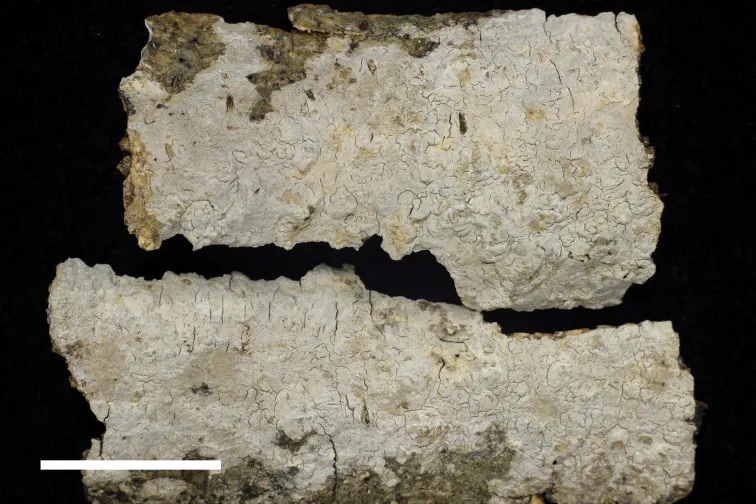
The noteworthy features of Dendrocorticiopsis orientalis are: (1) subiculum composed of a basal layer, with compact texture; (2) oily materials usually present in hymenial layer; (3) cystidia with resinous materials at apices; (4) shortly clavate to subclavate basidia; (5) ellipsoid to ovoid basidiospores measuring 5–7 × 3.2–5.2 μm. Basidiomata annual, resupinate, effused, adnate, membranaceous, 50–100 μm thick in section. Hymenial surface brownish ivory, grayish ivory to lilac ivory, smooth, finely cracked; margin concolourous, slightly pruinose, rather determinate. Hyphal system monomitic; generative hyphae nodose-septate. Subiculum fairly uniform, composed of a basal layer, with fairly compact texture, usually with crystal masses; up to 30 μm thick, sometimes indistinct; hyphae mainly horizontal, colorless, fairly straight, 3–4 μm diam, with walls slightly thickened up to 1 μm. Hymenial layer thickening, with more or less compact texture, usually with oily materials, 50–70 μm thick; hyphae more or less vertical, colorless, 2–4 μm diam, with walls slightly thickened up to 1 μm. Dendrohyphidia numerous, 12–28 × 2–3 μm, thick-walled toward base, with walls up to 1 μm thick, colorless. Cystidia clavate, apically with resinous materials, gradually dissolving in KOH, 10–20 × 3.5–5.5 μm, slightly thick-walled, or thickening toward base, with walls up to 1 μm thick. Basidia clavate to subclavate, usually broadened at basal or middle parts, 18–35 × 5–7 μm, 4-sterigmata, thickening toward base, with walls up to 1 μm thick. Basidiospores ellipsoid to ovoid, or broadly ellipsoid, smooth, colorless, with homogenous contents, thin-walled or occasionally slightly thick-walled, negative in Melzer’s reagent, acyanophilous, mostly 5–7 × 3.2–5.2 μm. (5.5)6–7(7.5) × 4.2–5.2(5.5) μm, L = 6.50±0.42 μm, W = 4.66±0.32 μm, Q = 1.40 (n = 30) (holotype, WEI 20-166). (5.7)6.2–7(7.5) × (4.2)4.5–5(5.2) μm, L = 6.61±0.43 μm, W = 4.77±0.25 μm, Q = 1.39 (n = 30) (WEI 20-173). (4.2)5–6.8(7) × (3)3.2–5(5.2) μm, L = 5.8 μm, W = 4.2 μm, Q = 1.38 (He 4195).
Habitat dan peran ekologis
On dead angiosperm wood (e.g., Acacia and Castanopsis), occurring in August. In subtropical regions, known from China: Jiangxi and Taiwan.
- Habitat atau konteks temuan
- Informasi belum tersedia pada sumber rilis ini.
- Substrat
- Informasi belum tersedia pada sumber rilis ini.
- Peran atau konteks
- Belum dikategorikan pada rilis ini.
Reproduksi
The noteworthy features of Dendrocorticiopsis orientalis are: (1) subiculum composed of a basal layer, with compact texture; (2) oily materials usually present in hymenial layer; (3) cystidia with resinous materials at apices; (4) shortly clavate to subclavate basidia; (5) ellipsoid to ovoid basidiospores measuring 5–7 × 3.2–5.2 μm. Basidiomata annual, resupinate, effused, adnate, membranaceous, 50–100 μm thick in section. Hymenial surface brownish ivory, grayish ivory to lilac ivory, smooth, finely cracked; margin concolourous, slightly pruinose, rather determinate. Hyphal system monomitic; generative hyphae nodose-septate. Subiculum fairly uniform, composed of a basal layer, with fairly compact texture, usually with crystal masses; up to 30 μm thick, sometimes indistinct; hyphae mainly horizontal, colorless, fairly straight, 3–4 μm diam, with walls slightly thickened up to 1 μm.
Catatan identitas dan cakupan
- Nama diterima mengikuti Catalogue of Life Base2026-09-11; uraian mempertahankan konsep dan nama sumber aslinya.
- Preserve original treatment localities, hosts and substrate scope. Materials examined describe documented specimens, not the full global range.
- Impor dan terjemahan otomatis belum diperiksa editorial per profil. Struktur reproduktif yang disebutkan tidak membuktikan seluruh siklus hidup diketahui.
- Pengukuran pada uraian mengikuti spesimen, kultur, dan metode sumber; angka tidak diperluas ke semua populasi.
Catatan distribusi dalam narasi mengikuti sumbernya. Dokumentasi spesimen atau foto mengikuti catatan sumber. Bukti wilayah Indonesia dan penilaian konservasi tidak disimpulkan dari gambar.
Melihat dengan konteks
Basidiomata of Dendrocorticiopsis orientalis (holotype, WEI 20-166). Scale bar: 1 cm.
- Jenis
- Pelat ilmiah
- Kredit
- Chia-Ling Wei, Che-Chih Chen, Shuang-Hui He, Sheng-Hua Wu
- Lisensi
- CC BY 4.0
- Sumber media
- Buka entri sumber
Dokumentasi tambahan
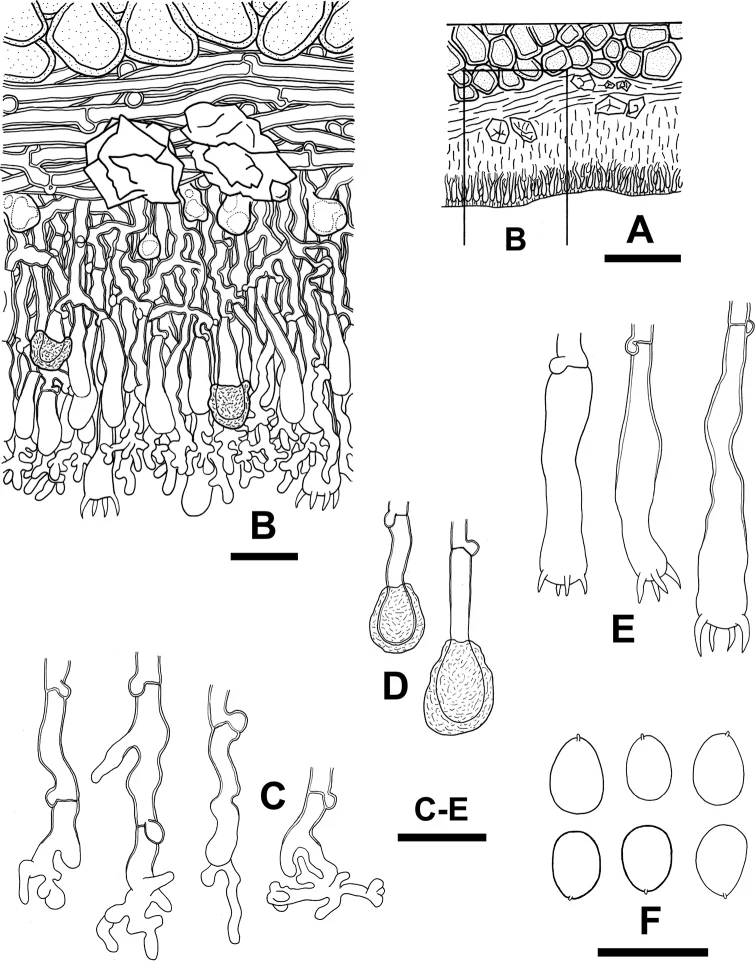
Micromorphological features of Dendrocorticiopsis orientalis (holotype, WEI 20-166) A profile of basidioma section B basidioma section C dendrohyphidia D cystidia E basidia F basidiospores. Scale bars: 50 μm (A); 10 μm (B–F).
Kredit dan penggunaan
Chia-Ling Wei, Che-Chih Chen, Shuang-Hui He, Sheng-Hua Wu
Ukuran dan format gambar disesuaikan tanpa pemotongan, retus, atau penambahan skala. Lisensi sumber dipertahankan.
Sumber profil
- [1] Dendrocorticiopsis orientalis gen. et sp. nov. of the Punctulariaceae (Corticiales, Basidiomycota) revealed by molecular data — Dendrocorticiopsis orientalis
- [2] Catalogue of Life Base2026-09-11 — Dendrocorticiopsis orientalis
- [3] Dokumentasi visual — Dendrocorticiopsis orientalis
- [4] Dokumentasi visual — Dendrocorticiopsis orientalis
Rujukan halaman ini
Fungi. Dendrocorticiopsis orientalis. Rilis data fungi-2026-10-12-expansion-2. https://fungi-atlas.mgadib.chatgpt.site/jamur/dendrocorticiopsis-orientalis/.
Status: impor sumber; pemeriksaan editorial per profil belum selesai. Untuk klaim biologis, gunakan rujukan pada bagian terkait dan periksa konteks sumber aslinya.