Ciri dan struktur
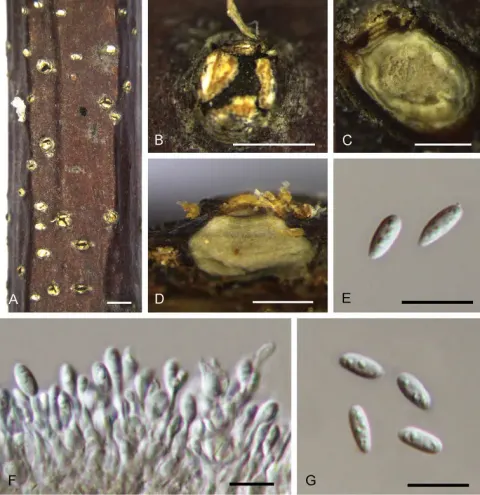
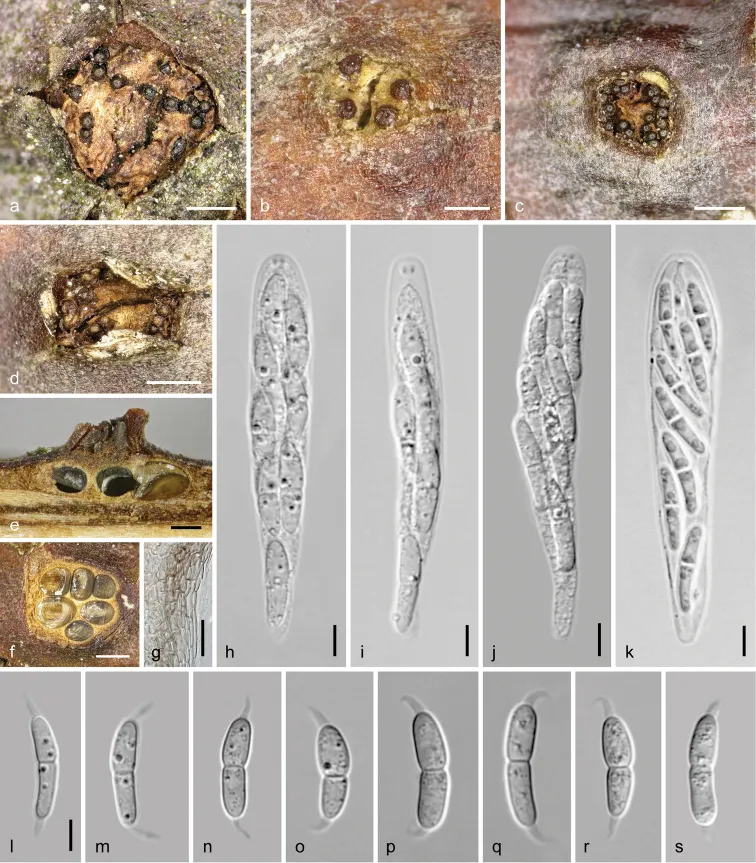
Dendrostoma castaneum is recognized by KOH+ purple ostioles, slender ascospores with small drops and subfusiform conidia, and the presence of hyphal conidiophores. Sexual morph: pseudostromata 0.8–3(–5) mm in their widest dimension in cross section, very variable, flat subconical or lenticular, in outline circular, elliptic or elongate, scattered, gregarious or confluent, and forming elongate patches, lifting the periderm slightly and often becoming visible as a dark zone on the bark surface, causing bumps in bark, splitting the periderm. Ectostromatic discs 0.3–2.7 mm in their widest dimension, often ill-defined and variable, cream, yellowish brown to dark brown, flat, surrounded by bark flaps, first present as a covering layer with ostiolar necks subsequently bursting through it, soon crumbling away. Ostioles 1–25 per disc, usually arising eccentrically from the perithecial venter, (53–)71–125(–180) µm (n = 51) in diameter, bluntly conical or cylindrical with black sides and red, yellowish, or greenish tip, often attenuated to a minute, ca 20–40 µm wide dark centre, in section rounded to angular, sometimes sulcate, variably arranged in the disc, projecting to 0.2 mm, periphysate; red colour of the ostiolar tip turning purple in 3% KOH and yellow in lactic acid. Entostroma yellowish to shades of brown, consisting of bark cells and hyaline to yellowish, 1.5–4.5 wide, thin-walled hyphae becoming thicker-walled and forming a pseudoparenchyma in the vicinity of perithecia. Perithecia tightly aggregated, (265–)305–460(–600) µm (n = 47) in diameter, depressed subglobose to ellipsoid, collapsing upward; peridium ca 10–30 µm thick, hyaline, pale olivaceous to brown, in section outside of brown isodiametric to strongly compressed thick-walled cells, inside of compressed and elongated hyaline to brownish cells, in combination (3–)4–15(–28) µm (n = 57) in diameter.
Habitat dan peran ekologis
Sizes of pseudostromata and acervuli strongly depend on twig thickness. Remarkably, red colour of the ostiolar tip, when present, turns purple in 3% KOH and yellow in lactic acid, a feature, which is typical of the Hypocreales and within the Diaporthales otherwise only found in the Cryphonectriaceae. So far, confirmed records of D. castaneum are only known from Europe where the species is widely co-occurring with its host, Castanea sativa. Kobayashi (1970) reported and illustrated D. castaneum (as Cryptodiaporthe castanea) from Castanea crenata and C. mollissima in Japan. However, it is unlikely that these collections are conspecific with the European D. castaneum, considering their different spore shape and hosts. The 1 or 2 large guttules per ascospore cell and the ascospore appendages illustrated in Kobayashi (1970: fig. 32) are similar to D. atlanticum rather than to D. castaneum. Remarkably, he also reported and illustrated dimorphic conidia for the Japanese collections, which we also observed in D. atlanticum. Considering hosts and distribution, the Japanese collections likely represent one of the species described by Jiang et al. (2019) or an undescribed species.
- Habitat atau konteks temuan
- Informasi belum tersedia pada sumber rilis ini.
- Substrat
- Informasi belum tersedia pada sumber rilis ini.
- Peran atau konteks
- Belum dikategorikan pada rilis ini.
Reproduksi
Dendrostoma castaneum is recognized by KOH+ purple ostioles, slender ascospores with small drops and subfusiform conidia, and the presence of hyphal conidiophores. Sexual morph: pseudostromata 0.8–3(–5) mm in their widest dimension in cross section, very variable, flat subconical or lenticular, in outline circular, elliptic or elongate, scattered, gregarious or confluent, and forming elongate patches, lifting the periderm slightly and often becoming visible as a dark zone on the bark surface, causing bumps in bark, splitting the periderm. Ectostromatic discs 0.3–2.7 mm in their widest dimension, often ill-defined and variable, cream, yellowish brown to dark brown, flat, surrounded by bark flaps, first present as a covering layer with ostiolar necks subsequently bursting through it, soon crumbling away.
Catatan identitas dan cakupan
- Nama diterima mengikuti Catalogue of Life Base2026-09-11; uraian mempertahankan konsep dan nama sumber aslinya.
- Preserve original treatment localities, hosts and substrate scope. Materials examined describe documented specimens, not the full global range.
- Impor dan terjemahan otomatis belum diperiksa editorial per profil. Struktur reproduktif yang disebutkan tidak membuktikan seluruh siklus hidup diketahui.
- Pengukuran pada uraian mengikuti spesimen, kultur, dan metode sumber; angka tidak diperluas ke semua populasi.
Catatan distribusi dalam narasi mengikuti sumbernya. Dokumentasi spesimen atau foto mengikuti catatan sumber. Bukti wilayah Indonesia dan penilaian konservasi tidak disimpulkan dari gambar.
Melihat dengan konteks
Dendrostoma castaneum. Sexual morph a–d ectostromatic discs and ostioles (in a ostioles breaking through covering layer) e pseudostroma in vertical section f pseudostroma in cross section g peridium in section (in 3% KOH) h–k asci l–s ascospores a, c–g, j, k, s WU 37030 = D230 b, n–r WU 37026 h, i, l, m WU 37028 = D192. Scale bars: 500 mm (a, c, d, f), 200 µm (b, e), 20 µm (g), 5 µm (h–s).
- Jenis
- Pelat ilmiah
- Kredit
- Walter M. Jaklitsch, Hermann Voglmayr
- Lisensi
- CC BY 4.0
- Sumber media
- Buka entri sumber
Dokumentasi tambahan
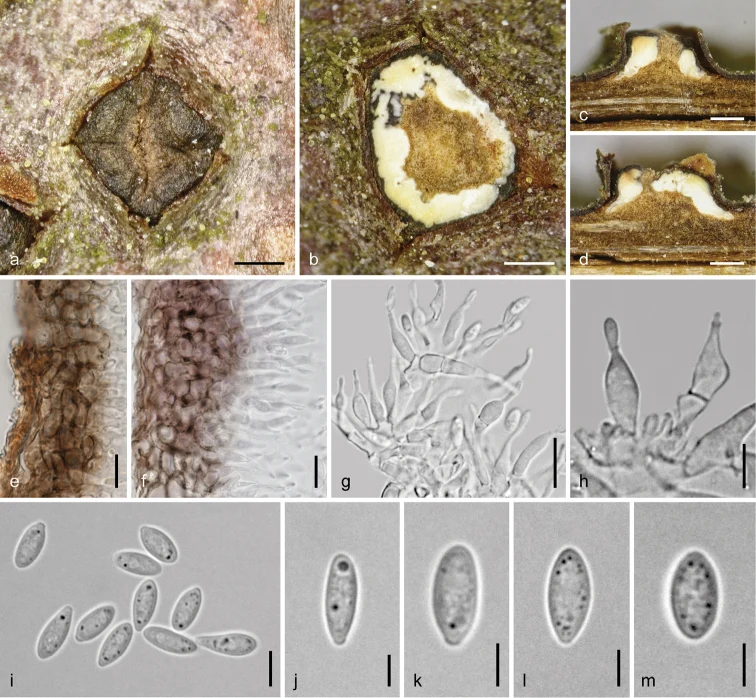
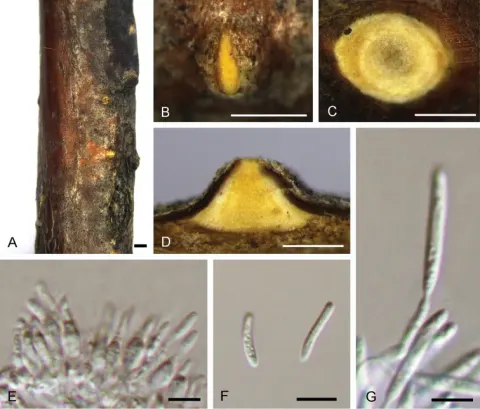
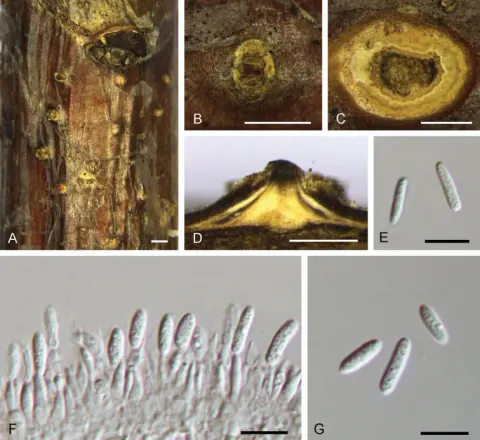
Dendrostoma castaneum (WU 37030 = D230). Asexual morph a conidioma in face view b conidioma in cross section c, d conidiomata in vertical section e outer upper wall of fertile chamber f wall, short conidiophores and phialides (note violaceous tone) g, h phialides and hyphal conidiophores i–m conidia f–m In 3% KOH. Scale bars: 300 µm (a–d), 10 µm (e–g), 5 µm (h, i), 3 µm (j–m).
Kredit dan penggunaan
Walter M. Jaklitsch, Hermann Voglmayr
Ukuran dan format gambar disesuaikan tanpa pemotongan, retus, atau penambahan skala. Lisensi sumber dipertahankan.
Sumber profil
- [1] European species of Dendrostoma (Diaporthales) — Dendrostoma castaneum
- [2] Catalogue of Life Base2026-09-11 — Dendrostoma castaneum
- [3] Dokumentasi visual — Dendrostoma castaneum
- [4] Dokumentasi visual — Dendrostoma castaneum
Rujukan halaman ini
Fungi. Dendrostoma castaneum. Rilis data fungi-2026-10-12-expansion-2. https://fungi-atlas.mgadib.chatgpt.site/jamur/dendrostoma-castaneum/.
Status: impor sumber; pemeriksaan editorial per profil belum selesai. Untuk klaim biologis, gunakan rujukan pada bagian terkait dan periksa konteks sumber aslinya.