Ciri dan struktur
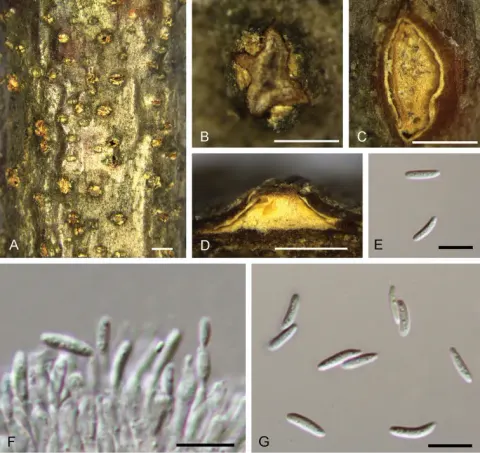
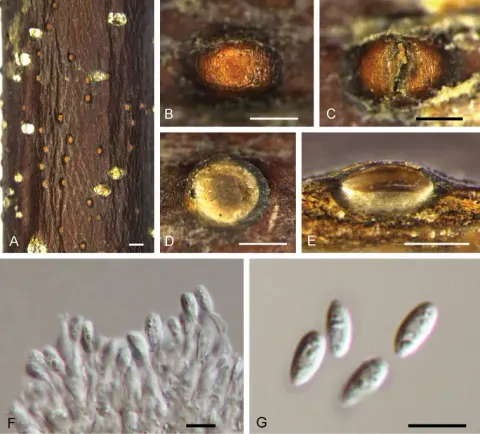
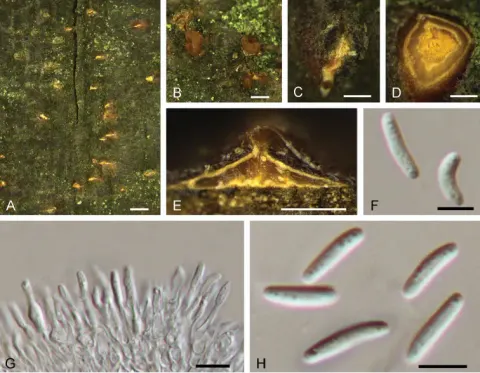
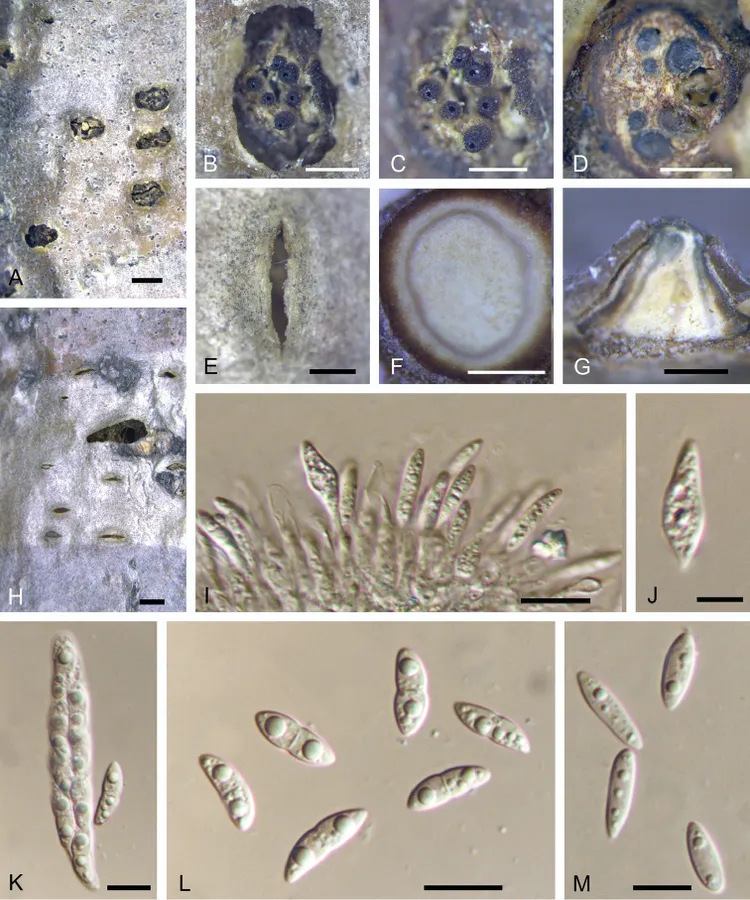
Dendrostoma quercus is recognised by the existence of dimorphic conidia, which is unique in the genus. Sexual morph: Pseudostromata erumpent, consisting of an inconspicuous ectostromatic disc, semi-immersed to superficial, causing a pustulate bark surface, 1000–1500 µm diam. Ectostromatic disc flat or concave, pale brown to brown, sometimes concealed by ostioles, surrounded by bark flaps, 400–800 µm diam.; central column yellowish to brownish. Stromatic zones lacking. Perithecia conspicuous, umber to fuscous black, 350–500 µm diam. Ostioles 5–8 per disc, flat in the disc or sometimes slightly projecting, cylindrical, covered by an orange, umber to fuscous black crust, 60–80 µm diam. Paraphyses slightly deliquescent. Asci fusoid to slightly fusiform, 8-spored, ascospores regularly disposed, with an apical ring, 55–65 × 8–11 µm. Ascospores hyaline, fusoid to cylindrical, smooth, often containing one guttule per cell to multiguttulate, symmetrical to asymmetrical, straight curved, bicellular, (13.4–)13.8–15.6(–16.6) × (5.1–)5.3–5.8(–5.9) μm, l/w = (2.4–)2.5–2.8(–2.9) (n = 50). Asexual morph: Conidiomata pycnidial, conical, occurring separately, pale yellow, semi-immersed in bark, 700–1000 μm high, 700–950 μm diam.; wall of several layers of pale yellow textura angularis; central column beneath the disc conical, yellow. Conidiophores reduced to conidiogenous cells. Conidiogenous cells lining the inner walls of the cavity, hyaline, smooth, subcylindrical to ampulliform, 4.5–9 × 2–4 μm. Conidia hyaline, aseptate, smooth, multiguttulate, thin-walled, dimorphic, type one (> 99%) ellipsoid to fusoid, straight to curved, (11–)13.3–16.1(–16.9) × (3.4–)3.5–4.2(–4.5) μm, l/w = (2.6–)3.3–4.4(–4.9) (n = 50); type two (< 1%) fusoid, apex acutely rounded, 13–16 × 4–6 μm.
Habitat dan peran ekologis
On PDA, cultures are initially white, becoming dark grey after 2 weeks. The colonies are flat with irregular edge; texture uniform, producing concentric circles with sparse conidiomata irregularly distributed within 1 month at 25 °C in the dark.
- Habitat atau konteks temuan
- kultur yang didokumentasikan
- Substrat
- Informasi belum tersedia pada sumber rilis ini.
- Peran atau konteks
- Belum dikategorikan pada rilis ini.
Reproduksi
Dendrostoma quercus is recognised by the existence of dimorphic conidia, which is unique in the genus. Sexual morph: Pseudostromata erumpent, consisting of an inconspicuous ectostromatic disc, semi-immersed to superficial, causing a pustulate bark surface, 1000–1500 µm diam. Ectostromatic disc flat or concave, pale brown to brown, sometimes concealed by ostioles, surrounded by bark flaps, 400–800 µm diam.; central column yellowish to brownish. Stromatic zones lacking. Perithecia conspicuous, umber to fuscous black, 350–500 µm diam. Ostioles 5–8 per disc, flat in the disc or sometimes slightly projecting, cylindrical, covered by an orange, umber to fuscous black crust, 60–80 µm diam. Paraphyses slightly deliquescent.
Catatan identitas dan cakupan
- Nama diterima mengikuti Catalogue of Life Base2026-09-11; uraian mempertahankan konsep dan nama sumber aslinya.
- Preserve original treatment localities, hosts and substrate scope. Materials examined describe documented specimens, not the full global range.
- Impor dan terjemahan otomatis belum diperiksa editorial per profil. Struktur reproduktif yang disebutkan tidak membuktikan seluruh siklus hidup diketahui.
- Pengukuran pada uraian mengikuti spesimen, kultur, dan metode sumber; angka tidak diperluas ke semua populasi.
Catatan distribusi dalam narasi mengikuti sumbernya. Dokumentasi spesimen atau foto mengikuti catatan sumber. Bukti wilayah Indonesia dan penilaian konservasi tidak disimpulkan dari gambar.
Melihat dengan konteks
Morphology of Dendrostoma quercus from Quercus sp. (BJFC -S1547). A–C Habit of psedostromata on branches D Transverse section of pseudostroma E, H Habit of conidiomata on branches F Transverse section of conidioma G Longitudinal section through conidioma I Conidiogenous cells producing dimorphic conidia J Secondary conidia K Asci and ascospores L Ascospores M Primary conidia. Scale bars: 1 mm (A, H); 0.5 mm (B–G); 10 μm (I, K–M); 5 μm (J).
- Jenis
- Pelat ilmiah
- Kredit
- Ning Jiang, Xin-Lei Fan, Pedro W. Crous, Cheng-Ming Tian
- Lisensi
- CC BY 4.0
- Sumber media
- Buka entri sumber
Sumber profil
- [1] Species of Dendrostoma (Erythrogloeaceae, Diaporthales) associated with chestnut and oak canker diseases in China — Dendrostoma quercus
- [2] Catalogue of Life Base2026-09-11 — Dendrostoma quercus
- [3] Dokumentasi visual — Dendrostoma quercus
Rujukan halaman ini
Fungi. Dendrostoma quercus. Rilis data fungi-2026-10-12-expansion-2. https://fungi-atlas.mgadib.chatgpt.site/jamur/dendrostoma-quercus/.
Status: impor sumber; pemeriksaan editorial per profil belum selesai. Untuk klaim biologis, gunakan rujukan pada bagian terkait dan periksa konteks sumber aslinya.