Ciri dan struktur
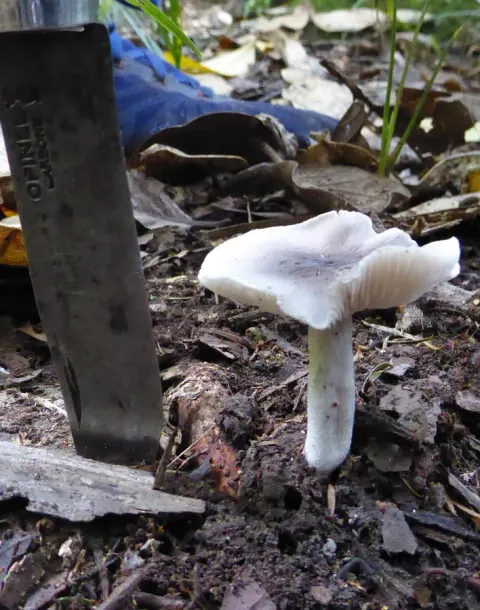
European species; basidiomata small, mycenoid; pilei 8–22 mm in diameter; stipes 1–2 mm wide; lamellae ash-gray; spores amyloid, ellipsoid to oblong, 5.8–6.7 × 3.7–4.4 μm; caulocystidia narrowly clavate or narrowly fusiform, 4–6 μm wide. Pileus 8–22 mm; when young conical-campanulate, when mature plano-convex with broad, rounded umbo; margin shortly enrolled, entire to slightly crenulate; surface matt, rugulose, densely minutely wrinkled, strongly hygrophanous; color when young or wet very dark gray-brown to almost black, when mature fading to dull ochre-gray with some lilac shade at center. Stipe 15–35 × 1–2 mm; cylindrical, flexuous to undulate-bumped; surface densely pruinose when young, remaining pruinose only at apex when mature; color blackish gray all over, with age fading to ochraceous gray-brown from apex towards the base. Lamellae distant, L = 12–16, l = 1–3; adnate-emarginate; color ash-gray, when mature rather lighter yellowish ochre; edges truncate, concolorous, entire. Context whitish to somewhat flesh-colored in pileus, gray-brown in stipe; odor farinaceous. Spores (5.5–)5.8–6.2–6.7(–7.8) × (3.4–)3.7–4–4.4(–4.8) μm; ellipsoid to oblong, Q = (1.34–)1.41–1.55–1.69(–1.86); walls amyloid; hilar appendage ca. 0.5–1 μm long. Basidia (21–)25–28.7–32(–40) × 6–6.5–7.5 μm; clavate; with 2 or 4 sterigmata. Basidioles first cylindrical, then clavate, ca. 4–6.5 μm wide. Marginal cells (17–)20–24.7–29.5(–40) × (3–)3.5–4.8–6(–7) μm; clavate, cylindrical or fusiform, often flexuous, occasionally moniliform, sometimes diverticulate or nodulose, apically obtuse or constricted.
Habitat dan peran ekologis
This species is only known from the type collecting area in Swiss Alps; probably restricted to alpine habitats, but insufficiently known.
- Habitat atau konteks temuan
- Informasi belum tersedia pada sumber rilis ini.
- Substrat
- Informasi belum tersedia pada sumber rilis ini.
- Peran atau konteks
- Belum dikategorikan pada rilis ini.
Reproduksi
European species; basidiomata small, mycenoid; pilei 8–22 mm in diameter; stipes 1–2 mm wide; lamellae ash-gray; spores amyloid, ellipsoid to oblong, 5.8–6.7 × 3.7–4.4 μm; caulocystidia narrowly clavate or narrowly fusiform, 4–6 μm wide. Pileus 8–22 mm; when young conical-campanulate, when mature plano-convex with broad, rounded umbo; margin shortly enrolled, entire to slightly crenulate; surface matt, rugulose, densely minutely wrinkled, strongly hygrophanous; color when young or wet very dark gray-brown to almost black, when mature fading to dull ochre-gray with some lilac shade at center. Stipe 15–35 × 1–2 mm; cylindrical, flexuous to undulate-bumped; surface densely pruinose when young, remaining pruinose only at apex when mature; color blackish gray all over, with age fading to ochraceous gray-brown from apex towards the base.
Catatan identitas dan cakupan
- Nama diterima mengikuti Catalogue of Life Base2026-09-11; uraian mempertahankan konsep dan nama sumber aslinya.
- Preserve original treatment localities, hosts and substrate scope. Materials examined describe documented specimens, not the full global range.
- Impor dan terjemahan otomatis belum diperiksa editorial per profil. Struktur reproduktif yang disebutkan tidak membuktikan seluruh siklus hidup diketahui.
- Pengukuran pada uraian mengikuti spesimen, kultur, dan metode sumber; angka tidak diperluas ke semua populasi.
Catatan distribusi dalam narasi mengikuti sumbernya. Dokumentasi spesimen atau foto mengikuti catatan sumber. Bukti wilayah Indonesia dan penilaian konservasi tidak disimpulkan dari gambar.
Melihat dengan konteks
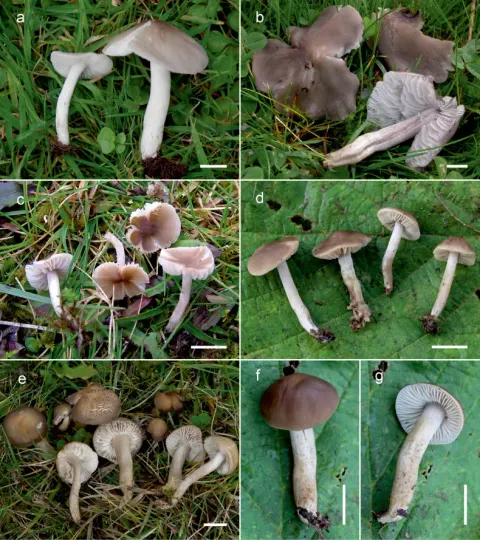
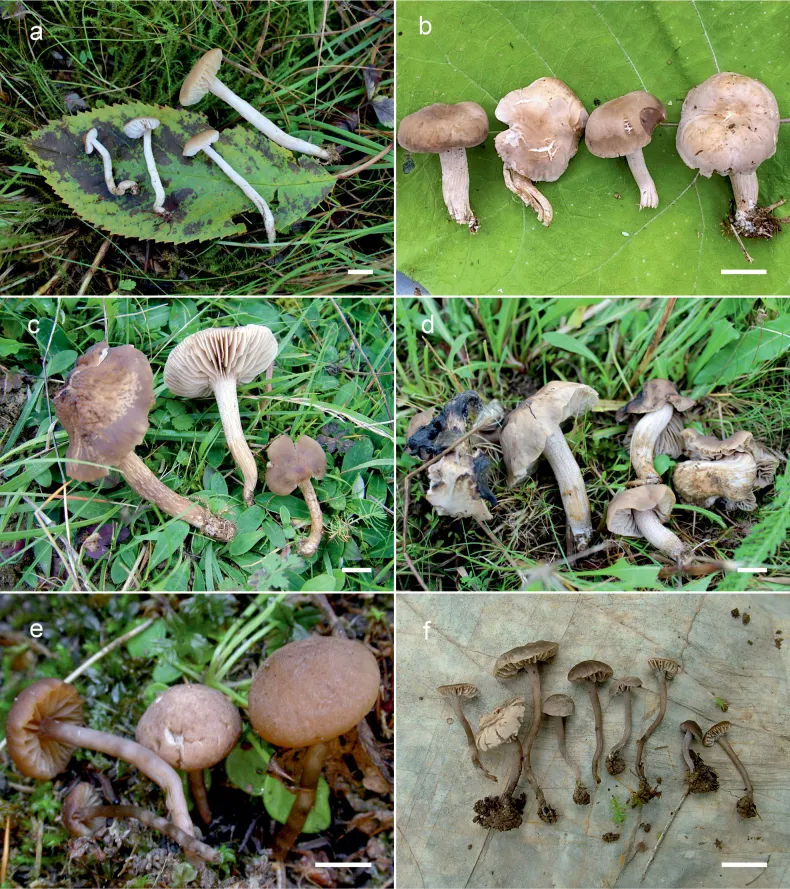
Basidiomata of Dermoloma in field appearance. a Dermoloma josserandii (SAV F-20808, epitype), photo S. Jančovičová; b Dermoloma josserandii (SAV F-20907, epitype), photo V. Shapkin; c Dermoloma magicum (SAV F-4142, epitype), photo S. Jančovičová; d Dermoloma magicum (SAV F-20618), photo S. Jančovičová; e Dermoloma murinellum [LIP (PAM06090203)], photo P.-A. Moreau; f Dermoloma obscurum (SAV F-20012, holotype), photo S. Jančovičová. Scale bar: 10 mm.
- Jenis
- Pelat ilmiah
- Kredit
- Katarína Adamčíková, Munazza Kiran, Miroslav Caboň, Brandon P. Matheny, Marisol Sánchez-García, Eef Arnolds, Michaela Caboňová, Gilles Corriol, Bálint Dima, Gernot Friebes, Gareth W. Griffith, Django Grootmyers, David Harries, Alexander Karich, Armin Mešić, Martin Mihaljevič, Pierre-Arthur Moreau, Ana Pošta, Vasilii Shapkin, Zdenko Tkalčec, Alfredo Vizzini, Lenka Vondrovicová, Slavomir Adamčík, Soňa Jančovičová
- Lisensi
- CC BY 4.0
- Sumber media
- Buka entri sumber
Dokumentasi tambahan
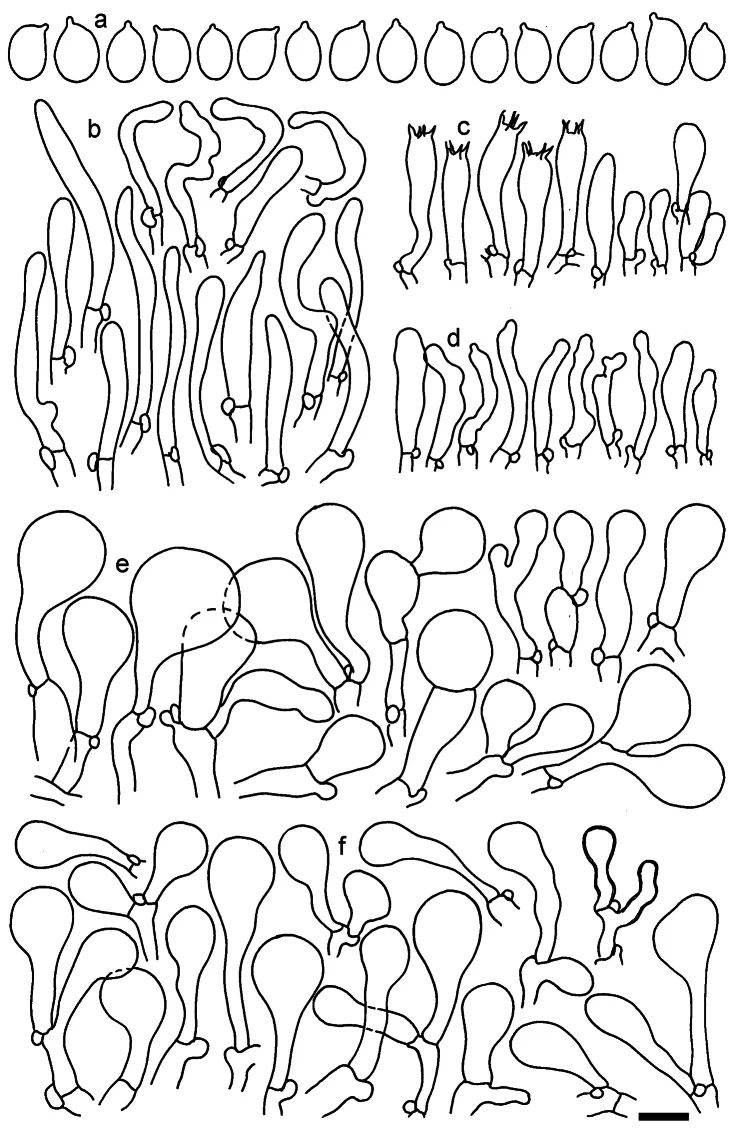
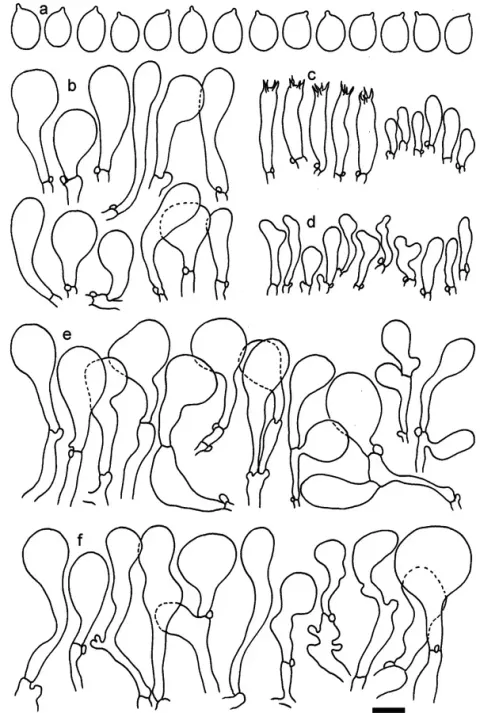
Dermoloma murinellum (ZT Myc 42786, holotype), microscopic elements. a Spores; b caulocystidia; c basidia and basidioles; d marginal cells; e pileipellis elements near the pileus margin; f pileipellis elements near the pileus center. Scale bar: 5 µm for spores and 10 µm for other elements.
Kredit dan penggunaan
Katarína Adamčíková, Munazza Kiran, Miroslav Caboň, Brandon P. Matheny, Marisol Sánchez-García, Eef Arnolds, Michaela Caboňová, Gilles Corriol, Bálint Dima, Gernot Friebes, Gareth W. Griffith, Django Grootmyers, David Harries, Alexander Karich, Armin Mešić, Martin Mihaljevič, Pierre-Arthur Moreau, Ana Pošta, Vasilii Shapkin, Zdenko Tkalčec, Alfredo Vizzini, Lenka Vondrovicová, Slavomir Adamčík, Soňa Jančovičová
Ukuran dan format gambar disesuaikan tanpa pemotongan, retus, atau penambahan skala. Lisensi sumber dipertahankan.
Sumber profil
- [1] A phylogenetic and morphological study of the genus Dermoloma (Agaricales, Tricholomataceae) in Europe and North America exposes inefficiency of opportunistic species descriptions — Dermoloma murinellum
- [2] Catalogue of Life Base2026-09-11 — Dermoloma murinellum
- [3] Dokumentasi visual — Dermoloma murinellum
- [4] Dokumentasi visual — Dermoloma murinellum
Rujukan halaman ini
Fungi. Dermoloma murinellum. Rilis data fungi-2026-10-12-expansion-2. https://fungi-atlas.mgadib.chatgpt.site/jamur/dermoloma-murinellum/.
Status: impor sumber; pemeriksaan editorial per profil belum selesai. Untuk klaim biologis, gunakan rujukan pada bagian terkait dan periksa konteks sumber aslinya.