Ciri dan struktur
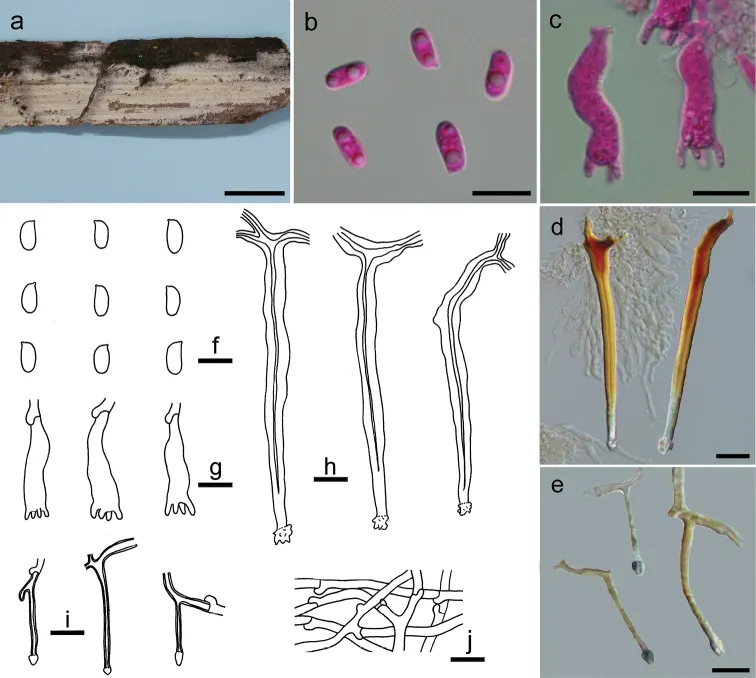
Hyphal system monomitic; generative hyphae with clamp connections, hyaline, thin-walled, frequently branched and septate, loosely interwoven, 2–3 µm in diam. Cystidia-like branches present, branched from subicular hyphae, embedded, hyaline, thick-walled, encrusted at apex, 20–30 × 1.5–2 µm. Hymenial cystidia abundant, subulate, projecting beyond hymenium, bi- or multi-rooted, hyaline, distinctly thick-walled with a narrow lumen, slightly encrusted at apex, distinctly dextrinoid, 50–110 × 5–6 µm. Basidia suburniform to subclavate, hyaline, thin-walled, with 4 sterigmata and a basal clamp connection, 20–30 × 5–8 µm; sterigmata mostly cylindrical with a blunt tip; basidioles in shape similar to basidia, but slightly smaller. Basidiospores abundant, oblong ellipsoid to short cylindrical, hyaline, thin-walled, smooth, negative in Melzer’s reagent, acyanophilous, (7–)7.5–8.8(–9) × (3.2–)3.3–4 µm, L = 8.1 µm, W = 3.7 µm, Q = 2.1–2.2 (n = 60/2).
Habitat dan peran ekologis
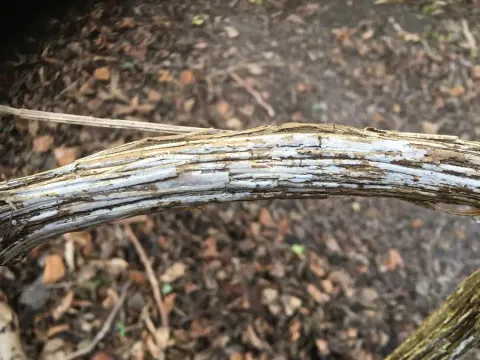
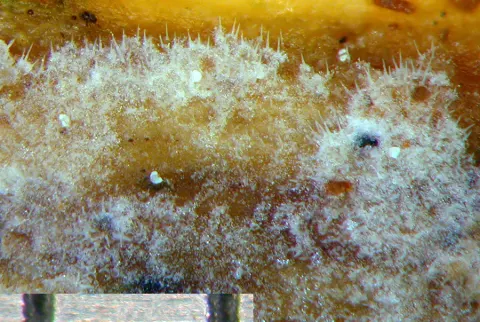
CHINA. Fujian Province, Wuyishan County, Wuyishan Nature Reserve, on dead culms of Calamus, 3 Oct 2018, He 5701 (holotype, BJFC 026763). CHINA. Fujian Province, Wuyishan County, Wuyishan Nature Reserve, on dead culms of Calamus, 3 Oct 2018, He 5693 (BJFC 026755) & He 5700 (BJFC 026762).
- Habitat atau konteks temuan
- Informasi belum tersedia pada sumber rilis ini.
- Substrat
- Informasi belum tersedia pada sumber rilis ini.
- Peran atau konteks
- Belum dikategorikan pada rilis ini.
Reproduksi
Hyphal system monomitic; generative hyphae with clamp connections, hyaline, thin-walled, frequently branched and septate, loosely interwoven, 2–3 µm in diam. Cystidia-like branches present, branched from subicular hyphae, embedded, hyaline, thick-walled, encrusted at apex, 20–30 × 1.5–2 µm. Hymenial cystidia abundant, subulate, projecting beyond hymenium, bi- or multi-rooted, hyaline, distinctly thick-walled with a narrow lumen, slightly encrusted at apex, distinctly dextrinoid, 50–110 × 5–6 µm. Basidia suburniform to subclavate, hyaline, thin-walled, with 4 sterigmata and a basal clamp connection, 20–30 × 5–8 µm; sterigmata mostly cylindrical with a blunt tip; basidioles in shape similar to basidia, but slightly smaller.
Catatan identitas dan cakupan
- Nama diterima mengikuti Catalogue of Life Base2026-09-11; uraian mempertahankan konsep dan nama sumber aslinya.
- Preserve original treatment localities, hosts and substrate scope. Materials examined describe documented specimens, not the full global range.
- Impor dan terjemahan otomatis belum diperiksa editorial per profil. Struktur reproduktif yang disebutkan tidak membuktikan seluruh siklus hidup diketahui.
- Pengukuran pada uraian mengikuti spesimen, kultur, dan metode sumber; angka tidak diperluas ke semua populasi.
Catatan distribusi dalam narasi mengikuti sumbernya. Dokumentasi spesimen atau foto mengikuti catatan sumber. Bukti wilayah Indonesia dan penilaian konservasi tidak disimpulkan dari gambar.
Melihat dengan konteks
Dextrinocystis calamicola (holotype, He 5701). a basidiomata b, f basidiospores c, g basidia d, h cystidia e, i cystidia-like branches in subiculum j subicular hyphae. Scale bars: 1 cm (a), 10 µm (b–j). b, c Taken in phloxine d, e taken in Melzer’s reagent.
- Jenis
- Pelat ilmiah
- Kredit
- Shi-Liang Liu, Hai-Xia Ma, Shuang-Hui He, Yu-Cheng Dai
- Lisensi
- CC BY 4.0
- Sumber media
- Buka entri sumber
Sumber profil
- [1] Four new corticioid species in Trechisporales (Basidiomycota) from East Asia and notes on phylogeny of the order — Dextrinocystis calamicola
- [2] Catalogue of Life Base2026-09-11 — Dextrinocystis calamicola
- [3] Dokumentasi visual — Dextrinocystis calamicola
Rujukan halaman ini
Fungi. Dextrinocystis calamicola. Rilis data fungi-2026-10-12-expansion-2. https://fungi-atlas.mgadib.chatgpt.site/jamur/dextrinocystis-calamicola/.
Status: impor sumber; pemeriksaan editorial per profil belum selesai. Untuk klaim biologis, gunakan rujukan pada bagian terkait dan periksa konteks sumber aslinya.