01 / Morfologi

Ciri dan struktur

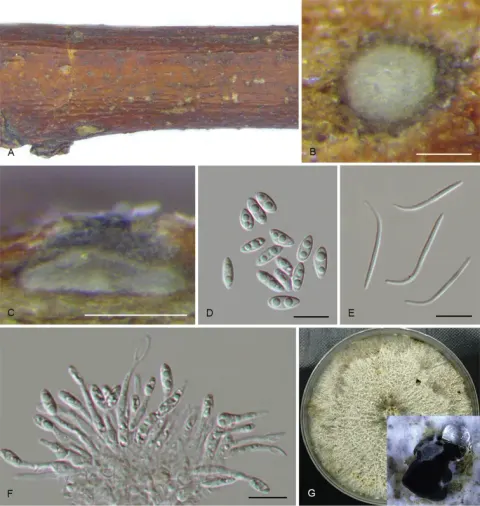
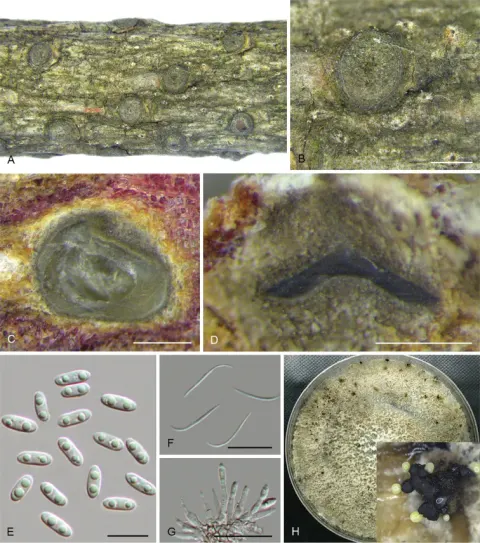
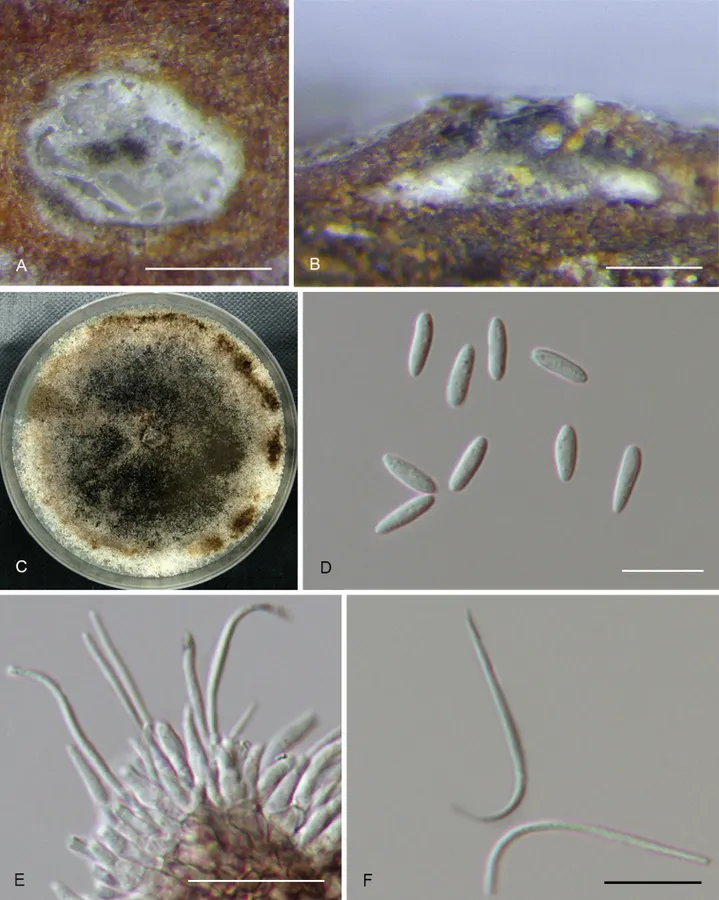
Diaporthe caryae differs from its closest phylogenetic neighbour, D. charlesworthii and D. sackstonii, in ITS, tef1 and tub2 loci based on the alignments deposited in TreeBASE. Conidiomata pycnidial, immersed in bark, scattered, slightly erumpent through the bark surface, nearly flat, discoid, with a solitary undivided locule. Ectostromatic disc brown to black, one ostiole per disc. Locule undivided, 310–325 μm diam. Conidiophores 7–11 × 1.4–2.2 μm, cylindrical, phialidic, unbranched, sometimes inflated. Alpha conidia hyaline, aseptate, ellipsoidal or fusiform, eguttulate, obtuse at both ends, 7–8.5 × 2.1–2.5 μm (av. = 8 × 2.3 μm, n = 30). Beta conidia hyaline, aseptate, filiform, straight or hamate, eguttulate, base subtruncate, tapering towards one apex, 15.5–34 × 1.1–1.4 µm (av. = 27.5 × 1.2 µm, n = 30).

Sebagian uraian ditampilkan dalam bahasa sumber; terjemahannya belum tersedia atau belum lolos pemeriksaan.

Rujukan: [1]

Pengukuran mengikuti objek, spesimen atau kultur, dan metode yang disebutkan sumber. Baca uraian asli untuk konteks lengkap.

02 / Kehidupan

Habitat dan peran ekologis

Cultures incubated on PDA at 25 °C in darkness. Colony at first flat with white felty mycelium, becoming black in the centre and black at the marginal area with age, conidiomata not observed.

Sebagian uraian ditampilkan dalam bahasa sumber; terjemahannya belum tersedia atau belum lolos pemeriksaan.

Rujukan: [1]

Habitat atau konteks temuan
kultur yang didokumentasikan
Substrat
Informasi belum tersedia pada sumber rilis ini.
Peran atau konteks
Belum dikategorikan pada rilis ini.
Temukan hubungan serupa
03 / Siklus hidup

Reproduksi

Conidiomata pycnidial, immersed in bark, scattered, slightly erumpent through the bark surface, nearly flat, discoid, with a solitary undivided locule. Ectostromatic disc brown to black, one ostiole per disc. Locule undivided, 310–325 μm diam. Conidiophores 7–11 × 1.4–2.2 μm, cylindrical, phialidic, unbranched, sometimes inflated. Alpha conidia hyaline, aseptate, ellipsoidal or fusiform, eguttulate, obtuse at both ends, 7–8.5 × 2.1–2.5 μm (av. = 8 × 2.3 μm, n = 30). Beta conidia hyaline, aseptate, filiform, straight or hamate, eguttulate, base subtruncate, tapering towards one apex, 15.5–34 × 1.1–1.4 µm (av. = 27.5 × 1.2 µm, n = 30).

Sebagian uraian ditampilkan dalam bahasa sumber; terjemahannya belum tersedia atau belum lolos pemeriksaan.

Rujukan: [1]

04 / Batas informasi

Catatan identitas dan cakupan

  • Nama diterima mengikuti Catalogue of Life Base2026-09-11; uraian mempertahankan konsep dan nama sumber aslinya.
  • Preserve original treatment localities, hosts and substrate scope. Materials examined describe documented specimens, not the full global range.
  • Impor dan terjemahan otomatis belum diperiksa editorial per profil. Struktur reproduktif yang disebutkan tidak membuktikan seluruh siklus hidup diketahui.
  • Pengukuran pada uraian mengikuti spesimen, kultur, dan metode sumber; angka tidak diperluas ke semua populasi.

Catatan distribusi dalam narasi mengikuti sumbernya. Dokumentasi spesimen atau foto mengikuti catatan sumber. Bukti wilayah Indonesia dan penilaian konservasi tidak disimpulkan dari gambar.

05 / Dokumentasi

Melihat dengan konteks

Diaporthe caryae (CFCC 52563) A Transverse section of conidioma B Longitudinal section of conidioma C Culture on PDA D Alpha conidia E Conidiophores F Beta conidia. Scale bars: 200 μm (A), 100 μm (B), 10 μm (D, F), 20 μm (E).

Jenis
Pelat ilmiah
Kredit
Qin Yang, Xin-Lei Fan, Vladimiro Guarnaccia, Cheng-Ming Tian,
Lisensi
CC BY 4.0
Sumber media
Buka entri sumber

Gambar menunjukkan objek menurut identifikasi sumber, bukan verifikasi independen spesimen oleh Fungi. Tidak ada skala baru yang ditambahkan.

06 / Rujukan

Sumber profil

  1. [1] High diversity of Diaporthe species associated with dieback diseases in China, with twelve new species described — Diaporthe caryaeBagian sumber: PMC6160862_section_39
    Tanggal penghimpunan sumber: 2026-10-12
    Teks sumber: CC BY 4.0 · Yang Q, Fan XL, Guarnaccia V, Tian CM.
  2. [2] Catalogue of Life Base2026-09-11 — Diaporthe caryaeBagian sumber: ColDP NameUsage.tsv ID 35CR9; accepted species; source 2073
    Tanggal penghimpunan sumber: 2026-10-12
  3. [3] Dokumentasi visual — Diaporthe caryaeBagian sumber: Individual media record; identification follows the source, not independent determination
    Tanggal penghimpunan sumber: 2026-10-12
    Media sumber: CC BY 4.0 · Qin Yang, Xin-Lei Fan, Vladimiro Guarnaccia, Cheng-Ming Tian,

Adaptasi teks: CC BY 4.0. Yang Q, Fan XL, Guarnaccia V, Tian CM. — High diversity of Diaporthe species associated with dieback diseases in China, with twelve new species described — Diaporthe caryae

Uraian asli dan riwayat sumber

Riwayat atau halaman sumber

Ringkasan sumber

Diaporthe caryae differs from its closest phylogenetic neighbour, D. charlesworthii and D. sackstonii, in ITS, tef1 and tub2 loci based on the alignments deposited in TreeBASE. Conidiomata pycnidial, immersed in bark, scattered, slightly erumpent through the bark surface, nearly flat, discoid, with a solitary undivided locule. Ectostromatic disc brown to black, one ostiole per disc. Locule undivided, 310–325 μm diam. Conidiophores 7–11 × 1.4–2.2 μm, cylindrical, phialidic, unbranched, sometimes inflated.

Revisi sumber

Morfologi sumber

Diaporthe caryae differs from its closest phylogenetic neighbour, D. charlesworthii and D. sackstonii, in ITS, tef1 and tub2 loci based on the alignments deposited in TreeBASE. Conidiomata pycnidial, immersed in bark, scattered, slightly erumpent through the bark surface, nearly flat, discoid, with a solitary undivided locule. Ectostromatic disc brown to black, one ostiole per disc. Locule undivided, 310–325 μm diam. Conidiophores 7–11 × 1.4–2.2 μm, cylindrical, phialidic, unbranched, sometimes inflated. Alpha conidia hyaline, aseptate, ellipsoidal or fusiform, eguttulate, obtuse at both ends, 7–8.5 × 2.1–2.5 μm (av. = 8 × 2.3 μm, n = 30). Beta conidia hyaline, aseptate, filiform, straight or hamate, eguttulate, base subtruncate, tapering towards one apex, 15.5–34 × 1.1–1.4 µm (av. = 27.5 × 1.2 µm, n = 30).

Revisi sumber

Ekologi sumber

Cultures incubated on PDA at 25 °C in darkness. Colony at first flat with white felty mycelium, becoming black in the centre and black at the marginal area with age, conidiomata not observed.

Revisi sumber

Struktur reproduksi sumber

Conidiomata pycnidial, immersed in bark, scattered, slightly erumpent through the bark surface, nearly flat, discoid, with a solitary undivided locule. Ectostromatic disc brown to black, one ostiole per disc. Locule undivided, 310–325 μm diam. Conidiophores 7–11 × 1.4–2.2 μm, cylindrical, phialidic, unbranched, sometimes inflated. Alpha conidia hyaline, aseptate, ellipsoidal or fusiform, eguttulate, obtuse at both ends, 7–8.5 × 2.1–2.5 μm (av. = 8 × 2.3 μm, n = 30). Beta conidia hyaline, aseptate, filiform, straight or hamate, eguttulate, base subtruncate, tapering towards one apex, 15.5–34 × 1.1–1.4 µm (av. = 27.5 × 1.2 µm, n = 30).

Revisi sumber

Rujukan halaman ini

Fungi. Diaporthe caryae. Rilis data fungi-2026-10-12-expansion-2. https://fungi-atlas.mgadib.chatgpt.site/jamur/diaporthe-caryae/.

Status: impor sumber; pemeriksaan editorial per profil belum selesai. Untuk klaim biologis, gunakan rujukan pada bagian terkait dan periksa konteks sumber aslinya.