01 / Morfologi

Ciri dan struktur

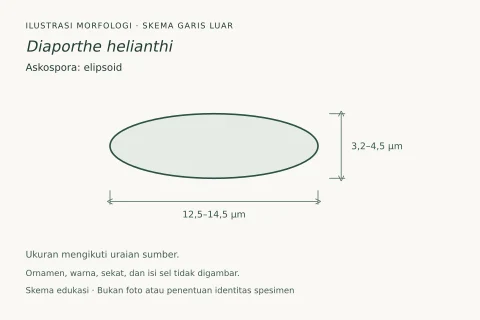
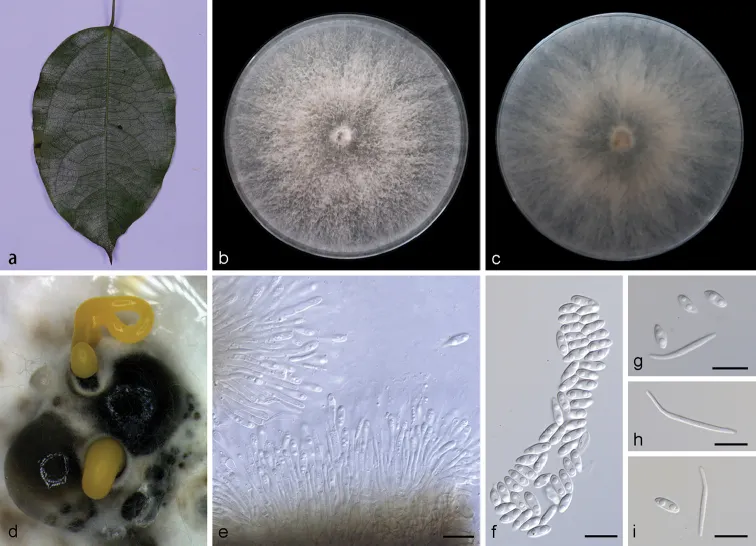
Diaporthe grandiflori can be distinguished from the phylogenetically closely related species D. penetriteum Y.H. Gao & L. Cai in larger α-conidia and β-conidia. Asexual morph: Conidiomata pycnidial, subglobose to globose, solitary or aggregated in groups, black, erumpent, coated with white hyphae, thick-walled, exuding golden yellow spiral conidial cirrus from ostiole. Conidiophores hyaline, smooth, septate, branched, densely aggregated, cylindrical, straight to slightly sinuous, 9.5–16.5 × 1.9–2.8 μm. Conidiogenous cells 19.0–22.8 × 1.4–2.4 μm, cylindrical, multi-guttulate, terminal, tapering towards the apex. Alpha conidia abundant in culture, biguttulate, hyaline, smooth, aseptate, ellipsoidal, apex subobtuse, base subtruncate, 6.3–8.3 × 2.8–3.3 µm (mean = 7.5 × 2.9 μm, n = 20). Beta conidia, not numerous, hyaline, aseptate, filiform, slightly curved, tapering towards the apex, 21.5–30.5 × 1.5–2.1 µm (mean = 24.0 × 1.7 μm, n = 20). Gamma conidia not observed. Sexual morph not observed. Pure culture was isolated by subbing hyphal tips growing from surface sterilized plant material. Colonies on PDA cover the Petri dish after 15 days kept in dark conditions at 25 °C, cottony with abundant aerial mycelium, white on surface side, white to grayish on reverse.

Sebagian uraian ditampilkan dalam bahasa sumber; terjemahannya belum tersedia atau belum lolos pemeriksaan.

Rujukan: [1]

Pengukuran mengikuti objek, spesimen atau kultur, dan metode yang disebutkan sumber. Baca uraian asli untuk konteks lengkap.

02 / Kehidupan

Habitat dan peran ekologis

Pure culture was isolated by subbing hyphal tips growing from surface sterilized plant material. Colonies on PDA cover the Petri dish after 15 days kept in dark conditions at 25 °C, cottony with abundant aerial mycelium, white on surface side, white to grayish on reverse.

Sebagian uraian ditampilkan dalam bahasa sumber; terjemahannya belum tersedia atau belum lolos pemeriksaan.

Rujukan: [1]

Habitat atau konteks temuan
kultur yang didokumentasikan
Substrat
Informasi belum tersedia pada sumber rilis ini.
Peran atau konteks
Belum dikategorikan pada rilis ini.
Temukan hubungan serupa
03 / Siklus hidup

Reproduksi

Diaporthe grandiflori can be distinguished from the phylogenetically closely related species D. penetriteum Y.H. Gao & L. Cai in larger α-conidia and β-conidia. Asexual morph: Conidiomata pycnidial, subglobose to globose, solitary or aggregated in groups, black, erumpent, coated with white hyphae, thick-walled, exuding golden yellow spiral conidial cirrus from ostiole. Conidiophores hyaline, smooth, septate, branched, densely aggregated, cylindrical, straight to slightly sinuous, 9.5–16.5 × 1.9–2.8 μm. Conidiogenous cells 19.0–22.8 × 1.4–2.4 μm, cylindrical, multi-guttulate, terminal, tapering towards the apex. Alpha conidia abundant in culture, biguttulate, hyaline, smooth, aseptate, ellipsoidal, apex subobtuse, base subtruncate, 6.3–8.3 × 2.8–3.3 µm (mean = 7.5 × 2.9 μm, n = 20).

Sebagian uraian ditampilkan dalam bahasa sumber; terjemahannya belum tersedia atau belum lolos pemeriksaan.

Rujukan: [1]

04 / Batas informasi

Catatan identitas dan cakupan

  • Nama diterima mengikuti Catalogue of Life Base2026-09-11; uraian mempertahankan konsep dan nama sumber aslinya.
  • Preserve original treatment localities, hosts and substrate scope. Materials examined describe documented specimens, not the full global range.
  • Impor dan terjemahan otomatis belum diperiksa editorial per profil. Struktur reproduktif yang disebutkan tidak membuktikan seluruh siklus hidup diketahui.
  • Pengukuran pada uraian mengikuti spesimen, kultur, dan metode sumber; angka tidak diperluas ke semua populasi.

Catatan distribusi dalam narasi mengikuti sumbernya. Dokumentasi spesimen atau foto mengikuti catatan sumber. Bukti wilayah Indonesia dan penilaian konservasi tidak disimpulkan dari gambar.

05 / Dokumentasi

Melihat dengan konteks

Diaporthe grandiflori (SAUCC194.84) a leaf of Heterostemma grandiflorum b, c surface (b) and reverse (c) sides of colony after incubation for 15 days on PDA d conidiomata e conidiophores and conidiogenous cells f alpha conidia g, i alpha conidia and beta conidia h beta conidia. Scale bars: 10 μm (e–i).

Jenis
Pelat ilmiah
Kredit
Wenxiu Sun, Shengting Huang, Jiwen Xia, Xiuguo Zhang, Zhuang Li
Lisensi
CC BY 4.0
Sumber media
Buka entri sumber

Gambar menunjukkan objek menurut identifikasi sumber, bukan verifikasi independen spesimen oleh Fungi. Tidak ada skala baru yang ditambahkan.

06 / Rujukan

Sumber profil

  1. [1] Morphological and molecular identification of Diaporthe species in south-western China, with description of eight new species — Diaporthe grandifloriBagian sumber: PMC7819953_section_16
    Tanggal penghimpunan sumber: 2026-10-12
    Teks sumber: CC BY 4.0 · Sun W, Huang S, Xia J, Zhang X, Li Z.
  2. [2] Catalogue of Life Base2026-09-11 — Diaporthe grandifloriBagian sumber: ColDP NameUsage.tsv ID B2MFZ; accepted species; source 2073
    Tanggal penghimpunan sumber: 2026-10-12
  3. [3] Dokumentasi visual — Diaporthe grandifloriBagian sumber: Individual media record; identification follows the source, not independent determination
    Tanggal penghimpunan sumber: 2026-10-12
    Media sumber: CC BY 4.0 · Wenxiu Sun, Shengting Huang, Jiwen Xia, Xiuguo Zhang, Zhuang Li

Adaptasi teks: CC BY 4.0. Sun W, Huang S, Xia J, Zhang X, Li Z. — Morphological and molecular identification of Diaporthe species in south-western China, with description of eight new species — Diaporthe grandiflori

Uraian asli dan riwayat sumber

Riwayat atau halaman sumber

Ringkasan sumber

Diaporthe grandiflori can be distinguished from the phylogenetically closely related species D. penetriteum Y.H. Gao & L. Cai in larger α-conidia and β-conidia. Asexual morph: Conidiomata pycnidial, subglobose to globose, solitary or aggregated in groups, black, erumpent, coated with white hyphae, thick-walled, exuding golden yellow spiral conidial cirrus from ostiole. Conidiophores hyaline, smooth, septate, branched, densely aggregated, cylindrical, straight to slightly sinuous, 9.5–16.5 × 1.9–2.8 μm.

Revisi sumber

Morfologi sumber

Diaporthe grandiflori can be distinguished from the phylogenetically closely related species D. penetriteum Y.H. Gao & L. Cai in larger α-conidia and β-conidia. Asexual morph: Conidiomata pycnidial, subglobose to globose, solitary or aggregated in groups, black, erumpent, coated with white hyphae, thick-walled, exuding golden yellow spiral conidial cirrus from ostiole. Conidiophores hyaline, smooth, septate, branched, densely aggregated, cylindrical, straight to slightly sinuous, 9.5–16.5 × 1.9–2.8 μm. Conidiogenous cells 19.0–22.8 × 1.4–2.4 μm, cylindrical, multi-guttulate, terminal, tapering towards the apex. Alpha conidia abundant in culture, biguttulate, hyaline, smooth, aseptate, ellipsoidal, apex subobtuse, base subtruncate, 6.3–8.3 × 2.8–3.3 µm (mean = 7.5 × 2.9 μm, n = 20). Beta conidia, not numerous, hyaline, aseptate, filiform, slightly curved, tapering towards the apex, 21.5–30.5 × 1.5–2.1 µm (mean = 24.0 × 1.7 μm, n = 20). Gamma conidia not observed. Sexual morph not observed. Pure culture was isolated by subbing hyphal tips growing from surface sterilized plant material. Colonies on PDA cover the Petri dish after 15 days kept in dark conditions at 25 °C, cottony with abundant aerial mycelium, white on surface side, white to grayish on reverse.

Revisi sumber

Ekologi sumber

Pure culture was isolated by subbing hyphal tips growing from surface sterilized plant material. Colonies on PDA cover the Petri dish after 15 days kept in dark conditions at 25 °C, cottony with abundant aerial mycelium, white on surface side, white to grayish on reverse.

Revisi sumber

Struktur reproduksi sumber

Diaporthe grandiflori can be distinguished from the phylogenetically closely related species D. penetriteum Y.H. Gao & L. Cai in larger α-conidia and β-conidia. Asexual morph: Conidiomata pycnidial, subglobose to globose, solitary or aggregated in groups, black, erumpent, coated with white hyphae, thick-walled, exuding golden yellow spiral conidial cirrus from ostiole. Conidiophores hyaline, smooth, septate, branched, densely aggregated, cylindrical, straight to slightly sinuous, 9.5–16.5 × 1.9–2.8 μm. Conidiogenous cells 19.0–22.8 × 1.4–2.4 μm, cylindrical, multi-guttulate, terminal, tapering towards the apex. Alpha conidia abundant in culture, biguttulate, hyaline, smooth, aseptate, ellipsoidal, apex subobtuse, base subtruncate, 6.3–8.3 × 2.8–3.3 µm (mean = 7.5 × 2.9 μm, n = 20).

Revisi sumber

Rujukan halaman ini

Fungi. Diaporthe grandiflori. Rilis data fungi-2026-10-12-expansion-2. https://fungi-atlas.mgadib.chatgpt.site/jamur/diaporthe-grandiflori/.

Status: impor sumber; pemeriksaan editorial per profil belum selesai. Untuk klaim biologis, gunakan rujukan pada bagian terkait dan periksa konteks sumber aslinya.