01 / Morfologi

Ciri dan struktur

Culture characteristics: Colonies on PDA 50–70 mm in diameter after two weeks at 27 °C, white to gray, circular, flat to effuse, medium dense, fimbriate margin; white at the reverse, without pigments produced in PDA, but produced black dots and released fluid secretions after one month, but without any spores were observed. Vegetative hyphae 1–3 μm wide, hyaline, smooth-walled.

Sebagian uraian ditampilkan dalam bahasa sumber; terjemahannya belum tersedia atau belum lolos pemeriksaan.

Rujukan: [1]

Pengukuran mengikuti objek, spesimen atau kultur, dan metode yang disebutkan sumber. Baca uraian asli untuk konteks lengkap.

02 / Kehidupan

Habitat dan peran ekologis

Culture characteristics: Colonies on PDA 50–70 mm in diameter after two weeks at 27 °C, white to gray, circular, flat to effuse, medium dense, fimbriate margin; white at the reverse, without pigments produced in PDA, but produced black dots and released fluid secretions after one month, but without any spores were observed. Vegetative hyphae 1–3 μm wide, hyaline, smooth-walled. Notes: Diaporthe pseudomangiferae and D. pseudophoenicicola were isolated from Mangifera indica with or without pathogenetic symptoms [ 63 ]. Our new isolate D. hongheensis fits well with the concept of Diaporthe by having fully immersed, mostly subglobose, ellipsoid to cylindrical ascomata, hyaline, septate ascospores with appendages [ 58 ]. Diaporthe hongheensis is different by having 6(–8)-spores asci, while most Diaporthe species which available sexual morph have 8-spored asci, like D. eucalyptorum, D. alnea, and D. neilliae [ 67 ]. The BLASTn results of ITS, β-tubulin, CAL, and tef1-α gene region were shown in Table 1. In addition, the multi-locus phylogenetic analysis separated D. hongheensis (KUMCC 21-0457) well although closely related to D. viniferae, D. pandanicola and D. fraxini-angustifoliae clades.

Sebagian uraian ditampilkan dalam bahasa sumber; terjemahannya belum tersedia atau belum lolos pemeriksaan.

Rujukan: [1]

Habitat atau konteks temuan
Informasi belum tersedia pada sumber rilis ini.
Substrat
Informasi belum tersedia pada sumber rilis ini.
Peran atau konteks
Belum dikategorikan pada rilis ini.
Temukan hubungan serupa
03 / Siklus hidup

Reproduksi

Culture characteristics: Colonies on PDA 50–70 mm in diameter after two weeks at 27 °C, white to gray, circular, flat to effuse, medium dense, fimbriate margin; white at the reverse, without pigments produced in PDA, but produced black dots and released fluid secretions after one month, but without any spores were observed. Vegetative hyphae 1–3 μm wide, hyaline, smooth-walled.

Sebagian uraian ditampilkan dalam bahasa sumber; terjemahannya belum tersedia atau belum lolos pemeriksaan.

Rujukan: [1]

04 / Batas informasi

Catatan identitas dan cakupan

  • Nama diterima mengikuti Catalogue of Life Base2026-09-11; uraian mempertahankan konsep dan nama sumber aslinya.
  • Preserve original treatment localities, hosts and substrate scope. Materials examined describe documented specimens, not the full global range.
  • Impor dan terjemahan otomatis belum diperiksa editorial per profil. Struktur reproduktif yang disebutkan tidak membuktikan seluruh siklus hidup diketahui.
  • Pengukuran pada uraian mengikuti spesimen, kultur, dan metode sumber; angka tidak diperluas ke semua populasi.

Catatan distribusi dalam narasi mengikuti sumbernya. Dokumentasi spesimen atau foto mengikuti catatan sumber. Bukti wilayah Indonesia dan penilaian konservasi tidak disimpulkan dari gambar.

05 / Dokumentasi

Melihat dengan konteks

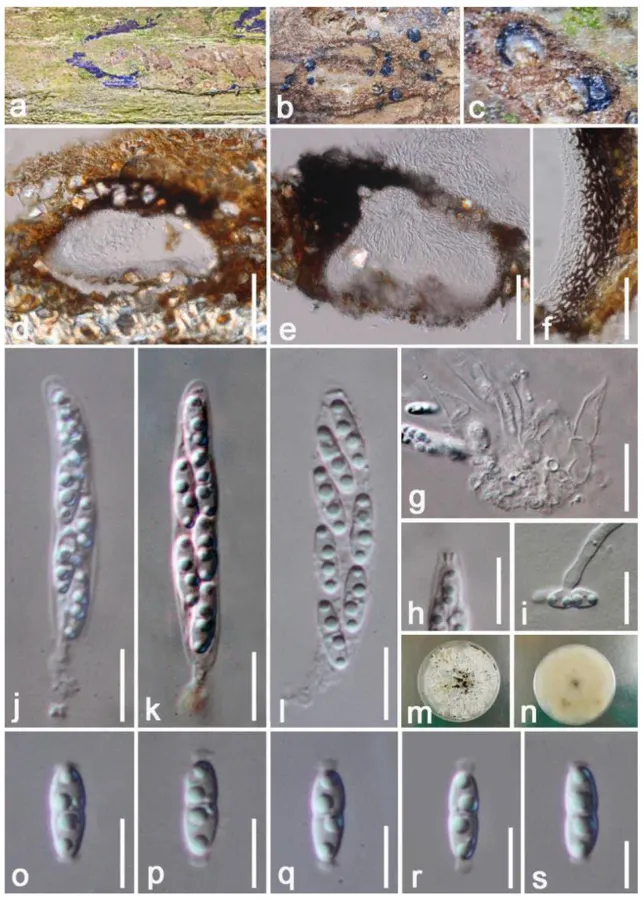
Diaporthe hongheensis (HKAS 122657, holotype). (a) Appearance of ascomata on the host; (b, c) Close-up of ascomata with horizontal section; (d, e) Sections through of ascomata; (f) Peridium; (j – l) Asci ((k), stained by Congo red reagent); (g) Paraphyses; (h) apical apparatus; (i) Ascospore with germinated tube; (m, n) Colony on PDA; (o – s) Ascospore. Scale bars: (d, e) = 100 μm; (f) = 35 μm; (g) = 15 μm; (h – l) = 10 μm; (o – s) = 5 μm.

Jenis
Pelat ilmiah
Kredit
© 2022 by the authors.
Lisensi
CC BY 4.0
Sumber media
Buka entri sumber

Gambar menunjukkan objek menurut identifikasi sumber, bukan verifikasi independen spesimen oleh Fungi. Tidak ada skala baru yang ditambahkan.

06 / Rujukan

Sumber profil

  1. [1] Taxonomy and Phylogeny of Fungi Associated with Mangifera indica from Yunnan, China — Diaporthe hongheensisBagian sumber: PMC9780836_Taxonomy_paragraph_37
    Tanggal penghimpunan sumber: 2026-10-12
    Teks sumber: CC BY 4.0 · Yang EF, Karunarathna SC, Dai DQ, Stephenson SL, Elgorban AM, Al-Rejaie S, Xiong YR, Promputtha I, Samarakoon MC, Tibpromma S.
  2. [2] Catalogue of Life Base2026-09-11 — Diaporthe hongheensisBagian sumber: ColDP NameUsage.tsv ID C9GK3; accepted species; source 2073
    Tanggal penghimpunan sumber: 2026-10-12
  3. [3] Dokumentasi visual — Diaporthe hongheensisBagian sumber: Individual media record; identification follows the source, not independent determination
    Tanggal penghimpunan sumber: 2026-10-12
    Media sumber: CC BY 4.0 · © 2022 by the authors.

Adaptasi teks: CC BY 4.0. Yang EF, Karunarathna SC, Dai DQ, Stephenson SL, Elgorban AM, Al-Rejaie S, Xiong YR, Promputtha I, Samarakoon MC, Tibpromma S. — Taxonomy and Phylogeny of Fungi Associated with Mangifera indica from Yunnan, China — Diaporthe hongheensis

Uraian asli dan riwayat sumber

Riwayat atau halaman sumber

Ringkasan sumber

Culture characteristics: Colonies on PDA 50–70 mm in diameter after two weeks at 27 °C, white to gray, circular, flat to effuse, medium dense, fimbriate margin; white at the reverse, without pigments produced in PDA, but produced black dots and released fluid secretions after one month, but without any spores were observed. Vegetative hyphae 1–3 μm wide, hyaline, smooth-walled.

Revisi sumber

Morfologi sumber

Culture characteristics: Colonies on PDA 50–70 mm in diameter after two weeks at 27 °C, white to gray, circular, flat to effuse, medium dense, fimbriate margin; white at the reverse, without pigments produced in PDA, but produced black dots and released fluid secretions after one month, but without any spores were observed. Vegetative hyphae 1–3 μm wide, hyaline, smooth-walled.

Revisi sumber

Ekologi sumber

Culture characteristics: Colonies on PDA 50–70 mm in diameter after two weeks at 27 °C, white to gray, circular, flat to effuse, medium dense, fimbriate margin; white at the reverse, without pigments produced in PDA, but produced black dots and released fluid secretions after one month, but without any spores were observed. Vegetative hyphae 1–3 μm wide, hyaline, smooth-walled. Notes: Diaporthe pseudomangiferae and D. pseudophoenicicola were isolated from Mangifera indica with or without pathogenetic symptoms [ 63 ]. Our new isolate D. hongheensis fits well with the concept of Diaporthe by having fully immersed, mostly subglobose, ellipsoid to cylindrical ascomata, hyaline, septate ascospores with appendages [ 58 ]. Diaporthe hongheensis is different by having 6(–8)-spores asci, while most Diaporthe species which available sexual morph have 8-spored asci, like D. eucalyptorum, D. alnea, and D. neilliae [ 67 ]. The BLASTn results of ITS, β-tubulin, CAL, and tef1-α gene region were shown in Table 1. In addition, the multi-locus phylogenetic analysis separated D. hongheensis (KUMCC 21-0457) well although closely related to D. viniferae, D. pandanicola and D. fraxini-angustifoliae clades.

Revisi sumber

Struktur reproduksi sumber

Culture characteristics: Colonies on PDA 50–70 mm in diameter after two weeks at 27 °C, white to gray, circular, flat to effuse, medium dense, fimbriate margin; white at the reverse, without pigments produced in PDA, but produced black dots and released fluid secretions after one month, but without any spores were observed. Vegetative hyphae 1–3 μm wide, hyaline, smooth-walled.

Revisi sumber

Rujukan halaman ini

Fungi. Diaporthe hongheensis. Rilis data fungi-2026-10-12-expansion-2. https://fungi-atlas.mgadib.chatgpt.site/jamur/diaporthe-hongheensis/.

Status: impor sumber; pemeriksaan editorial per profil belum selesai. Untuk klaim biologis, gunakan rujukan pada bagian terkait dan periksa konteks sumber aslinya.