01 / Morfologi

Ciri dan struktur

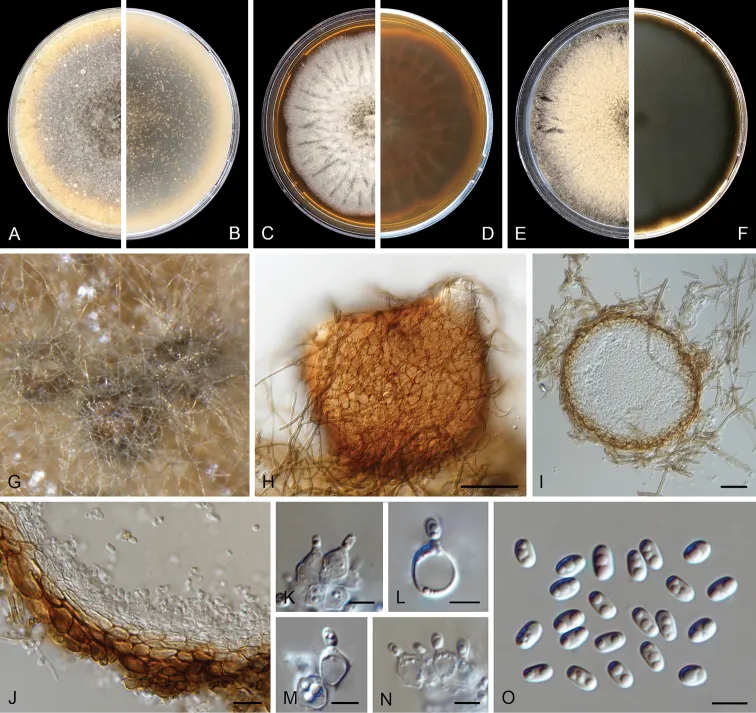
Colonies after 7 d at 25 °C, on OA reaching 55–60 mm diam, aerial mycelium floccose, pale smoke grey, pale brown towards periphery, abundant production of confluent pycnidia, margin regular; reverse pale olivaceous, with some olivaceous black zones. On MEA reaching 50–55 mm diam, aerial mycelium woolly, pale olivaceous grey, margin irregular; reverse buff near the centre, dark brown with orange edge. On PDA reaching 50–55 mm diam, aerial mycelium floccose, pale mouse grey with olivaceous edge, margin irregular; reverse dark brown with pale brown edge. NaOH spot test negative on OA.

Sebagian uraian ditampilkan dalam bahasa sumber; terjemahannya belum tersedia atau belum lolos pemeriksaan.

Rujukan: [1]

Pengukuran mengikuti objek, spesimen atau kultur, dan metode yang disebutkan sumber. Baca uraian asli untuk konteks lengkap.

02 / Kehidupan

Habitat dan peran ekologis

The Netherlands. Utrecht province, Vleuten, isolated from garden soil, Mar. 2017, N. Kooiman & R. Kooiman (holotype designated here CBS H-24106, living ex-type culture CBS 144951 = JW 27006). Conidiomata pycnidial, superficial or semi-immersed, scattered or solitary, sometimes confluent, globose to subglobose, irregularly-shaped with age, pale brown to brown, covered by hyphal outgrowths, especially near the ostioles, 200–375 × 195–280 μm; with 1–3(–6) papillate ostioles; pycnidial wall pseudoparenchymatous, 3–5 layers, 10–35 μm thick, outer layers composed of pale brown, flattened polygonal cells of 16–32 μm diam. Conidiogenous cells phialidic, hyaline, smooth, ampulliform, lageniform or somewhat isodiametric, (4.5–)5.5–10 × 3.5–9 μm. Conidia ellipsoidal to oblong, straight, thin- and smooth-walled, hyaline, aseptate, 3.5–7 × 2–3 μm, 2-guttulate, big. Conidial matrix buff. Colonies after 7 d at 25 °C, on OA reaching 55–60 mm diam, aerial mycelium floccose, pale smoke grey, pale brown towards periphery, abundant production of confluent pycnidia, margin regular; reverse pale olivaceous, with some olivaceous black zones. On MEA reaching 50–55 mm diam, aerial mycelium woolly, pale olivaceous grey, margin irregular; reverse buff near the centre, dark brown with orange edge.

Sebagian uraian ditampilkan dalam bahasa sumber; terjemahannya belum tersedia atau belum lolos pemeriksaan.

Rujukan: [1]

Habitat atau konteks temuan
kultur yang didokumentasikan
Substrat
Informasi belum tersedia pada sumber rilis ini.
Peran atau konteks
Belum dikategorikan pada rilis ini.
Temukan hubungan serupa
03 / Siklus hidup

Reproduksi

The Netherlands. Utrecht province, Vleuten, isolated from garden soil, Mar. 2017, N. Kooiman & R. Kooiman (holotype designated here CBS H-24106, living ex-type culture CBS 144951 = JW 27006). Conidiomata pycnidial, superficial or semi-immersed, scattered or solitary, sometimes confluent, globose to subglobose, irregularly-shaped with age, pale brown to brown, covered by hyphal outgrowths, especially near the ostioles, 200–375 × 195–280 μm; with 1–3(–6) papillate ostioles; pycnidial wall pseudoparenchymatous, 3–5 layers, 10–35 μm thick, outer layers composed of pale brown, flattened polygonal cells of 16–32 μm diam. Conidiogenous cells phialidic, hyaline, smooth, ampulliform, lageniform or somewhat isodiametric, (4.5–)5.5–10 × 3.5–9 μm.

Sebagian uraian ditampilkan dalam bahasa sumber; terjemahannya belum tersedia atau belum lolos pemeriksaan.

Rujukan: [1]

04 / Batas informasi

Catatan identitas dan cakupan

  • Nama diterima mengikuti Catalogue of Life Base2026-09-11; uraian mempertahankan konsep dan nama sumber aslinya.
  • Preserve original treatment localities, hosts and substrate scope. Materials examined describe documented specimens, not the full global range.
  • Impor dan terjemahan otomatis belum diperiksa editorial per profil. Struktur reproduktif yang disebutkan tidak membuktikan seluruh siklus hidup diketahui.
  • Pengukuran pada uraian mengikuti spesimen, kultur, dan metode sumber; angka tidak diperluas ke semua populasi.

Catatan distribusi dalam narasi mengikuti sumbernya. Dokumentasi spesimen atau foto mengikuti catatan sumber. Bukti wilayah Indonesia dan penilaian konservasi tidak disimpulkan dari gambar.

05 / Dokumentasi

Melihat dengan konteks

Didymella kooimaniorum (CBS 144951). A, B Colony on OA (front and reverse) C, D colony on MEA (front and reverse) E, F colony on PDA (front and reverse) G pycnidia forming on OA H pycnidia I section of pycnidium J section of pycnidial wall K–M conidiogenous cells N conidia. Scale bars: 100 μm (H); 50 μm (I); 10 μm (J); 5 μm (K–N).

Jenis
Pelat ilmiah
Kredit
Lingwei Hou, Margarita Hernández-Restrepo, Johannes Zacharias Groenewald, Lei Cai, Pedro W. Crous
Lisensi
CC BY 4.0
Sumber media
Buka entri sumber

Gambar menunjukkan objek menurut identifikasi sumber, bukan verifikasi independen spesimen oleh Fungi. Tidak ada skala baru yang ditambahkan.

06 / Rujukan

Sumber profil

  1. [1] Citizen science project reveals high diversity in Didymellaceae (Pleosporales, Dothideomycetes) — Didymella kooimaniorumBagian sumber: PMC7078340_section_22
    Tanggal penghimpunan sumber: 2026-10-12
    Teks sumber: CC BY 4.0 · Hou L, Hernández-Restrepo M, Groenewald JZ, Cai L, Crous PW.
  2. [2] Catalogue of Life Base2026-09-11 — Didymella kooimaniorumBagian sumber: ColDP NameUsage.tsv ID 9Z5PT; accepted species; source 2073
    Tanggal penghimpunan sumber: 2026-10-12
  3. [3] Dokumentasi visual — Didymella kooimaniorumBagian sumber: Individual media record; identification follows the source, not independent determination
    Tanggal penghimpunan sumber: 2026-10-12
    Media sumber: CC BY 4.0 · Lingwei Hou, Margarita Hernández-Restrepo, Johannes Zacharias Groenewald, Lei Cai, Pedro W. Crous

Adaptasi teks: CC BY 4.0. Hou L, Hernández-Restrepo M, Groenewald JZ, Cai L, Crous PW. — Citizen science project reveals high diversity in Didymellaceae (Pleosporales, Dothideomycetes) — Didymella kooimaniorum

Uraian asli dan riwayat sumber

Riwayat atau halaman sumber

Ringkasan sumber

Colonies after 7 d at 25 °C, on OA reaching 55–60 mm diam, aerial mycelium floccose, pale smoke grey, pale brown towards periphery, abundant production of confluent pycnidia, margin regular; reverse pale olivaceous, with some olivaceous black zones. On MEA reaching 50–55 mm diam, aerial mycelium woolly, pale olivaceous grey, margin irregular; reverse buff near the centre, dark brown with orange edge. On PDA reaching 50–55 mm diam, aerial mycelium floccose, pale mouse grey with olivaceous edge, margin irregular; reverse dark brown with pale brown edge.

Revisi sumber

Morfologi sumber

Colonies after 7 d at 25 °C, on OA reaching 55–60 mm diam, aerial mycelium floccose, pale smoke grey, pale brown towards periphery, abundant production of confluent pycnidia, margin regular; reverse pale olivaceous, with some olivaceous black zones. On MEA reaching 50–55 mm diam, aerial mycelium woolly, pale olivaceous grey, margin irregular; reverse buff near the centre, dark brown with orange edge. On PDA reaching 50–55 mm diam, aerial mycelium floccose, pale mouse grey with olivaceous edge, margin irregular; reverse dark brown with pale brown edge. NaOH spot test negative on OA.

Revisi sumber

Ekologi sumber

The Netherlands. Utrecht province, Vleuten, isolated from garden soil, Mar. 2017, N. Kooiman & R. Kooiman (holotype designated here CBS H-24106, living ex-type culture CBS 144951 = JW 27006). Conidiomata pycnidial, superficial or semi-immersed, scattered or solitary, sometimes confluent, globose to subglobose, irregularly-shaped with age, pale brown to brown, covered by hyphal outgrowths, especially near the ostioles, 200–375 × 195–280 μm; with 1–3(–6) papillate ostioles; pycnidial wall pseudoparenchymatous, 3–5 layers, 10–35 μm thick, outer layers composed of pale brown, flattened polygonal cells of 16–32 μm diam. Conidiogenous cells phialidic, hyaline, smooth, ampulliform, lageniform or somewhat isodiametric, (4.5–)5.5–10 × 3.5–9 μm. Conidia ellipsoidal to oblong, straight, thin- and smooth-walled, hyaline, aseptate, 3.5–7 × 2–3 μm, 2-guttulate, big. Conidial matrix buff. Colonies after 7 d at 25 °C, on OA reaching 55–60 mm diam, aerial mycelium floccose, pale smoke grey, pale brown towards periphery, abundant production of confluent pycnidia, margin regular; reverse pale olivaceous, with some olivaceous black zones. On MEA reaching 50–55 mm diam, aerial mycelium woolly, pale olivaceous grey, margin irregular; reverse buff near the centre, dark brown with orange edge.

Revisi sumber

Struktur reproduksi sumber

The Netherlands. Utrecht province, Vleuten, isolated from garden soil, Mar. 2017, N. Kooiman & R. Kooiman (holotype designated here CBS H-24106, living ex-type culture CBS 144951 = JW 27006). Conidiomata pycnidial, superficial or semi-immersed, scattered or solitary, sometimes confluent, globose to subglobose, irregularly-shaped with age, pale brown to brown, covered by hyphal outgrowths, especially near the ostioles, 200–375 × 195–280 μm; with 1–3(–6) papillate ostioles; pycnidial wall pseudoparenchymatous, 3–5 layers, 10–35 μm thick, outer layers composed of pale brown, flattened polygonal cells of 16–32 μm diam. Conidiogenous cells phialidic, hyaline, smooth, ampulliform, lageniform or somewhat isodiametric, (4.5–)5.5–10 × 3.5–9 μm.

Revisi sumber

Rujukan halaman ini

Fungi. Didymella kooimaniorum. Rilis data fungi-2026-10-12-expansion-2. https://fungi-atlas.mgadib.chatgpt.site/jamur/didymella-kooimaniorum/.

Status: impor sumber; pemeriksaan editorial per profil belum selesai. Untuk klaim biologis, gunakan rujukan pada bagian terkait dan periksa konteks sumber aslinya.