01 / Morfologi

Ciri dan struktur

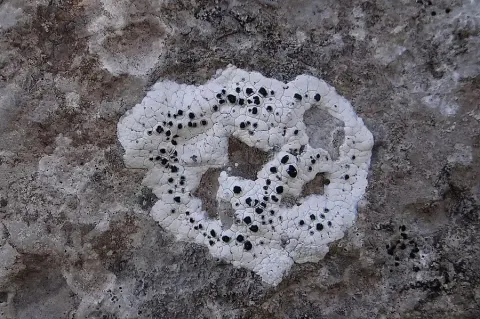
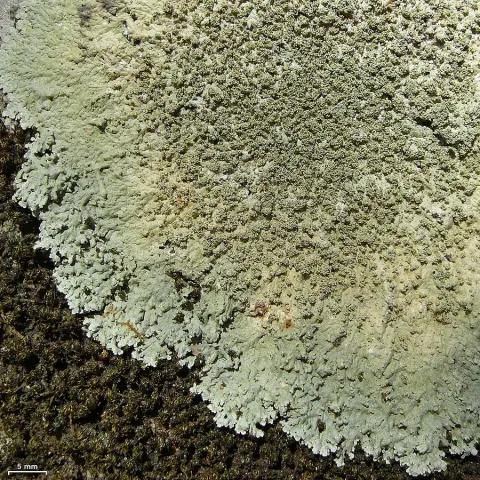
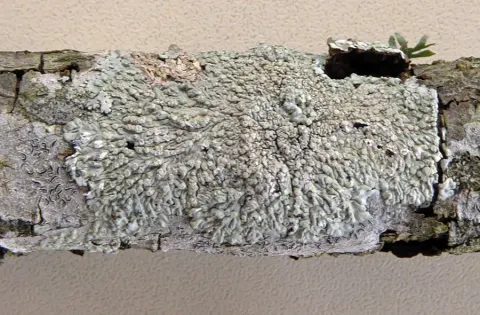
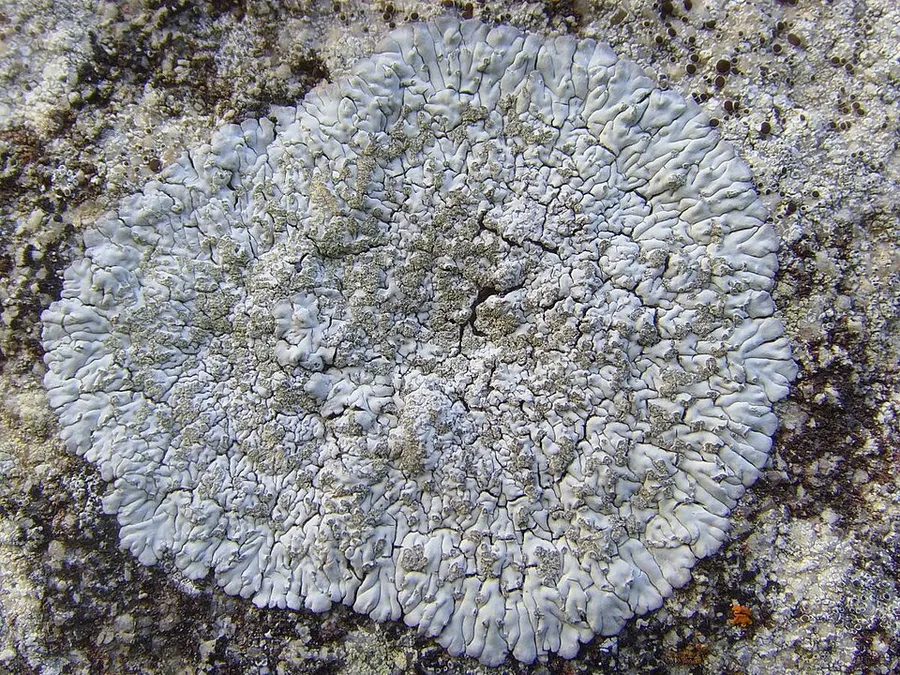
Diploicia canescens is a crustose lichen with lobed margins, a growth type known as "placodioid". It grows in rosettes up to 6 cm across. The thallus, which can range in color from white to very pale gray, is typically darker in the center and very white-pruinose on the marginal lobes. These lobes are convex, becoming wider at the tips – up to 1 mm wide. The center of the thallus is generally covered with soralia, which are flour-like and pale to slightly yellow in color. The photobiont of D. canescens is a green algae (chlorococcoid). Like many lichens, D. canescens disperses primarily by means of symbiotic vegetative propagules; most are covered with extensive mats of soralia. Apothecia are rare, but where they occur are black, lecideine (meaning that they have no thalline margin), and measure 0.3–1 mm in diameter. Each ascus contains eight spores. Each spore is brown with a cell wall (called a septum) that divides it into two cells; it measures 10–15 μm x 5–8 μm. Observations in Ireland found apothecia only between the months of August and December. The production of spores increased over that time period, with peak germination occurring in October and November.

Sebagian uraian ditampilkan dalam bahasa sumber; terjemahannya belum tersedia atau belum lolos pemeriksaan.

Rujukan: [1]

Pengukuran mengikuti objek, spesimen atau kultur, dan metode yang disebutkan sumber. Baca uraian asli untuk konteks lengkap.

02 / Kehidupan

Habitat dan peran ekologis

Diploicia canescens has been found on every continent but Antarctica, though it is less common on some continents than others. It was only added to the North American list in 1984; previous records actually referred to a different species. Unlike some lichens, D. canescens occurs in abundance on both calcareous and siliceous substrates. It occurs on rocks, old walls, and tree trunks, favoring nutrient-enriched areas, such as birds' perching stones. In Nepal, Diploicia canescens has been reported at 4,650 m elevation in a compilation of published records; this reported range lies above the tree line used in the study. Diploicia canescens contains various chemical compounds including depsidones (such as diploicin and scensidin), depsides (atranorin and chloroatranorin), phthalides (buellolide and canesolide), dechlorodiploicin, isofulgidin, and minor or trace amounts of dechloro-O-methyldiploicin and secalonic acids A, B, C. Derivatives of diploicin have been shown, in vitro, to be active against bacterial species including Mycobacterium smegmatis, Corynebacterium diphtheriae (mitis), and M. tuberculosis. The overall status of D. canescens has not been evaluated by the International Union for Conservation of Nature.

Sebagian uraian ditampilkan dalam bahasa sumber; terjemahannya belum tersedia atau belum lolos pemeriksaan.

Rujukan: [1]

Habitat atau konteks temuan
Informasi belum tersedia pada sumber rilis ini.
Substrat
Informasi belum tersedia pada sumber rilis ini.
Peran atau konteks
Pembentuk liken
Temukan hubungan serupa
03 / Siklus hidup

Reproduksi

Like many lichens, D. canescens disperses primarily by means of symbiotic vegetative propagules; most are covered with extensive mats of soralia. Apothecia are rare, but where they occur are black, lecideine (meaning that they have no thalline margin), and measure 0.3–1 mm in diameter. Each ascus contains eight spores. Each spore is brown with a cell wall (called a septum) that divides it into two cells; it measures 10–15 μm x 5–8 μm. Observations in Ireland found apothecia only between the months of August and December. The production of spores increased over that time period, with peak germination occurring in October and November.

Sebagian uraian ditampilkan dalam bahasa sumber; terjemahannya belum tersedia atau belum lolos pemeriksaan.

Rujukan: [1]

Sinonim menurut acuan taksonomi rilis: Buellia canescens; Catolechia canescens; Diploicia canescens subsp. australasica; Diplotomma canescens; Diplotomma canescens subsp. australasica; Lecidea canescens; Lepidoma canescens; Lichen canescens; Patellaria canescens; Placodium canescens; Psora canescens
04 / Batas informasi

Catatan identitas dan cakupan

  • Nama diterima mengikuti Catalogue of Life Base2026-09-11; uraian mempertahankan konsep dan nama sumber aslinya.
  • Original geographic, specimen and life-cycle scope retained; source import awaits individual editorial review.
  • Impor dan terjemahan otomatis belum diperiksa editorial per profil. Struktur reproduktif yang disebutkan tidak membuktikan seluruh siklus hidup diketahui.
  • Pengukuran pada uraian mengikuti spesimen, kultur, dan metode sumber; angka tidak diperluas ke semua populasi.

Catatan distribusi dalam narasi mengikuti sumbernya. Dokumentasi spesimen atau foto mengikuti catatan sumber. Bukti wilayah Indonesia dan penilaian konservasi tidak disimpulkan dari gambar.

05 / Dokumentasi

Melihat dengan konteks

Dokumentasi Diploicia canescens dari Wikimedia Commons. Diploicia canescens sur le mur d'une maison, Penn ar Run, Goulien, Finistère, Bretagne, France Identifikasi mengikuti record berkas sumber.

Jenis
Fotografi
Kredit
Jymm
Sumber media
Buka entri sumber

Gambar menunjukkan objek menurut identifikasi sumber, bukan verifikasi independen spesimen oleh Fungi. Tidak ada skala baru yang ditambahkan.

06 / Rujukan

Sumber profil

  1. [1] Diploicia canescens — Wikipedia (en)Bagian sumber: Frozen revision 1342784789
    Tanggal penghimpunan sumber: 2026-10-12
    Teks sumber: CC BY-SA4.0 · Wikipedia contributors
  2. [2] Catalogue of Life Base2026-09-11 — Diploicia canescensBagian sumber: ColDP NameUsage.tsv ID 6CXS9; accepted species; source 2073
    Tanggal penghimpunan sumber: 2026-10-12
  3. [3] Dokumentasi visual — Diploicia canescensBagian sumber: Individual media record; identification follows the source, not independent determination
    Tanggal penghimpunan sumber: 2026-10-12
    Media sumber: Public domain · Jymm

Adaptasi teks: CC BY-SA 4.0. Wikipedia contributors — Diploicia canescens — Wikipedia (en)

Uraian asli dan riwayat sumber

Riwayat atau halaman sumber

Ringkasan sumber

Diploicia canescens is a widespread species of lichen-forming fungus in the family Caliciaceae. It is found throughout much of the world, occurring on every continent except Antarctica. It is a crustose lichen with distinctive lobed margins that grows in rosettes up to 6 cm across, appearing white to pale gray with white- marginal . The species contains various biologically active compounds including depsidones, depsides, and phthalides. It typically grows on rocks, old walls, and tree trunks, particularly favoring nutrient-enriched areas such as birds' perching stones, though it is sensitive to sulfur dioxide pollution.

Revisi sumber

Morfologi sumber

Diploicia canescens is a crustose lichen with lobed margins, a growth type known as "placodioid". It grows in rosettes up to 6 cm across. The thallus, which can range in color from white to very pale gray, is typically darker in the center and very white-pruinose on the marginal lobes. These lobes are convex, becoming wider at the tips – up to 1 mm wide. The center of the thallus is generally covered with soralia, which are flour-like and pale to slightly yellow in color. The photobiont of D. canescens is a green algae (chlorococcoid). Like many lichens, D. canescens disperses primarily by means of symbiotic vegetative propagules; most are covered with extensive mats of soralia. Apothecia are rare, but where they occur are black, lecideine (meaning that they have no thalline margin), and measure 0.3–1 mm in diameter. Each ascus contains eight spores. Each spore is brown with a cell wall (called a septum) that divides it into two cells; it measures 10–15 μm x 5–8 μm. Observations in Ireland found apothecia only between the months of August and December. The production of spores increased over that time period, with peak germination occurring in October and November.

Revisi sumber

Ekologi sumber

Diploicia canescens has been found on every continent but Antarctica, though it is less common on some continents than others. It was only added to the North American list in 1984; previous records actually referred to a different species. Unlike some lichens, D. canescens occurs in abundance on both calcareous and siliceous substrates. It occurs on rocks, old walls, and tree trunks, favoring nutrient-enriched areas, such as birds' perching stones. In Nepal, Diploicia canescens has been reported at 4,650 m elevation in a compilation of published records; this reported range lies above the tree line used in the study. Diploicia canescens contains various chemical compounds including depsidones (such as diploicin and scensidin), depsides (atranorin and chloroatranorin), phthalides (buellolide and canesolide), dechlorodiploicin, isofulgidin, and minor or trace amounts of dechloro-O-methyldiploicin and secalonic acids A, B, C. Derivatives of diploicin have been shown, in vitro, to be active against bacterial species including Mycobacterium smegmatis, Corynebacterium diphtheriae (mitis), and M. tuberculosis. The overall status of D. canescens has not been evaluated by the International Union for Conservation of Nature.

Revisi sumber

Struktur reproduksi sumber

Like many lichens, D. canescens disperses primarily by means of symbiotic vegetative propagules; most are covered with extensive mats of soralia. Apothecia are rare, but where they occur are black, lecideine (meaning that they have no thalline margin), and measure 0.3–1 mm in diameter. Each ascus contains eight spores. Each spore is brown with a cell wall (called a septum) that divides it into two cells; it measures 10–15 μm x 5–8 μm. Observations in Ireland found apothecia only between the months of August and December. The production of spores increased over that time period, with peak germination occurring in October and November.

Revisi sumber

Rujukan halaman ini

Fungi. Diploicia canescens. Rilis data fungi-2026-10-12-expansion-2. https://fungi-atlas.mgadib.chatgpt.site/jamur/diploicia-canescens/.

Status: impor sumber; pemeriksaan editorial per profil belum selesai. Untuk klaim biologis, gunakan rujukan pada bagian terkait dan periksa konteks sumber aslinya.