01 / Morfologi

Ciri dan struktur

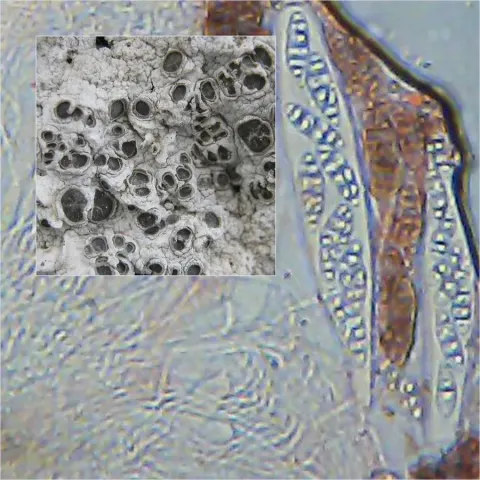
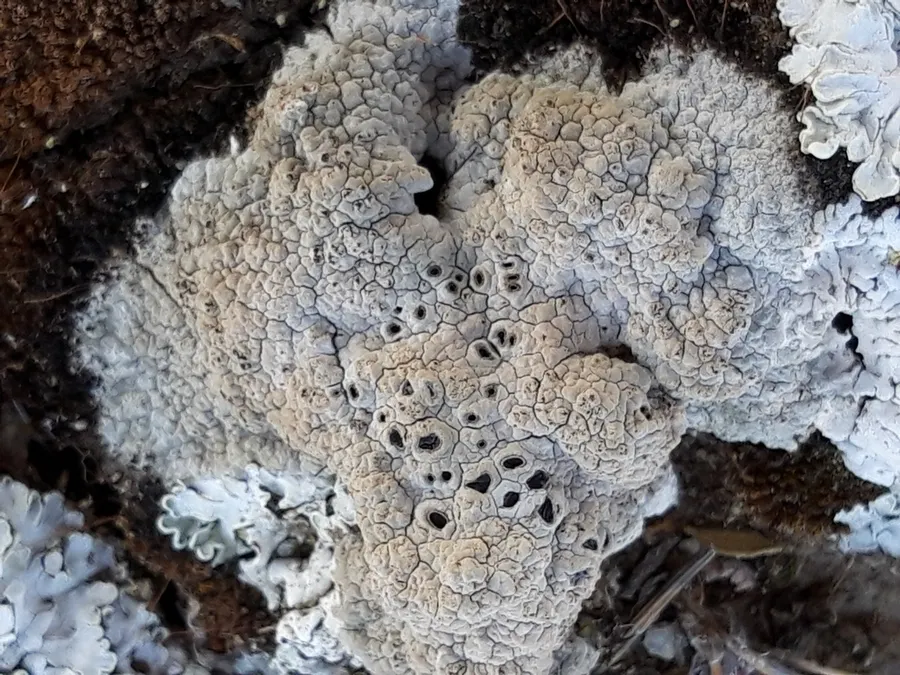
Diploschistes diacapsis is a soil-dwelling crustose lichen that forms a greyish to greyish-white crust broken by fine cracks into small, irregular (patches). In the Greater Sonoran Desert flora, the thallus is described as cracked (rimose) and sometimes warty, forming areoles 0.5–2.5 mm wide and a rough, dull, whitish to whitish-grey upper surface that may be scarcely to abundantly pruinose (powder-dusted). The apothecia are urceolate, sessile, and up to 2.5 mm in diameter, with a concave, blackish disc. The thallus is often very thick and heavily pruinose, giving it a pale grey, sometimes slightly undulating appearance, and it may form patches more than 5 cm across; the areoles may reach about 2.5 mm in diameter, and rhizines (root-like anchoring structures) are absent. The (photosynthetic algal partner) is a green alga of the Trebouxia type. The apothecia are usually urn-shaped (), sometimes becoming more open, about 2–5 mm across, and may also be pruinose; the proper rim is brown and built of tightly packed tissue. Under the microscope, the hymenium (spore-bearing layer) is about 110–180 μm tall, with simple paraphyses 1–2 μm thick. The asci are subclavate to cylindrical (about 100–140 × 20–28 μm) and contain 4–8 spores. Ascospores are brown and muriform (divided into many compartments), typically 20–40 × 9–17 μm, with 3–6 transverse and 1–2 longitudinal septa. Asexual spores are produced in immersed (sunken) pycnidia; the conidia are bacilliform (rod-shaped), about 4–6 × 1.0–1.5 μm. D. diacapsis contains lecanoric acid and diploschistesic acid. In standard spot tests the thallus is K+ (yellow turning red) and C+ (red), and PD−.

Sebagian uraian ditampilkan dalam bahasa sumber; terjemahannya belum tersedia atau belum lolos pemeriksaan.

Rujukan: [1]

Pengukuran mengikuti objek, spesimen atau kultur, dan metode yang disebutkan sumber. Baca uraian asli untuk konteks lengkap.

02 / Kehidupan

Habitat dan peran ekologis

Diploschistes diacapsis is a soil-dwelling crustose lichen of open, exposed habitats, reported chiefly from calcareous (lime-rich) soils and also from gypsum-rich ground. Lumbsch characterised its overall range as "northern xeric" (dry regions of the Northern Hemisphere) and listed collections from the United States, Mexico, Macaronesia, Eurasia, and northern Africa; in Europe, he reported its northern limit as southern Switzerland. In western North America it is reported as common on gypsiferous soils in cool-desert regions, including coastal Sonora and southern California grasslands and chaparral, and it has also been reported from a wider range of soils farther south and east. In the Greater Sonoran Desert Region, D. diacapsis is described as common in semi-arid exposed habitats and coastal areas at 5–250 m and up to about 800 m in Baja California and southern California. It is also reported from higher elevations, occurring in open bushlands or open pine forests at about 1,600–1,800 m in Arizona and Chihuahua; the same flora describes its world distribution as nearly cosmopolitan (widespread, but not truly worldwide) in open habitats with Mediterranean to arid climates. Across multiple site reports, the species appears regularly in biological soil crusts in dry Mediterranean and steppe (semi-arid grassland) settings.

Sebagian uraian ditampilkan dalam bahasa sumber; terjemahannya belum tersedia atau belum lolos pemeriksaan.

Rujukan: [1]

Habitat atau konteks temuan
padang rumput
Substrat
Informasi belum tersedia pada sumber rilis ini.
Peran atau konteks
Pembentuk liken
Temukan hubungan serupa
03 / Siklus hidup

Reproduksi

Under the microscope, the hymenium (spore-bearing layer) is about 110–180 μm tall, with simple paraphyses 1–2 μm thick. The asci are subclavate to cylindrical (about 100–140 × 20–28 μm) and contain 4–8 spores. Ascospores are brown and muriform (divided into many compartments), typically 20–40 × 9–17 μm, with 3–6 transverse and 1–2 longitudinal septa. Asexual spores are produced in immersed (sunken) pycnidia; the conidia are bacilliform (rod-shaped), about 4–6 × 1.0–1.5 μm. D. diacapsis contains lecanoric acid and diploschistesic acid. In standard spot tests the thallus is K+ (yellow turning red) and C+ (red), and PD−. D. diacapsis contains diploschistesic and lecanoric acids as major components and orsellinic acid as a minor constituent.

Sebagian uraian ditampilkan dalam bahasa sumber; terjemahannya belum tersedia atau belum lolos pemeriksaan.

Rujukan: [1]

Sinonim menurut acuan taksonomi rilis: Diploschistes diacapsis subsp. interpediens; Lecanora scruposa var. diacapsis; Parmelia scruposa var. diacapsis; Urceolaria diacapsis; Urceolaria scruposa var. diacapsis; Urceolaria scruposa var. interpediens
04 / Batas informasi

Catatan identitas dan cakupan

  • Nama diterima mengikuti Catalogue of Life Base2026-09-11; uraian mempertahankan konsep dan nama sumber aslinya.
  • Original geographic, specimen and life-cycle scope retained; source import awaits individual editorial review.
  • Impor dan terjemahan otomatis belum diperiksa editorial per profil. Struktur reproduktif yang disebutkan tidak membuktikan seluruh siklus hidup diketahui.
  • Pengukuran pada uraian mengikuti spesimen, kultur, dan metode sumber; angka tidak diperluas ke semua populasi.

Catatan distribusi dalam narasi mengikuti sumbernya. Dokumentasi spesimen atau foto mengikuti catatan sumber. Bukti wilayah Indonesia dan penilaian konservasi tidak disimpulkan dari gambar.

05 / Dokumentasi

Melihat dengan konteks

Dokumentasi Diploschistes diacapsis menurut asosiasi foto pada record takson iNaturalist. Kredit: Rafael Medina. Identitas mengikuti sumber; bukan penentuan spesimen independen.

Jenis
Fotografi
Kredit
(c) Rafael Medina, some rights reserved (CC BY), uploaded by Rafael Medina
Lisensi
CC BY 4.0
Sumber media
Buka entri sumber

Gambar menunjukkan objek menurut identifikasi sumber, bukan verifikasi independen spesimen oleh Fungi. Tidak ada skala baru yang ditambahkan.

06 / Rujukan

Sumber profil

  1. [1] Diploschistes diacapsis — Wikipedia (en)Bagian sumber: Frozen revision 1334005367
    Tanggal penghimpunan sumber: 2026-10-12
    Teks sumber: CC BY-SA4.0 · Wikipedia contributors
  2. [2] Catalogue of Life Base2026-09-11 — Diploschistes diacapsisBagian sumber: ColDP NameUsage.tsv ID 36N2N; accepted species; source 2073
    Tanggal penghimpunan sumber: 2026-10-12
  3. [3] Dokumentasi visual — Diploschistes diacapsisBagian sumber: Individual media record; identification follows the source, not independent determination
    Tanggal penghimpunan sumber: 2026-10-12
    Media sumber: CC BY 4.0 · (c) Rafael Medina, some rights reserved (CC BY), uploaded by Rafael Medina

Adaptasi teks: CC BY-SA 4.0. Wikipedia contributors — Diploschistes diacapsis — Wikipedia (en)

Uraian asli dan riwayat sumber

Riwayat atau halaman sumber

Ringkasan sumber

Diploschistes diacapsis (also called the desert crater lichen) is a ground-dwelling crustose lichen in the family Graphidaceae. It forms a thick, pale grey to greyish-white crust that cracks into small patches. Its fruiting bodies (apothecia) are sunken and often dusted with a powdery coating (), and it produces brown, (multichambered) ascospores. The lichen body (thallus) contains lecanoric and diploschistesic acids. The species typically grows in arid and semi-arid regions on calcium-rich or gypsum soils, where it can form extensive pale carpets within biological soil crusts (surface communities of lichens, mosses, and microbes that bind soil).

Revisi sumber

Morfologi sumber

Diploschistes diacapsis is a soil-dwelling crustose lichen that forms a greyish to greyish-white crust broken by fine cracks into small, irregular (patches). In the Greater Sonoran Desert flora, the thallus is described as cracked (rimose) and sometimes warty, forming areoles 0.5–2.5 mm wide and a rough, dull, whitish to whitish-grey upper surface that may be scarcely to abundantly pruinose (powder-dusted). The apothecia are urceolate, sessile, and up to 2.5 mm in diameter, with a concave, blackish disc. The thallus is often very thick and heavily pruinose, giving it a pale grey, sometimes slightly undulating appearance, and it may form patches more than 5 cm across; the areoles may reach about 2.5 mm in diameter, and rhizines (root-like anchoring structures) are absent. The (photosynthetic algal partner) is a green alga of the Trebouxia type. The apothecia are usually urn-shaped (), sometimes becoming more open, about 2–5 mm across, and may also be pruinose; the proper rim is brown and built of tightly packed tissue. Under the microscope, the hymenium (spore-bearing layer) is about 110–180 μm tall, with simple paraphyses 1–2 μm thick. The asci are subclavate to cylindrical (about 100–140 × 20–28 μm) and contain 4–8 spores. Ascospores are brown and muriform (divided into many compartments), typically 20–40 × 9–17 μm, with 3–6 transverse and 1–2 longitudinal septa. Asexual spores are produced in immersed (sunken) pycnidia; the conidia are bacilliform (rod-shaped), about 4–6 × 1.0–1.5 μm. D. diacapsis contains lecanoric acid and diploschistesic acid. In standard spot tests the thallus is K+ (yellow turning red) and C+ (red), and PD−.

Revisi sumber

Ekologi sumber

Diploschistes diacapsis is a soil-dwelling crustose lichen of open, exposed habitats, reported chiefly from calcareous (lime-rich) soils and also from gypsum-rich ground. Lumbsch characterised its overall range as "northern xeric" (dry regions of the Northern Hemisphere) and listed collections from the United States, Mexico, Macaronesia, Eurasia, and northern Africa; in Europe, he reported its northern limit as southern Switzerland. In western North America it is reported as common on gypsiferous soils in cool-desert regions, including coastal Sonora and southern California grasslands and chaparral, and it has also been reported from a wider range of soils farther south and east. In the Greater Sonoran Desert Region, D. diacapsis is described as common in semi-arid exposed habitats and coastal areas at 5–250 m and up to about 800 m in Baja California and southern California. It is also reported from higher elevations, occurring in open bushlands or open pine forests at about 1,600–1,800 m in Arizona and Chihuahua; the same flora describes its world distribution as nearly cosmopolitan (widespread, but not truly worldwide) in open habitats with Mediterranean to arid climates. Across multiple site reports, the species appears regularly in biological soil crusts in dry Mediterranean and steppe (semi-arid grassland) settings.

Revisi sumber

Struktur reproduksi sumber

Under the microscope, the hymenium (spore-bearing layer) is about 110–180 μm tall, with simple paraphyses 1–2 μm thick. The asci are subclavate to cylindrical (about 100–140 × 20–28 μm) and contain 4–8 spores. Ascospores are brown and muriform (divided into many compartments), typically 20–40 × 9–17 μm, with 3–6 transverse and 1–2 longitudinal septa. Asexual spores are produced in immersed (sunken) pycnidia; the conidia are bacilliform (rod-shaped), about 4–6 × 1.0–1.5 μm. D. diacapsis contains lecanoric acid and diploschistesic acid. In standard spot tests the thallus is K+ (yellow turning red) and C+ (red), and PD−. D. diacapsis contains diploschistesic and lecanoric acids as major components and orsellinic acid as a minor constituent.

Revisi sumber

Rujukan halaman ini

Fungi. Diploschistes diacapsis. Rilis data fungi-2026-10-12-expansion-2. https://fungi-atlas.mgadib.chatgpt.site/jamur/diploschistes-diacapsis/.

Status: impor sumber; pemeriksaan editorial per profil belum selesai. Untuk klaim biologis, gunakan rujukan pada bagian terkait dan periksa konteks sumber aslinya.