01 / Morfologi

Ciri dan struktur

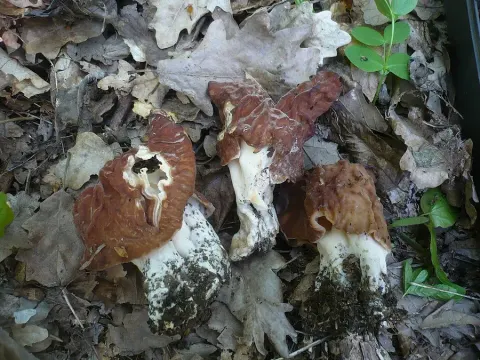
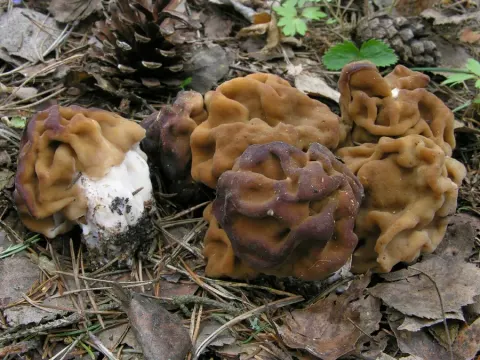
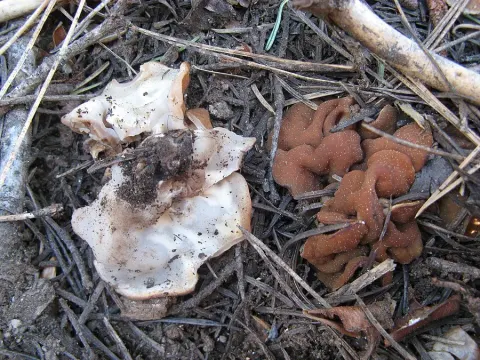
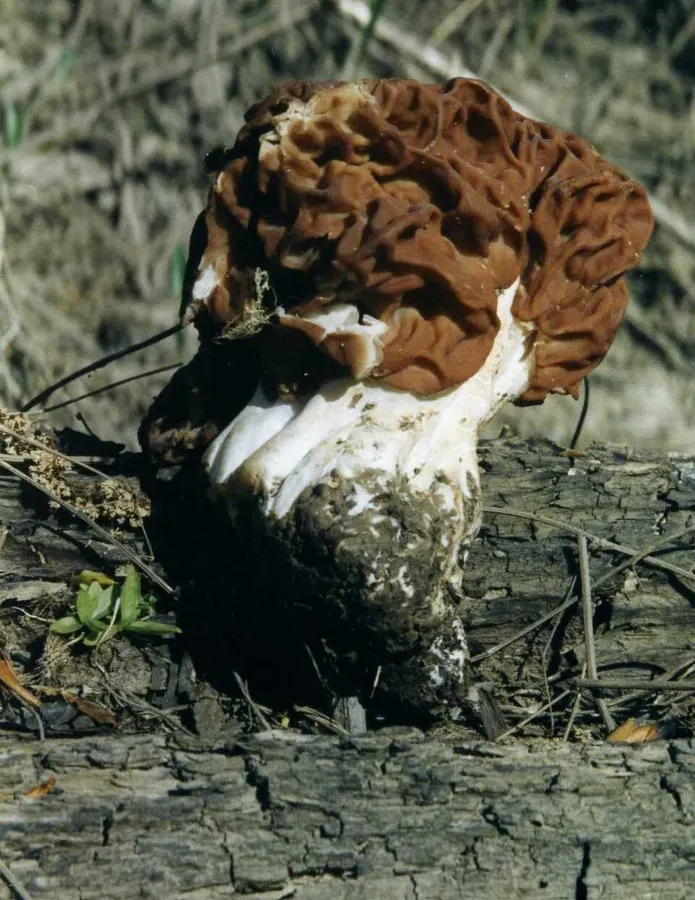
The cap is roughly spherical to elliptical, and features a folded, crumpled, or corrugated surface that somewhat resembles the surface of a brain. It has areas of more or less symmetrical pits, or ribs arranged vertically. The cap margin is close to the stipe and sometimes adheres to it. The color is reddish to reddish-brown, but becomes darker in weathered specimens; the reverse side is whitish. Fruit bodies are typically 6 – 7 cm across but can grow to be much larger. Fred J. Seaver reported one specimen to have grown to a height of 10.5 in, but a more usual height range is 15 – 20 cm. The underside is whitish, but not readily visible. The stipe is short and stout, furrowed, typically 6 – 10 cm long by 4 – 6 cm wide but sometimes much larger, and usually thickest at the base. Pure white when young and with a felt-like surface, it discolors in age or with handling. The upper portion of the stipe is usually branched, but the branches are hidden by the cap. The whitish flesh forms locules (chambers) and is densely packed in the stipe and cap, forming branches to the points of attachment. The spores are narrowly elliptical, hyaline (translucent), and apiculate (with a sharply pointed tip), measuring 30–33 by 11.5–14 μm. Spores usually have one large oil droplet and one or two smaller ones. Initially smooth, the spore surface becomes reticulate and coarse, developing small warts. The use of scanning electron microscopy has revealed up to 6 short apiculi (the part of a spore that attaches to the sterigmata) that originate from extensions of the reticulation. Asci (spore-bearing cells) are 320–420 by 18.5–23 μm, and the paraphyses are 6.5–5.9 μm wide.

Sebagian uraian ditampilkan dalam bahasa sumber; terjemahannya belum tersedia atau belum lolos pemeriksaan.

Rujukan: [1]

Pengukuran mengikuti objek, spesimen atau kultur, dan metode yang disebutkan sumber. Baca uraian asli untuk konteks lengkap.

02 / Kehidupan

Habitat dan peran ekologis

Buah jamur secara tunggal atau dalam kelompok longgar di tanah di bawah pohon kayu keras, dalam humus yang kaya. Tubuh buah tumbuh perlahan, dan spesimen yang tersisa sampai akhir musim bisa tumbuh hingga lima pon atau lebih.

Rujukan: [1]

Habitat atau konteks temuan
Informasi belum tersedia pada sumber rilis ini.
Substrat
tanah
Peran atau konteks
Belum dikategorikan pada rilis ini.
Temukan hubungan serupa
03 / Siklus hidup

Reproduksi

The spores are narrowly elliptical, hyaline (translucent), and apiculate (with a sharply pointed tip), measuring 30–33 by 11.5–14 μm. Spores usually have one large oil droplet and one or two smaller ones. Initially smooth, the spore surface becomes reticulate and coarse, developing small warts. The use of scanning electron microscopy has revealed up to 6 short apiculi (the part of a spore that attaches to the sterigmata) that originate from extensions of the reticulation. Asci (spore-bearing cells) are 320–420 by 18.5–23 μm, and the paraphyses are 6.5–5.9 μm wide.

Sebagian uraian ditampilkan dalam bahasa sumber; terjemahannya belum tersedia atau belum lolos pemeriksaan.

Rujukan: [1]

Sinonim menurut acuan taksonomi rilis: Gyromitra caroliniana; Helvella caroliniana; Mitrophora caroliniana; Morchella caroliniana; Neogyromitra caroliniana
04 / Batas informasi

Catatan identitas dan cakupan

  • Nama diterima mengikuti Catalogue of Life Base2026-09-11; uraian mempertahankan konsep dan nama sumber aslinya.
  • Original geographic, specimen and life-cycle scope retained; source import awaits individual editorial review.
  • Impor dan terjemahan otomatis belum diperiksa editorial per profil. Struktur reproduktif yang disebutkan tidak membuktikan seluruh siklus hidup diketahui.
  • Pengukuran pada uraian mengikuti spesimen, kultur, dan metode sumber; angka tidak diperluas ke semua populasi.

Catatan distribusi dalam narasi mengikuti sumbernya. Dokumentasi spesimen atau foto mengikuti catatan sumber. Bukti wilayah Indonesia dan penilaian konservasi tidak disimpulkan dari gambar.

05 / Dokumentasi

Melihat dengan konteks

Dokumentasi Gyromitra caroliniana dari Wikimedia Commons. The "false morel" Gyromitra caroliniana (Bosc) Fr. Specimen photographed in Holla Bend Wildlife Refuge, Pope County, Arkansas, USA. Identifikasi mengikuti record berkas sumber.

Jenis
Fotografi
Kredit
This image was created by user Ron Pastorino (Ronpast) at Mushroom Observer , a source for mycological images. You can contact this user here .
Sumber media
Buka entri sumber

Gambar menunjukkan objek menurut identifikasi sumber, bukan verifikasi independen spesimen oleh Fungi. Tidak ada skala baru yang ditambahkan.

06 / Rujukan

Sumber profil

  1. [1] Gyromitra caroliniana — Wikipedia (en)Bagian sumber: Frozen revision 1354169215
    Tanggal penghimpunan sumber: 2026-10-12
    Teks sumber: CC BY-SA4.0 · Wikipedia contributors
  2. [2] Catalogue of Life Base2026-09-11 — Discina carolinianaBagian sumber: ColDP NameUsage.tsv ID 36SRM; accepted species; source 2073
    Tanggal penghimpunan sumber: 2026-10-12
  3. [3] Dokumentasi visual — Gyromitra carolinianaBagian sumber: Individual media record; identification follows the source, not independent determination
    Tanggal penghimpunan sumber: 2026-10-12
    Media sumber: CC BY-SA 3.0 · This image was created by user Ron Pastorino (Ronpast) at Mushroom Observer , a source for mycological images. You can contact this user here .

Adaptasi teks: CC BY-SA 4.0. Wikipedia contributors — Gyromitra caroliniana — Wikipedia (en)

Uraian asli dan riwayat sumber

Riwayat atau halaman sumber

Ringkasan sumber

Gyromitra caroliniana, known commonly as the Carolina false morel or big red, is an ascomycete fungus of the genus Gyromitra, within the Pezizales group of fungi. It is found in hardwood forests of the southeastern United States, where it fruits in early spring soon after snowmelt. The fruit body, or ascocarp, appears on the ground in woodland, and can grow to massive sizes. The heavily wrinkled cap is red-brown in color, nearly spherical to roughly elliptical in shape, and typically measures 15 to 20 cm tall and 6 to 13 cm wide.

Revisi sumber

Morfologi sumber

The cap is roughly spherical to elliptical, and features a folded, crumpled, or corrugated surface that somewhat resembles the surface of a brain. It has areas of more or less symmetrical pits, or ribs arranged vertically. The cap margin is close to the stipe and sometimes adheres to it. The color is reddish to reddish-brown, but becomes darker in weathered specimens; the reverse side is whitish. Fruit bodies are typically 6 – 7 cm across but can grow to be much larger. Fred J. Seaver reported one specimen to have grown to a height of 10.5 in, but a more usual height range is 15 – 20 cm. The underside is whitish, but not readily visible. The stipe is short and stout, furrowed, typically 6 – 10 cm long by 4 – 6 cm wide but sometimes much larger, and usually thickest at the base. Pure white when young and with a felt-like surface, it discolors in age or with handling. The upper portion of the stipe is usually branched, but the branches are hidden by the cap. The whitish flesh forms locules (chambers) and is densely packed in the stipe and cap, forming branches to the points of attachment. The spores are narrowly elliptical, hyaline (translucent), and apiculate (with a sharply pointed tip), measuring 30–33 by 11.5–14 μm. Spores usually have one large oil droplet and one or two smaller ones. Initially smooth, the spore surface becomes reticulate and coarse, developing small warts. The use of scanning electron microscopy has revealed up to 6 short apiculi (the part of a spore that attaches to the sterigmata) that originate from extensions of the reticulation. Asci (spore-bearing cells) are 320–420 by 18.5–23 μm, and the paraphyses are 6.5–5.9 μm wide.

Revisi sumber

Ekologi sumber

The fungus fruits singly or in loose groups on the ground under hardwood trees, in rich humus. The fruit bodies develop slowly, and specimens left until late in the season can grow up to five pounds or more.

Revisi sumber

Struktur reproduksi sumber

The spores are narrowly elliptical, hyaline (translucent), and apiculate (with a sharply pointed tip), measuring 30–33 by 11.5–14 μm. Spores usually have one large oil droplet and one or two smaller ones. Initially smooth, the spore surface becomes reticulate and coarse, developing small warts. The use of scanning electron microscopy has revealed up to 6 short apiculi (the part of a spore that attaches to the sterigmata) that originate from extensions of the reticulation. Asci (spore-bearing cells) are 320–420 by 18.5–23 μm, and the paraphyses are 6.5–5.9 μm wide.

Revisi sumber

Rujukan halaman ini

Fungi. Discina caroliniana. Rilis data fungi-2026-10-12-expansion-2. https://fungi-atlas.mgadib.chatgpt.site/jamur/discina-caroliniana/.

Status: impor sumber; pemeriksaan editorial per profil belum selesai. Untuk klaim biologis, gunakan rujukan pada bagian terkait dan periksa konteks sumber aslinya.