Ciri dan struktur
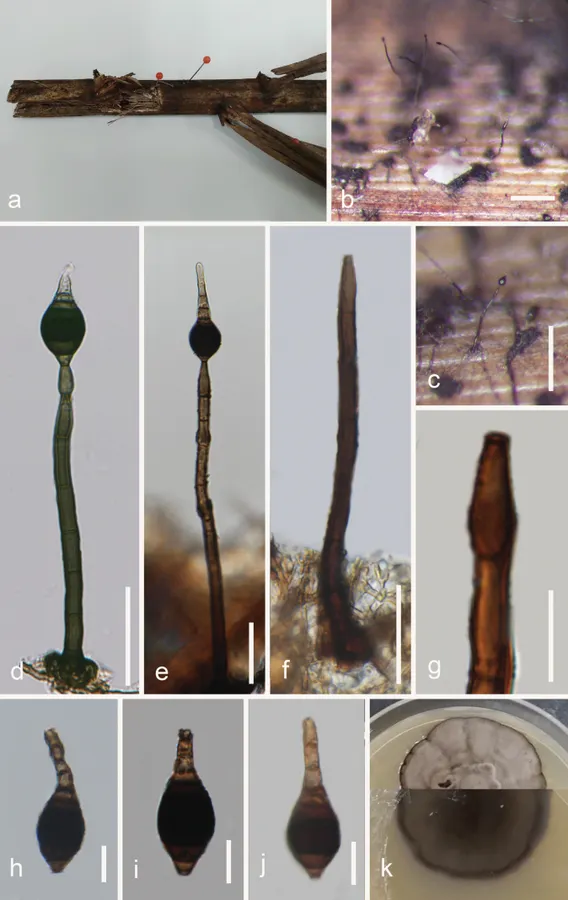
Saprobic on submerged rachis of Eleiodoxa conferta in peatswamp forest. Sexual morph: Undetermined. Asexual morph: Hyphomycetous. Mycelium immersed to superfacial, septate, smooth, brown to dark brown. Colonies on submerged rachis, solitary, scattered, dark brown to black. Conidiophores 71–161 × 5–6.5 µm (x̄ = 110 × 5.7 µm, n = 20), macronematous, mononematous, cylindrical, erect, straight to flexuous, unbranched, smooth or finely verrucose, thick-walled, dark brown, 5–10-septate with lobed basal cells, percurrent proliferations at the apex. Conidiogenous cells 13.5–18.8 × 5–6.8 µm (x̄ = 15.96 × 5.6 µm, n = 20), holoblastic, monoblastic, terminal, integrated, cylindrical to ampulliform, percurrent, brown to dark brown, smooth. Conidia 31.5–48 × 13.5–15.8 µm (x̄ = 40.8 × 14.8 µm, n = 30), secession schizolytic, solitary, obpyriform, rostrate, truncated base, 6–7-euseptate, verrucose, thick-walled, brown with dark brown to black cells in the middle, paler towards the apex. Colonies grown on PDA, reaching 30 mm in diameter after 15 days at 25 °C, under dark conditions, circular, entire to radially with lobate edge, well-defined margin, low convex, dull surface, felted, dense, mycelium superficial to immersed, without pigment diffusion and sporulation, greyish-brown on the top with dark brown margin, reverse brown with dark brown centre and margin.
Habitat dan peran ekologis
Saprobic on submerged rachis of Eleiodoxa conferta in peatswamp forest. Sexual morph: Undetermined. Asexual morph: Hyphomycetous. Mycelium immersed to superfacial, septate, smooth, brown to dark brown. Colonies on submerged rachis, solitary, scattered, dark brown to black. Conidiophores 71–161 × 5–6.5 µm (x̄ = 110 × 5.7 µm, n = 20), macronematous, mononematous, cylindrical, erect, straight to flexuous, unbranched, smooth or finely verrucose, thick-walled, dark brown, 5–10-septate with lobed basal cells, percurrent proliferations at the apex. Conidiogenous cells 13.5–18.8 × 5–6.8 µm (x̄ = 15.96 × 5.6 µm, n = 20), holoblastic, monoblastic, terminal, integrated, cylindrical to ampulliform, percurrent, brown to dark brown, smooth. Conidia 31.5–48 × 13.5–15.8 µm (x̄ = 40.8 × 14.8 µm, n = 30), secession schizolytic, solitary, obpyriform, rostrate, truncated base, 6–7-euseptate, verrucose, thick-walled, brown with dark brown to black cells in the middle, paler towards the apex. Colonies grown on PDA, reaching 30 mm in diameter after 15 days at 25 °C, under dark conditions, circular, entire to radially with lobate edge, well-defined margin, low convex, dull surface, felted, dense, mycelium superficial to immersed, without pigment diffusion and sporulation, greyish-brown on the top with dark brown margin, reverse brown with dark brown centre and margin.
- Habitat atau konteks temuan
- hutan
- Substrat
- Informasi belum tersedia pada sumber rilis ini.
- Peran atau konteks
- Pengurai
Reproduksi
Saprobic on submerged rachis of Eleiodoxa conferta in peatswamp forest. Sexual morph: Undetermined. Asexual morph: Hyphomycetous. Mycelium immersed to superfacial, septate, smooth, brown to dark brown. Colonies on submerged rachis, solitary, scattered, dark brown to black. Conidiophores 71–161 × 5–6.5 µm (x̄ = 110 × 5.7 µm, n = 20), macronematous, mononematous, cylindrical, erect, straight to flexuous, unbranched, smooth or finely verrucose, thick-walled, dark brown, 5–10-septate with lobed basal cells, percurrent proliferations at the apex. Conidiogenous cells 13.5–18.8 × 5–6.8 µm (x̄ = 15.96 × 5.6 µm, n = 20), holoblastic, monoblastic, terminal, integrated, cylindrical to ampulliform, percurrent, brown to dark brown, smooth.
Catatan identitas dan cakupan
- Nama diterima mengikuti Catalogue of Life Base2026-09-11; uraian mempertahankan konsep dan nama sumber aslinya.
- Preserve original treatment localities, hosts and substrate scope. Materials examined describe documented specimens, not the full global range.
- Impor dan terjemahan otomatis belum diperiksa editorial per profil. Struktur reproduktif yang disebutkan tidak membuktikan seluruh siklus hidup diketahui.
- Pengukuran pada uraian mengikuti spesimen, kultur, dan metode sumber; angka tidak diperluas ke semua populasi.
Catatan distribusi dalam narasi mengikuti sumbernya. Dokumentasi spesimen atau foto mengikuti catatan sumber. Bukti wilayah Indonesia dan penilaian konservasi tidak disimpulkan dari gambar.
Melihat dengan konteks
Distoseptispora eleiodoxae (MFLU 23-0277, holotype) a host material b, c colonies on the substrate d–f conidiophores and conidia g conidiogenous cell h–j conidia k culture on PDA (top and reverse). Scale bars: 100 µm (b, c); 30 µm (d–f); 10 µm (g–j).
- Jenis
- Pelat ilmiah
- Kredit
- Omid Karimi, K. W. Thilini Chethana, Antonio R. G. de Farias, Raheleh Asghari, Saithong Kaewchai, Kevin D. Hyde, Qirui Li
- Lisensi
- CC BY 4.0
- Sumber media
- Buka entri sumber
Sumber profil
- [1] Morphology and multigene phylogeny reveal three new species of Distoseptispora (Distoseptisporales, Distoseptisporaceae) on palms (Arecaceae) from peatswamp areas in southern Thailand — Distoseptispora eleiodoxae
- [2] Catalogue of Life Base2026-09-11 — Distoseptispora eleiodoxae
- [3] Dokumentasi visual — Distoseptispora eleiodoxae
Rujukan halaman ini
Fungi. Distoseptispora eleiodoxae. Rilis data fungi-2026-10-12-expansion-2. https://fungi-atlas.mgadib.chatgpt.site/jamur/distoseptispora-eleiodoxae/.
Status: impor sumber; pemeriksaan editorial per profil belum selesai. Untuk klaim biologis, gunakan rujukan pada bagian terkait dan periksa konteks sumber aslinya.