01 / Morfologi

Ciri dan struktur

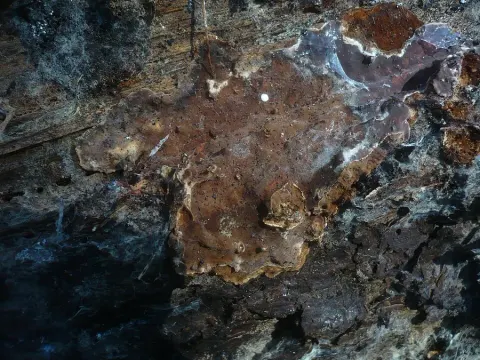
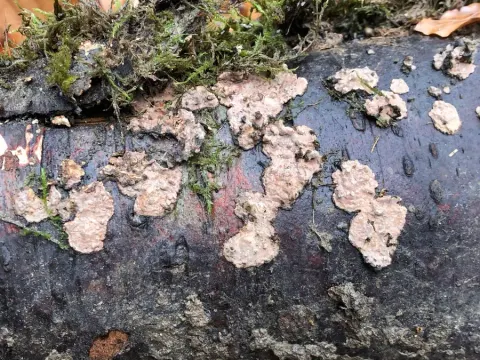
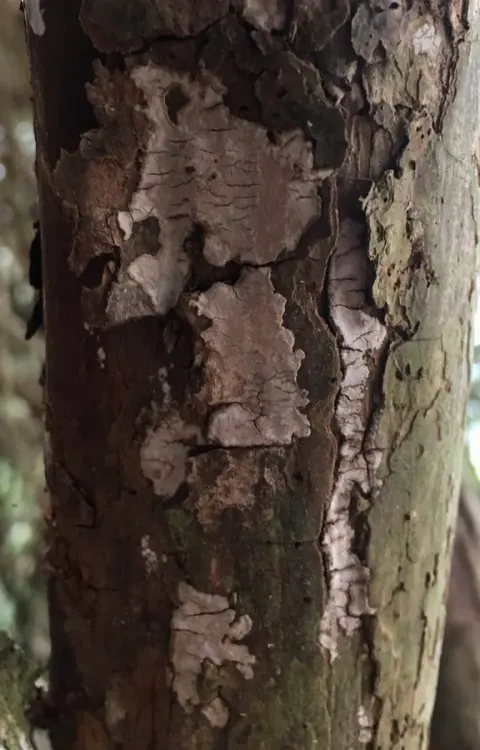
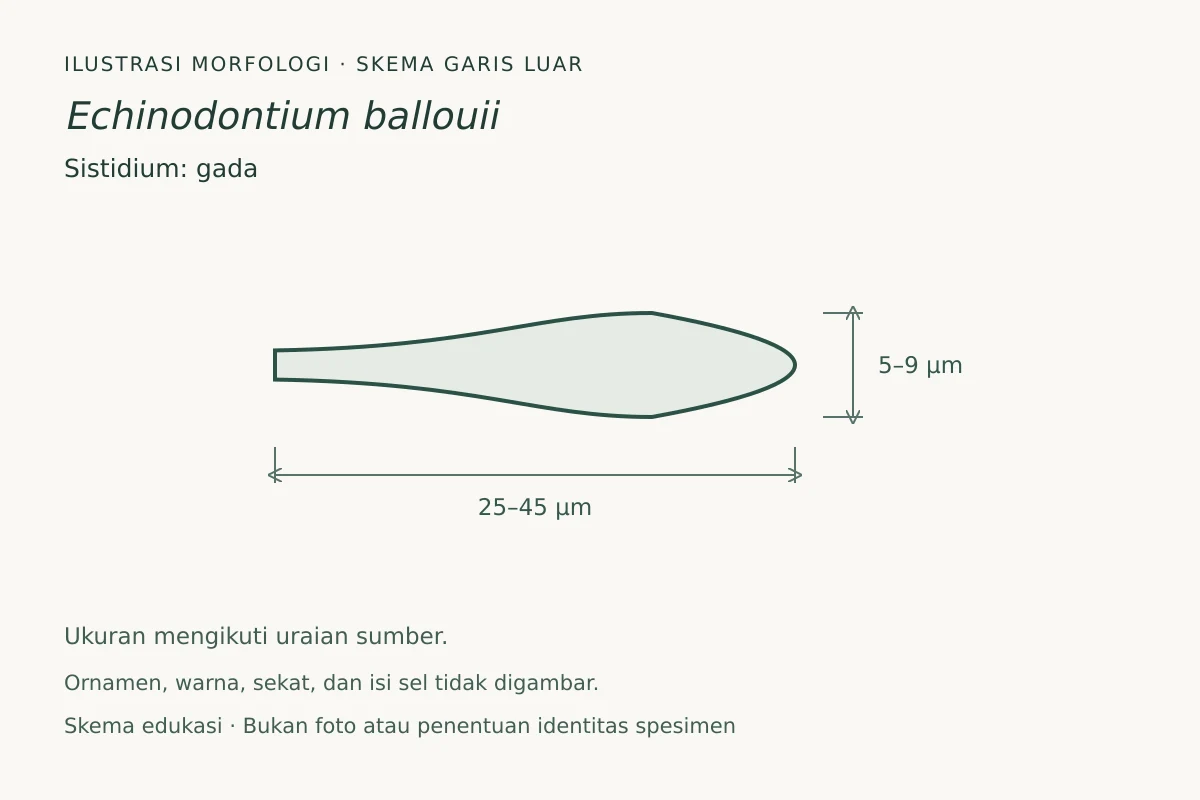
The fungi's fruiting bodies are irregularly-shaped shelf-like formations. Their diameters can span 5-50 centimeters, and they can grow up to 20 centimeters tall. and the body is tough and woody. They are commonly seen with “teeth” or “spines” protruding from the cap's underside. As a polypore, the fungus's spores are released from an underside covered in small pores, which is lighter in color. These pores are conchate or bell-shaped and release the fungus's basidiospores. The fungus's spores measure between 5-7 μm long and 2-3 μm tall and are strongly amyloid (turn blue-black under Melzer's reagent).As a polypore, Echinodontium ballouii is perennial, releasing spores once a year and forming a new layered hymenium directly on top of that of last year. The cystidia are 25-45 × 5-9 μm and club-shaped, becoming more thick-walled and dark with age. The basidia measure 20-25 × 6-8 μm and have 4 sterigma each. The context (flesh) is made of skeletal and generative hyphae. The skeletal hyphae have a diameter of 3.5-4.5 μm, and are brown and smooth, with thick walls. The generative hyphae have a similar diameter and texture, but are transparent, thin-walled and nodose-septate. The small number of recorded Echinodontium ballouii has resulted in its classification as endangered. This is in part due to the formerly high demand for the fungi's host body, the Atlantic white cedar, for shipbuilding lumber, especially due to its coastal proximity. Today, demand for lumber still puts this important decomposer at risk. The fungus is named for William Hosea Ballou, one of its earliest discoverers.

Sebagian uraian ditampilkan dalam bahasa sumber; terjemahannya belum tersedia atau belum lolos pemeriksaan.

Rujukan: [1]

Pengukuran mengikuti objek, spesimen atau kultur, dan metode yang disebutkan sumber. Baca uraian asli untuk konteks lengkap.

02 / Kehidupan

Habitat dan peran ekologis

Echinodontium ballouii is a hemi-biotrophic wood decomposer, feeding off of only a single species of tree: the Chamaecyparis thyoides Atlantic white cedar. The fungus forms complex mycelial networks inside the tree's trunk, slowly digesting cellulose and lignin, and emerging as fruiting bodies in order to reproduce. They are often found relatively high up on trees, below branching points. Because this fungus only inhabits Chamaecyparis thyoides, its habitat is limited to this tree's ecological environment: swampy, coniferous forests within 150 miles of the Eastern coast of the United States. The production of fruiting bodies can take up to forty years, which means that the fungus is typically found on old growth trees. The fungus's limited host species results in a very confined geographical distribution. Only about twenty visibly occupied trees have been documented to date, each in the East coast of the United States, with the first sighted in New Jersey.

Sebagian uraian ditampilkan dalam bahasa sumber; terjemahannya belum tersedia atau belum lolos pemeriksaan.

Rujukan: [1]

Habitat atau konteks temuan
hutan
Substrat
Informasi belum tersedia pada sumber rilis ini.
Peran atau konteks
Belum dikategorikan pada rilis ini.
Temukan hubungan serupa
03 / Siklus hidup

Reproduksi

The fungi's fruiting bodies are irregularly-shaped shelf-like formations. Their diameters can span 5-50 centimeters, and they can grow up to 20 centimeters tall. and the body is tough and woody. They are commonly seen with “teeth” or “spines” protruding from the cap's underside. As a polypore, the fungus's spores are released from an underside covered in small pores, which is lighter in color. These pores are conchate or bell-shaped and release the fungus's basidiospores. The fungus's spores measure between 5-7 μm long and 2-3 μm tall and are strongly amyloid (turn blue-black under Melzer's reagent).As a polypore, Echinodontium ballouii is perennial, releasing spores once a year and forming a new layered hymenium directly on top of that of last year.

Sebagian uraian ditampilkan dalam bahasa sumber; terjemahannya belum tersedia atau belum lolos pemeriksaan.

Rujukan: [1]

Sinonim menurut acuan taksonomi rilis: Hydnum ballouii; Radulum ballouii; Steccherinum ballouii
04 / Batas informasi

Catatan identitas dan cakupan

  • Nama diterima mengikuti Catalogue of Life Base2026-09-11; uraian mempertahankan konsep dan nama sumber aslinya.
  • Original geographic, specimen and life-cycle scope retained; source import awaits individual editorial review.
  • Impor dan terjemahan otomatis belum diperiksa editorial per profil. Struktur reproduktif yang disebutkan tidak membuktikan seluruh siklus hidup diketahui.
  • Pengukuran pada uraian mengikuti spesimen, kultur, dan metode sumber; angka tidak diperluas ke semua populasi.

Catatan distribusi dalam narasi mengikuti sumbernya. Dokumentasi spesimen atau foto mengikuti catatan sumber. Bukti wilayah Indonesia dan penilaian konservasi tidak disimpulkan dari gambar.

05 / Dokumentasi

Melihat dengan konteks

Ilustrasi skematis garis luar sistidium Echinodontium ballouii, berdasarkan uraian sumber; ukuran yang dilaporkan 25–45 × 5–9 µm. Proporsi disederhanakan, bukan salinan satu spesimen. Ornamen permukaan, warna, sekat, dan isi sel tidak direkonstruksi. Sistidium berbentuk gada, 25–45 × 5–9 µm. Penebalan dinding tidak direkonstruksi; basidium dengan sterigma tidak digunakan. Ornamen, warna, sekat, dan isi sel tidak digambar. Skema edukasi, bukan alat identifikasi.

Jenis
Ilustrasi skematis
Kredit
Fungi, ilustrasi orisinal (2026); fakta morfologi berdasarkan Wikipedia contributors
Sumber media
Buka entri sumber

Gambar menunjukkan objek menurut identifikasi sumber, bukan verifikasi independen spesimen oleh Fungi. Tidak ada skala baru yang ditambahkan.

06 / Rujukan

Sumber profil

  1. [1] Echinodontium ballouii — Wikipedia (en)Bagian sumber: Frozen revision 1292471167
    Tanggal penghimpunan sumber: 2026-10-12
    Media sumber: CC BY-SA4.0 · Wikipedia contributors
  2. [2] Catalogue of Life Base2026-09-11 — Echinodontium ballouiiBagian sumber: ColDP NameUsage.tsv ID 6DVJB; accepted species; source 2073
    Tanggal penghimpunan sumber: 2026-10-12

Adaptasi teks: CC BY-SA 4.0. Wikipedia contributors — Echinodontium ballouii — Wikipedia (en)

Uraian asli dan riwayat sumber

Riwayat atau halaman sumber

Ringkasan sumber

The fungi's fruiting bodies are irregularly-shaped shelf-like formations. Their diameters can span 5-50 centimeters, and they can grow up to 20 centimeters tall. and the body is tough and woody. They are commonly seen with “teeth” or “spines” protruding from the cap's underside. As a polypore, the fungus's spores are released from an underside covered in small pores, which is lighter in color. These pores are conchate or bell-shaped and release the fungus's basidiospores. The fungus's spores measure between 5-7 μm long and 2-3 μm tall and are strongly amyloid (turn blue-black under Melzer's reagent).As a polypore, Echinodontium ballouii is perennial, releasing spores once a year and forming a new layered hymenium directly on top of that of last year.

Revisi sumber

Morfologi sumber

The fungi's fruiting bodies are irregularly-shaped shelf-like formations. Their diameters can span 5-50 centimeters, and they can grow up to 20 centimeters tall. and the body is tough and woody. They are commonly seen with “teeth” or “spines” protruding from the cap's underside. As a polypore, the fungus's spores are released from an underside covered in small pores, which is lighter in color. These pores are conchate or bell-shaped and release the fungus's basidiospores. The fungus's spores measure between 5-7 μm long and 2-3 μm tall and are strongly amyloid (turn blue-black under Melzer's reagent).As a polypore, Echinodontium ballouii is perennial, releasing spores once a year and forming a new layered hymenium directly on top of that of last year. The cystidia are 25-45 × 5-9 μm and club-shaped, becoming more thick-walled and dark with age. The basidia measure 20-25 × 6-8 μm and have 4 sterigma each. The context (flesh) is made of skeletal and generative hyphae. The skeletal hyphae have a diameter of 3.5-4.5 μm, and are brown and smooth, with thick walls. The generative hyphae have a similar diameter and texture, but are transparent, thin-walled and nodose-septate. The small number of recorded Echinodontium ballouii has resulted in its classification as endangered. This is in part due to the formerly high demand for the fungi's host body, the Atlantic white cedar, for shipbuilding lumber, especially due to its coastal proximity. Today, demand for lumber still puts this important decomposer at risk. The fungus is named for William Hosea Ballou, one of its earliest discoverers.

Revisi sumber

Ekologi sumber

Echinodontium ballouii is a hemi-biotrophic wood decomposer, feeding off of only a single species of tree: the Chamaecyparis thyoides Atlantic white cedar. The fungus forms complex mycelial networks inside the tree's trunk, slowly digesting cellulose and lignin, and emerging as fruiting bodies in order to reproduce. They are often found relatively high up on trees, below branching points. Because this fungus only inhabits Chamaecyparis thyoides, its habitat is limited to this tree's ecological environment: swampy, coniferous forests within 150 miles of the Eastern coast of the United States. The production of fruiting bodies can take up to forty years, which means that the fungus is typically found on old growth trees. The fungus's limited host species results in a very confined geographical distribution. Only about twenty visibly occupied trees have been documented to date, each in the East coast of the United States, with the first sighted in New Jersey.

Revisi sumber

Struktur reproduksi sumber

The fungi's fruiting bodies are irregularly-shaped shelf-like formations. Their diameters can span 5-50 centimeters, and they can grow up to 20 centimeters tall. and the body is tough and woody. They are commonly seen with “teeth” or “spines” protruding from the cap's underside. As a polypore, the fungus's spores are released from an underside covered in small pores, which is lighter in color. These pores are conchate or bell-shaped and release the fungus's basidiospores. The fungus's spores measure between 5-7 μm long and 2-3 μm tall and are strongly amyloid (turn blue-black under Melzer's reagent).As a polypore, Echinodontium ballouii is perennial, releasing spores once a year and forming a new layered hymenium directly on top of that of last year.

Revisi sumber

Rujukan halaman ini

Fungi. Echinodontium ballouii. Rilis data fungi-2026-10-12-expansion-2. https://fungi-atlas.mgadib.chatgpt.site/jamur/echinodontium-ballouii/.

Status: impor sumber; pemeriksaan editorial per profil belum selesai. Untuk klaim biologis, gunakan rujukan pada bagian terkait dan periksa konteks sumber aslinya.