Ciri dan struktur
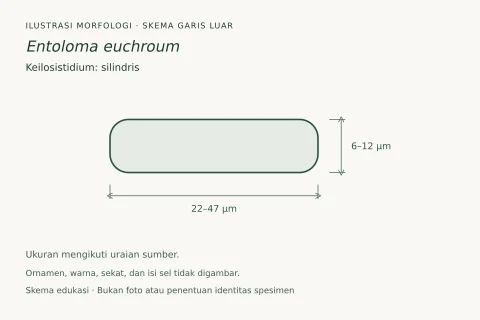
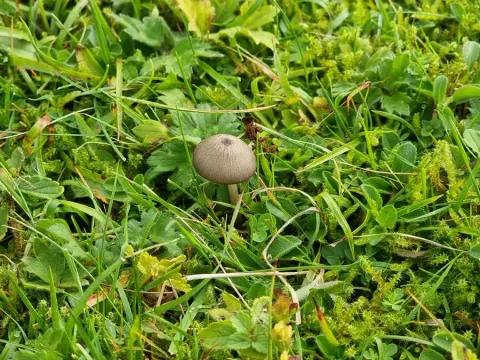
E. erectoides is distinguished by the greyish brown pileus covered with silvery fibrils, large basidiospores (13.5–17.5 × 8–9.5 µm) and presence of ovoid to subutriform cheilocystidia. Pileus 5–15 mm broad, bluntly conic, convex or campanulate, dry, slightly hygrophanous, greyish-brown to brown (5C2–5D2), densely covered with suberect fibrils or minutely fibrillose squamules; fibrils silvery greyish, striate from entire margin to near centre. Lamellae sinuate, ventricose, distant, up to 3.5 mm wide, moderately thick, with two tiers of lamellulae, dark grey to brownish-grey, with entire and concolorous edge. Stipe 40–60 × 1–2.5 mm, central, cylindrical, equal, dry, concolorous with pileus, densely covered with grey to greyish fibrils, hollow, surface dry, with a pale yellow brownish to pale brownish strigose base. Context thin, concolorous with pileus. Odour and taste not distinctive. Basidiospores (13–) 13.5–17.5 × 8–9.5 (–10.5) µm (x = 15.5 ± 0.5 × 8.8 ± 0.3 µm), Q = 1.50–1.94 (Q = 1.72 ± 0.03), heterodiametric, strongly angled in profile and face views with 6–9 facets, appearing nodulose, pale yellow brownish, thick-walled. Basidia 39–48 × 13–18 µm, subclavate or clavate, 4-spored. Aborted basidia scattered in the hymenium, often filled with dark brown amorphous cytoplasmic pigment. Lamellar trama dark brown, composed of parallel, cylindrical, heavily encrusted and thin-walled cells, 6–15 µm wide. Lamellar edge sterile. Cheilocystidia 33–90 × 12–33 µm, broadly ovoid to utriform (32–65 × 22–30 µm) or lageniform (70–90 × 16–20 µm), with pale brownish, intracellular pigment, slightly thick-walled.
Habitat dan peran ekologis
Scattered or gregarious on soil and amongst leaf litter in broadleaf forest dominated by Quercus or on soil amongst decaying leaves of Betula, Pandus and Abies.
- Habitat atau konteks temuan
- hutan
- Substrat
- tanah
- Peran atau konteks
- Belum dikategorikan pada rilis ini.
Reproduksi
E. erectoides is distinguished by the greyish brown pileus covered with silvery fibrils, large basidiospores (13.5–17.5 × 8–9.5 µm) and presence of ovoid to subutriform cheilocystidia. Pileus 5–15 mm broad, bluntly conic, convex or campanulate, dry, slightly hygrophanous, greyish-brown to brown (5C2–5D2), densely covered with suberect fibrils or minutely fibrillose squamules; fibrils silvery greyish, striate from entire margin to near centre. Lamellae sinuate, ventricose, distant, up to 3.5 mm wide, moderately thick, with two tiers of lamellulae, dark grey to brownish-grey, with entire and concolorous edge. Stipe 40–60 × 1–2.5 mm, central, cylindrical, equal, dry, concolorous with pileus, densely covered with grey to greyish fibrils, hollow, surface dry, with a pale yellow brownish to pale brownish strigose base.
Catatan identitas dan cakupan
- Nama diterima mengikuti Catalogue of Life Base2026-09-11; uraian mempertahankan konsep dan nama sumber aslinya.
- Preserve original treatment localities, hosts and substrate scope. Materials examined describe documented specimens, not the full global range.
- Impor dan terjemahan otomatis belum diperiksa editorial per profil. Struktur reproduktif yang disebutkan tidak membuktikan seluruh siklus hidup diketahui.
- Pengukuran pada uraian mengikuti spesimen, kultur, dan metode sumber; angka tidak diperluas ke semua populasi.
Catatan distribusi dalam narasi mengikuti sumbernya. Dokumentasi spesimen atau foto mengikuti catatan sumber. Bukti wilayah Indonesia dan penilaian konservasi tidak disimpulkan dari gambar.
Melihat dengan konteks
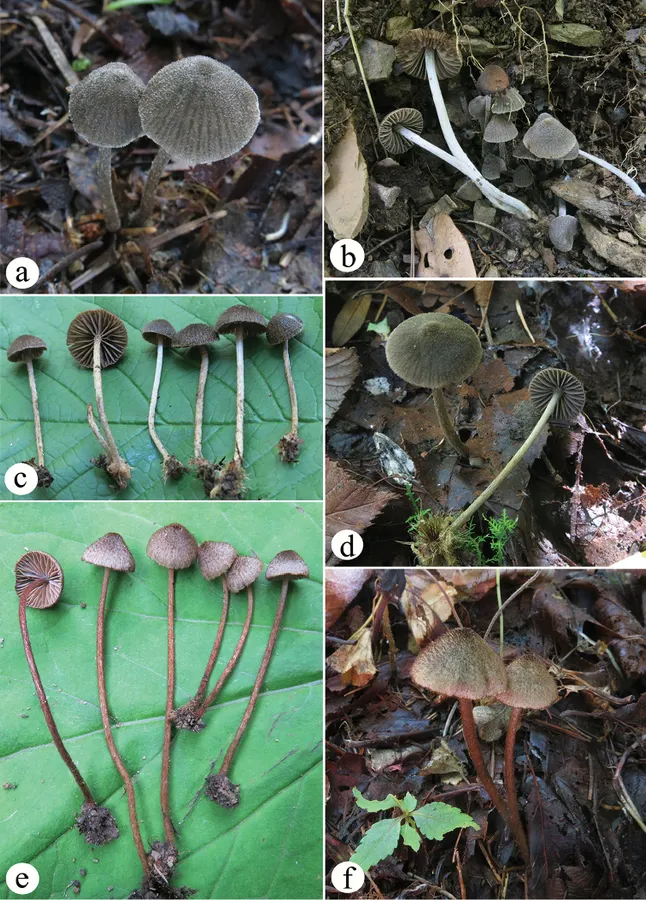
Basidiomata of the new species. a, b E. erectoides (SAAS 1361, SAAS 1232) c, d E. griseocarpum (SAAS 951, SAAS 1328) e, f E. rubropilosum (SAAS 406, SAAS 1112).
- Jenis
- Pelat ilmiah
- Kredit
- Xiao-Lan He, Egon Horak, Di Wang, Wei-Hong Peng, Bing-Cheng Gan
- Lisensi
- CC BY 4.0
- Sumber media
- Buka entri sumber
Dokumentasi tambahan
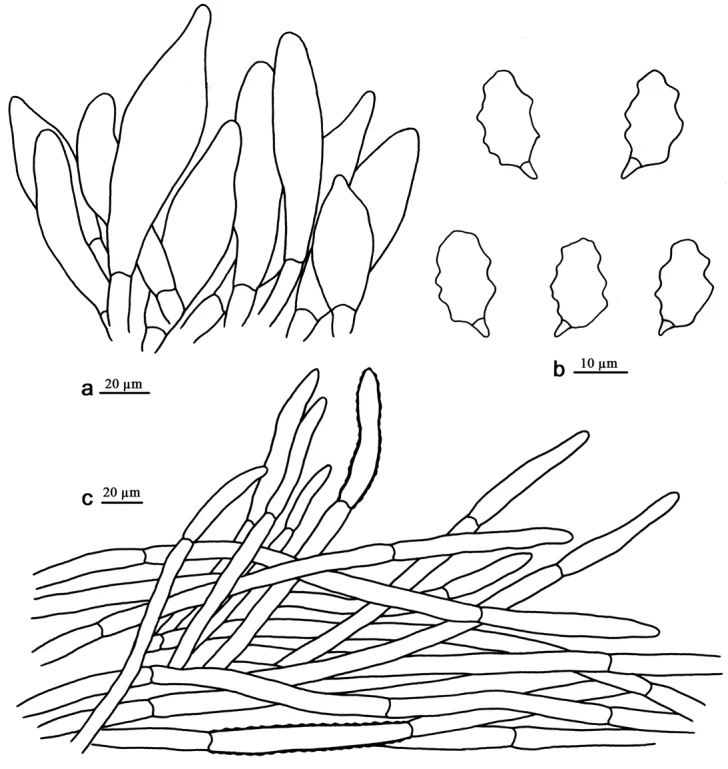
Microscopic structures of E. erectoides (drawn from the holotype). a Cheilocystidia b Basidiospores c Pileipellis.
Kredit dan penggunaan
Xiao-Lan He, Egon Horak, Di Wang, Wei-Hong Peng, Bing-Cheng Gan
Ukuran dan format gambar disesuaikan tanpa pemotongan, retus, atau penambahan skala. Lisensi sumber dipertahankan.
Sumber profil
- [1] Three new species of Entoloma subgenus Pouzarella from China based on morphological and molecular data — Entoloma erectoides
- [2] Catalogue of Life Base2026-09-11 — Entoloma erectoides
- [3] Dokumentasi visual — Entoloma erectoides
- [4] Dokumentasi visual — Entoloma erectoides
Rujukan halaman ini
Fungi. Entoloma erectoides. Rilis data fungi-2026-10-12-expansion-2. https://fungi-atlas.mgadib.chatgpt.site/jamur/entoloma-erectoides/.
Status: impor sumber; pemeriksaan editorial per profil belum selesai. Untuk klaim biologis, gunakan rujukan pada bagian terkait dan periksa konteks sumber aslinya.