Ciri dan struktur
Entoloma gregarium resembles the Chinese E. conchatum, but differs by smaller basidiospores. Pileus 5–10 mm, conchate, broadly convex, pure white, unchanging with age, entirely matted-tomentose to matted-depressed fibrillose, opaque, dry, not hygrophanous, margin not striate. Lamellae adnexed, subdistant to distant, subventricose, up to 2 mm wide, with two tiers of lamellulae, white at first, becoming pale pink, in moist condition with small red droplets at edges. Stipe 1–3 × 0.5–1 mm, strongly reduced, lateral, translucent, covered with minutely, white fibrils, equal, with white basal mycelium. Context white, unchanging, thin. Odour and taste not distinctive. Basidiospores 7–9 (9.5) × 5.5–7 µm (x = 7.7 ± 0.3 × 6.3 ± 0.3 µm), Q = 1.16–1.47, Q = 1.25 ± 0.04, 5–6 (7)-angled, heterodiametric in profile view. Basidia (26–) 30–34 × 7–10 µm, subclavate, 4-spored, clampless. Lamellar edge fertile. Cheilocystidia, pleurocystidia and caulocystidia absent. Pileipellis a cutis of cylindrical hyphae, terminal cells (25–) 35–60 × 5–10 µm, subclavate or cylindrical (rarely also subfusoid), repent or slightly uplifted, non-gelatinised wall thin, smooth, with inconspicuous plasmatic pigment, subpellis composed of short-celled cylindrical hyphae, 6–14 µm diam. Oleiferous hyphae present in pileipellis. Clamp-connections present in all tissues.
Habitat dan peran ekologis
As compared to other sympatric Chinese species, E. gregarium is unique due to the combination of the following characters viz. persistently white and gregarious basidiomes and small basidiospores. The aforementioned taxa of Claudopus viz. E. conchatum, E. indocarneum, E. crepidotoides, E. exiguum, E. jahnii, C. minutoincanus, C. pandanicola, E. parasiticum, E. pitereka, C. rupestris and C. viscosus have white basidiomes and, accordingly, are macroscopically similar to E. gregarium. However, E. gregarium is separated from E. conchatum, E. jahnii, C. minutoincanus, E. parasiticum, E. pitereka and C. viscosus by smaller basidiospores; C. rupestris differs by the 4–5-angled basidiospores (Largent et al. 2011; Noordeloos 2004). Based on macromorphological characters, E. gregarium is difficult to distinguish from E. crepidotoides (Deng et al. 2015); however, the different habitats allow the two species to be discriminated. Additionally, the molecular evidence (Figs 8, 9) of E. crepidotoides and E. gregarium clearly indicate that they are two distinctive species. E. indocarneum is characterised by smooth pileus and presence of mycelial rhizoids (Manimohan et al. 2002). Claudopus pandanicola, originally described from tropical Papua New Guinea, is separated by the striate pileus and the different shape of the basidiospores (7–8 × 6.5–7.5 µm, Horak 1980).
- Habitat atau konteks temuan
- Informasi belum tersedia pada sumber rilis ini.
- Substrat
- Informasi belum tersedia pada sumber rilis ini.
- Peran atau konteks
- Belum dikategorikan pada rilis ini.
Reproduksi
Entoloma gregarium resembles the Chinese E. conchatum, but differs by smaller basidiospores. Pileus 5–10 mm, conchate, broadly convex, pure white, unchanging with age, entirely matted-tomentose to matted-depressed fibrillose, opaque, dry, not hygrophanous, margin not striate. Lamellae adnexed, subdistant to distant, subventricose, up to 2 mm wide, with two tiers of lamellulae, white at first, becoming pale pink, in moist condition with small red droplets at edges. Stipe 1–3 × 0.5–1 mm, strongly reduced, lateral, translucent, covered with minutely, white fibrils, equal, with white basal mycelium. Context white, unchanging, thin. Odour and taste not distinctive. Basidiospores 7–9 (9.5) × 5.5–7 µm (x = 7.7 ± 0.3 × 6.3 ± 0.3 µm), Q = 1.16–1.47, Q = 1.25 ± 0.04, 5–6 (7)-angled, heterodiametric in profile view.
Catatan identitas dan cakupan
- Nama diterima mengikuti Catalogue of Life Base2026-09-11; uraian mempertahankan konsep dan nama sumber aslinya.
- Preserve original treatment localities, hosts and substrate scope. Materials examined describe documented specimens, not the full global range.
- Impor dan terjemahan otomatis belum diperiksa editorial per profil. Struktur reproduktif yang disebutkan tidak membuktikan seluruh siklus hidup diketahui.
- Pengukuran pada uraian mengikuti spesimen, kultur, dan metode sumber; angka tidak diperluas ke semua populasi.
Catatan distribusi dalam narasi mengikuti sumbernya. Dokumentasi spesimen atau foto mengikuti catatan sumber. Bukti wilayah Indonesia dan penilaian konservasi tidak disimpulkan dari gambar.
Melihat dengan konteks
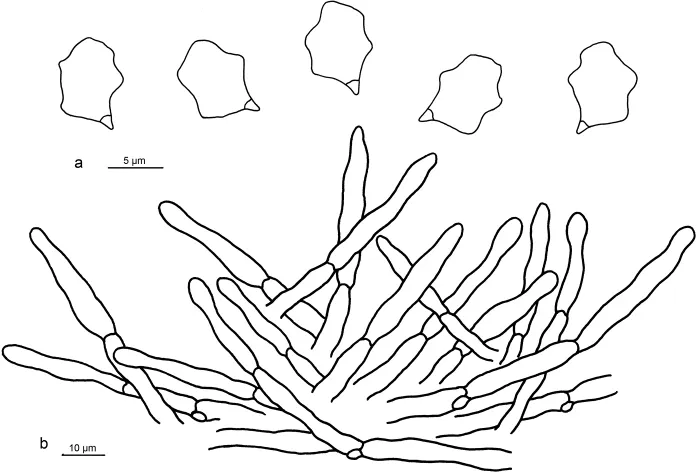
Microscopic structures of Entoloma gregarium (holotype) a Basidiospores b Basidia c Pileipellis.
- Jenis
- Pelat ilmiah
- Kredit
- Xiao-Lan He, Egon Horak, Di Wang, Tai-Hui Li, Wei-Hong Peng, Bing-Cheng Gan
- Lisensi
- CC BY 4.0
- Sumber media
- Buka entri sumber
Dokumentasi tambahan
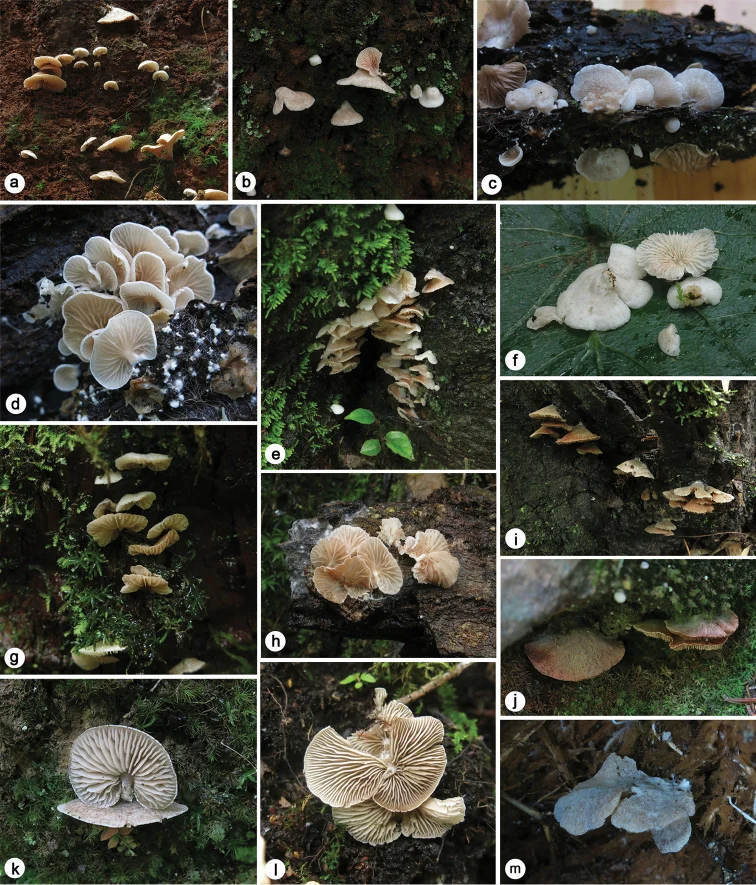
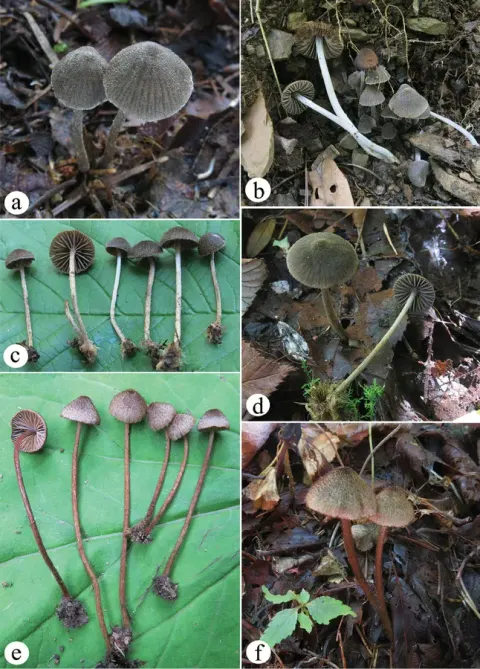
Pelat perbandingan tepian lamela. Entoloma gregarium ditampilkan pada panel f; panel lainnya memuat spesies pembanding. Pembagian panel mengikuti keterangan sumber.
Kredit dan penggunaan
Xiao-Lan He, Egon Horak, Di Wang, Tai-Hui Li, Wei-Hong Peng, Bing-Cheng Gan
Ukuran dan format gambar disesuaikan tanpa pemotongan, retus, atau penambahan skala. Lisensi sumber dipertahankan.
Sumber profil
- [1] Descriptions of five new species in Entoloma subgenus Claudopus from China, with molecular phylogeny of Entoloma s.l. — Entoloma gregarium
- [2] Catalogue of Life Base2026-09-11 — Entoloma gregarium
- [3] Dokumentasi visual — Entoloma gregarium
- [4] Dokumentasi visual — Entoloma gregarium
Rujukan halaman ini
Fungi. Entoloma gregarium. Rilis data fungi-2026-10-12-expansion-2. https://fungi-atlas.mgadib.chatgpt.site/jamur/entoloma-gregarium/.
Status: impor sumber; pemeriksaan editorial per profil belum selesai. Untuk klaim biologis, gunakan rujukan pada bagian terkait dan periksa konteks sumber aslinya.