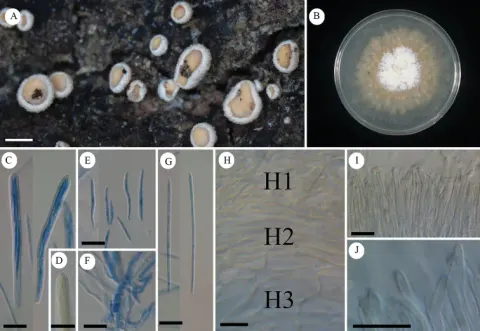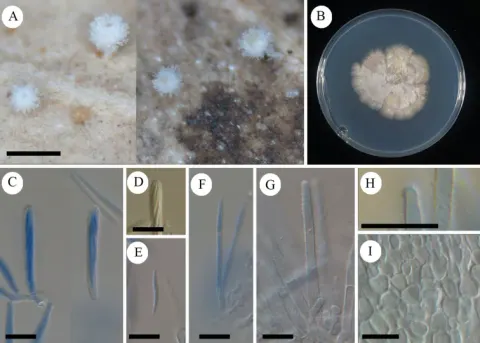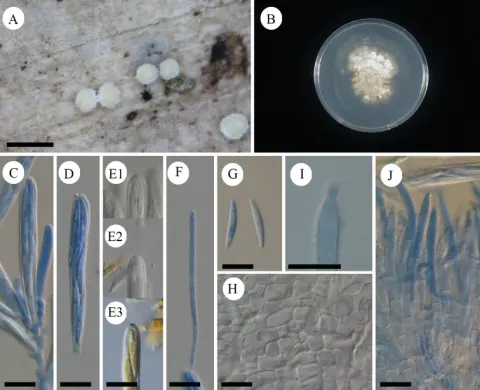
Ciri dan struktur
Differs from all other Erioscyphella species by the granulate walls of the ectal excipular cells. Apothecia scattered, superficial, 0.5–1.0 mm in diameter, having well-developed stipes, up to 1.5 mm high, cream to pale brown, externally covered with short and shiny hairs. Disc concave, cream to pale yellow. Ectal excipulum textura prismatica composed of long elongated cells to textura angularis, 6–25 × 5–13 µm, hyaline to relatively brown colored, somewhat thick-walled; cell walls covered by granules with a similar appearance to those on hairs. Stipe composed of textura prismatica with a granulate surface as ectal excipular cells. Medullary excipulum textura intricata of hyaline hyphae up to 3 µm wide. Hairs straight, cylindrical, 38–62 × 2.5–4.0 µm, hyaline, completely covered by brown granules, 2–3-septate, thin-walled, arising from swelling cells completely covered by granules; apex lacking crystals or apical amorphous materials, equipped with amber-colored resinous materials dissolvable with CB / LA at a little below the apex. Asci (36–)37.7–44(–46) × (3.5–)3.6–4.2(–4.5) µm (av. 41 ±3.2 × 3.9 ± 0.3 µm, n = 16), 8-spored, cylindrical-clavate; pore blue in MLZ without 3% KOH pretreatment; croziers absent at the basal septa. Ascospores (9–)10–12.3(–13) × 1.2–1.7(–1.8) µm (av. 11 ± 1.2 × 1.5 ± 0.2 µm, n = 16), Q = (6.3–)6.9–9.2(–10) (av. 7.8 ± 1.5, n = 16), fusiform, aseptate. Paraphyses straight, up to 2.5 µm wide, septate, exceeding the asci up to 5 µm, narrowly lanceolate. Colony of NBRC 114447/ TNS -F-26520 on PDA umbonate forming a dome-shape, slightly sulcate. Context not shiny, velvety, buff at the center, paler toward the margin, dark buff from the reverse.
Habitat dan peran ekologis
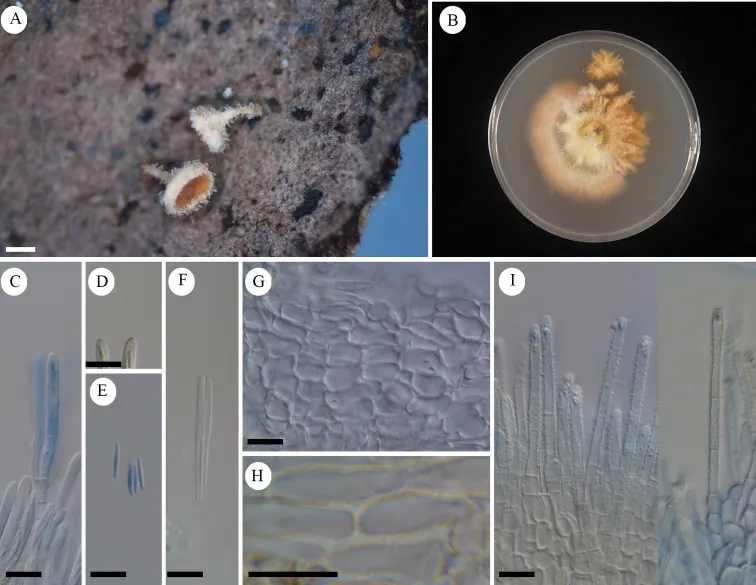
Colony of NBRC 114447/ TNS -F-26520 on PDA umbonate forming a dome-shape, slightly sulcate. Context not shiny, velvety, buff at the center, paler toward the margin, dark buff from the reverse. Sectors and zonation absent. Aerial mycelium white or buff, dense cottony, forming white mycelium strands except in the margin. Margin distinct, entire, flat. Asexual morph absent. Granulation on the surface of the ectal excipular cells has been observed only in Incrucipulum in Lachnaceae (Baral and Krieglsteiner 1985; Tochihara and Hosoya 2019), and E. boninensis is the first report for such a character in Erioscyphella (Fig. 5H, 6E). Phylogenetic analysis revealed that E. boninensis is closely related to E. paralushanensis (Fig. 1). The two species (Clade IA, Fig. 1) have colored granules on hairs and forming red mycelia on PDA. However, granulation of ectal excipulum is seen only in E. boninensis.
- Habitat atau konteks temuan
- kultur yang didokumentasikan
- Substrat
- Informasi belum tersedia pada sumber rilis ini.
- Peran atau konteks
- Belum dikategorikan pada rilis ini.
Reproduksi
Apothecia scattered, superficial, 0.5–1.0 mm in diameter, having well-developed stipes, up to 1.5 mm high, cream to pale brown, externally covered with short and shiny hairs. Disc concave, cream to pale yellow. Ectal excipulum textura prismatica composed of long elongated cells to textura angularis, 6–25 × 5–13 µm, hyaline to relatively brown colored, somewhat thick-walled; cell walls covered by granules with a similar appearance to those on hairs. Stipe composed of textura prismatica with a granulate surface as ectal excipular cells. Medullary excipulum textura intricata of hyaline hyphae up to 3 µm wide. Hairs straight, cylindrical, 38–62 × 2.5–4.0 µm, hyaline, completely covered by brown granules, 2–3-septate, thin-walled, arising from swelling cells completely covered by granules; apex lacking crystals or apical amorphous materials, equipped with amber-colored resinous materials dissolvable with CB / LA at a little below the apex.
Catatan identitas dan cakupan
- Nama diterima mengikuti Catalogue of Life Base2026-09-11; uraian mempertahankan konsep dan nama sumber aslinya.
- Preserve original treatment localities, hosts and substrate scope. Materials examined describe documented specimens, not the full global range.
- Impor dan terjemahan otomatis belum diperiksa editorial per profil. Struktur reproduktif yang disebutkan tidak membuktikan seluruh siklus hidup diketahui.
- Pengukuran pada uraian mengikuti spesimen, kultur, dan metode sumber; angka tidak diperluas ke semua populasi.
Catatan distribusi dalam narasi mengikuti sumbernya. Dokumentasi spesimen atau foto mengikuti catatan sumber. Bukti wilayah Indonesia dan penilaian konservasi tidak disimpulkan dari gambar.
Melihat dengan konteks
Erioscyphella boninensis TNS -F-26520 (Holotype) A dried apothecia B pure culture on PDA (NBRC 114447) C ascus D ascal pore MLZ (+) E ascospores F paraphyses G ectal excipular cells H ectal excipular cells with red granules I hairs with resinous matters arising from ectal excipular cells. Mounted in CB / LA (C, E–I), MLZ (D). Scale bars: 1 mm (A); 10 µm (C–I).
- Jenis
- Pelat ilmiah
- Kredit
- Yukito Tochihara, Tsuyoshi Hosoya
- Lisensi
- CC BY 4.0
- Sumber media
- Buka entri sumber
Dokumentasi tambahan
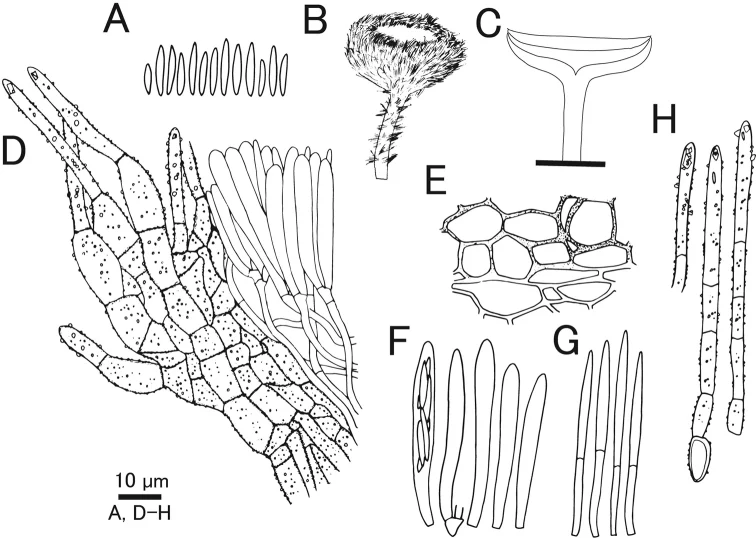
Erioscyphella boninensis TNS -F-26520 (Holotype) A ascospores B apothecium C vertical section of an apothecium D expansion of a vertical section of an apothecium E ectal excipular cells F asci G paraphyses H hairs.
Kredit dan penggunaan
Yukito Tochihara, Tsuyoshi Hosoya
Ukuran dan format gambar disesuaikan tanpa pemotongan, retus, atau penambahan skala. Lisensi sumber dipertahankan.
Sumber profil
- [1] Examination of the generic concept and species boundaries of the genus Erioscyphella (Lachnaceae, Helotiales, Ascomycota) with the proposal of new species and new combinations based on the Japanese materials — Erioscyphella boninensis
- [2] Catalogue of Life Base2026-09-11 — Erioscyphella boninensis
- [3] Dokumentasi visual — Erioscyphella boninensis
- [4] Dokumentasi visual — Erioscyphella boninensis
Rujukan halaman ini
Fungi. Erioscyphella boninensis. Rilis data fungi-2026-10-12-expansion-2. https://fungi-atlas.mgadib.chatgpt.site/jamur/erioscyphella-boninensis/.
Status: impor sumber; pemeriksaan editorial per profil belum selesai. Untuk klaim biologis, gunakan rujukan pada bagian terkait dan periksa konteks sumber aslinya.