01 / Morfologi

Ciri dan struktur

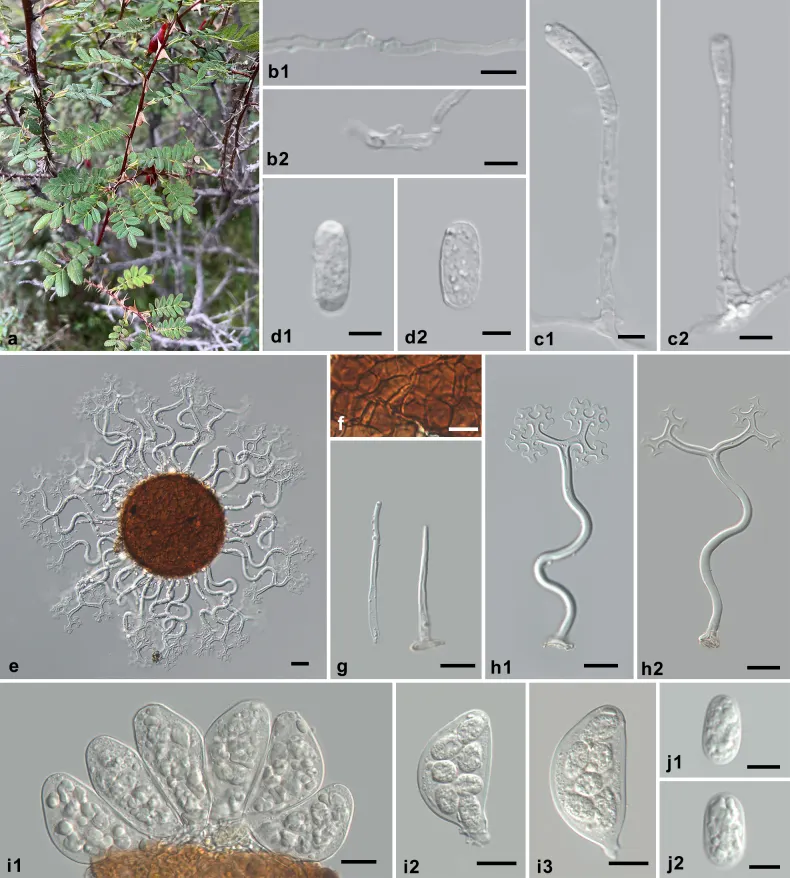
Erysiphe rosae is characterized by sinuous long appendages and bristle-like short appendages. This taxon has been controversially treated at the generic level. It was first introduced as the type species of the genus Medusosphaera and later transferred to Erysiphe because the morphology of the chasmothecial appendages was no longer recognized as suitable for differentiation at the generic level (Golovin and Gamalitskaya 1962; Braun and Takamatsu 2000). The correct allocation of M. rosae to Erysiphe was confirmed in the present study based on lobed hyphal appressoria and conidiophores with singly formed conidia (Fig. 4), as well as sequences successfully retrieved from specimens of this species, which form a highly supported species clade within Erysiphe (Fig. 1). It should be noted that the sequences of the three examined specimens clustered together according to their host plants, which indicates previously unrecognized diversity within E. rosae, possibly suggesting cryptic formae, a taxonomic unit recently reapplied in Erysiphaceae (Bradshaw et al. 2025c; Feng et al. 2025a). However, due to the limited number of specimens available, it was impossible to obtain additional molecular data or to observe potential morphological differences. Therefore, following the species concept proposed by Bradshaw et al. (2022), we provisionally treated these specimens as E. rosae s. lat. Since the holotype of this species from Kyrgyzstan has not yet been sequenced, the Chinese specimen HMAS 242383 on the type host Rosa albertii is selected as the reference collection with reference sequences for the interim.

Sebagian uraian ditampilkan dalam bahasa sumber; terjemahannya belum tersedia atau belum lolos pemeriksaan.

Rujukan: [1]

Pengukuran mengikuti objek, spesimen atau kultur, dan metode yang disebutkan sumber. Baca uraian asli untuk konteks lengkap.

02 / Kehidupan

Habitat dan peran ekologis

on Rosa (albertii, amblyotis, davurica, omeiensis, webbiana), Rosaceae; Asia (China, India, Kyrgyzstan, Russia, Far East).

Sebagian uraian ditampilkan dalam bahasa sumber; terjemahannya belum tersedia atau belum lolos pemeriksaan.

Rujukan: [1]

Habitat atau konteks temuan
Informasi belum tersedia pada sumber rilis ini.
Substrat
Informasi belum tersedia pada sumber rilis ini.
Peran atau konteks
Belum dikategorikan pada rilis ini.
Temukan hubungan serupa
03 / Siklus hidup

Reproduksi

Erysiphe rosae is characterized by sinuous long appendages and bristle-like short appendages. This taxon has been controversially treated at the generic level. It was first introduced as the type species of the genus Medusosphaera and later transferred to Erysiphe because the morphology of the chasmothecial appendages was no longer recognized as suitable for differentiation at the generic level (Golovin and Gamalitskaya 1962; Braun and Takamatsu 2000). The correct allocation of M. rosae to Erysiphe was confirmed in the present study based on lobed hyphal appressoria and conidiophores with singly formed conidia (Fig. 4), as well as sequences successfully retrieved from specimens of this species, which form a highly supported species clade within Erysiphe (Fig. 1).

Sebagian uraian ditampilkan dalam bahasa sumber; terjemahannya belum tersedia atau belum lolos pemeriksaan.

Rujukan: [1]

Sinonim menurut acuan taksonomi rilis: Medusosphaera rosae
04 / Batas informasi

Catatan identitas dan cakupan

  • Nama diterima mengikuti Catalogue of Life Base2026-09-11; uraian mempertahankan konsep dan nama sumber aslinya.
  • Preserve original treatment localities, hosts and substrate scope. Materials examined describe documented specimens, not the full global range.
  • Impor dan terjemahan otomatis belum diperiksa editorial per profil. Struktur reproduktif yang disebutkan tidak membuktikan seluruh siklus hidup diketahui.
  • Pengukuran pada uraian mengikuti spesimen, kultur, dan metode sumber; angka tidak diperluas ke semua populasi.

Catatan distribusi dalam narasi mengikuti sumbernya. Dokumentasi spesimen atau foto mengikuti catatan sumber. Bukti wilayah Indonesia dan penilaian konservasi tidak disimpulkan dari gambar.

05 / Dokumentasi

Melihat dengan konteks

Symptoms and morphology of Erysiphe rosae on Rosa omeiensis (HMJAU -PM92697). a Symptoms. b1, b2 Hyphal appressoria. c1, c2 Conidiophores with conidia formed singly. d1, d2 Conidia. e Chasmothecium. f Peridium cells. g Short appendages. h1, h2 Long appendages. i1–i3 Asci. j1, j2 Ascospores. Scale bars: 10 μm (b1, d2, f, j1, j2); 20 μm (e, g–i3).

Jenis
Pelat ilmiah
Kredit
Dan-Ni Jin, Shuang-Bao Wang, Le-Ping Guan, Xue-Lian Wu, Jing Feng, Li Liu, Michael Bradshaw, Uwe Braun, Jing-Han Yang, Shou-Rong Yu, Yu Li, Shu-Yan Liu
Lisensi
CC BY 4.0
Sumber media
Buka entri sumber

Gambar menunjukkan objek menurut identifikasi sumber, bukan verifikasi independen spesimen oleh Fungi. Tidak ada skala baru yang ditambahkan.

06 / Rujukan

Sumber profil

  1. [1] Revision of powdery mildews (Ascomycota, Erysiphaceae) on Rosa in China: unexpected taxonomic complexity with phytopathological implications — Erysiphe rosaeBagian sumber: PMC12980140_section_11
    Tanggal penghimpunan sumber: 2026-10-12
    Teks sumber: CC BY 4.0 · Jin DN, Wang SB, Guan LP, Wu XL, Feng J, Liu L, Bradshaw M, Braun U, Yang JH, Yu SR, Li Y, Liu SY.
  2. [2] Catalogue of Life Base2026-09-11 — Erysiphe rosaeBagian sumber: ColDP NameUsage.tsv ID 6GRY6; accepted species; source 2073
    Tanggal penghimpunan sumber: 2026-10-12
  3. [3] Dokumentasi visual — Erysiphe rosaeBagian sumber: Individual media record; identification follows the source, not independent determination
    Tanggal penghimpunan sumber: 2026-10-12
    Media sumber: CC BY 4.0 · Dan-Ni Jin, Shuang-Bao Wang, Le-Ping Guan, Xue-Lian Wu, Jing Feng, Li Liu, Michael Bradshaw, Uwe Braun, Jing-Han Yang, Shou-Rong Yu, Yu Li, Shu-Yan Liu

Adaptasi teks: CC BY 4.0. Jin DN, Wang SB, Guan LP, Wu XL, Feng J, Liu L, Bradshaw M, Braun U, Yang JH, Yu SR, Li Y, Liu SY. — Revision of powdery mildews (Ascomycota, Erysiphaceae) on Rosa in China: unexpected taxonomic complexity with phytopathological implications — Erysiphe rosae

Uraian asli dan riwayat sumber

Riwayat atau halaman sumber

Ringkasan sumber

Erysiphe rosae is characterized by sinuous long appendages and bristle-like short appendages. This taxon has been controversially treated at the generic level. It was first introduced as the type species of the genus Medusosphaera and later transferred to Erysiphe because the morphology of the chasmothecial appendages was no longer recognized as suitable for differentiation at the generic level (Golovin and Gamalitskaya 1962; Braun and Takamatsu 2000). The correct allocation of M. rosae to Erysiphe was confirmed in the present study based on lobed hyphal appressoria and conidiophores with singly formed conidia (Fig. 4), as well as sequences successfully retrieved from specimens of this species, which form a highly supported species clade within Erysiphe (Fig. 1).

Revisi sumber

Morfologi sumber

Erysiphe rosae is characterized by sinuous long appendages and bristle-like short appendages. This taxon has been controversially treated at the generic level. It was first introduced as the type species of the genus Medusosphaera and later transferred to Erysiphe because the morphology of the chasmothecial appendages was no longer recognized as suitable for differentiation at the generic level (Golovin and Gamalitskaya 1962; Braun and Takamatsu 2000). The correct allocation of M. rosae to Erysiphe was confirmed in the present study based on lobed hyphal appressoria and conidiophores with singly formed conidia (Fig. 4), as well as sequences successfully retrieved from specimens of this species, which form a highly supported species clade within Erysiphe (Fig. 1). It should be noted that the sequences of the three examined specimens clustered together according to their host plants, which indicates previously unrecognized diversity within E. rosae, possibly suggesting cryptic formae, a taxonomic unit recently reapplied in Erysiphaceae (Bradshaw et al. 2025c; Feng et al. 2025a). However, due to the limited number of specimens available, it was impossible to obtain additional molecular data or to observe potential morphological differences. Therefore, following the species concept proposed by Bradshaw et al. (2022), we provisionally treated these specimens as E. rosae s. lat. Since the holotype of this species from Kyrgyzstan has not yet been sequenced, the Chinese specimen HMAS 242383 on the type host Rosa albertii is selected as the reference collection with reference sequences for the interim.

Revisi sumber

Ekologi sumber

on Rosa (albertii, amblyotis, davurica, omeiensis, webbiana), Rosaceae; Asia (China, India, Kyrgyzstan, Russia, Far East).

Revisi sumber

Struktur reproduksi sumber

Erysiphe rosae is characterized by sinuous long appendages and bristle-like short appendages. This taxon has been controversially treated at the generic level. It was first introduced as the type species of the genus Medusosphaera and later transferred to Erysiphe because the morphology of the chasmothecial appendages was no longer recognized as suitable for differentiation at the generic level (Golovin and Gamalitskaya 1962; Braun and Takamatsu 2000). The correct allocation of M. rosae to Erysiphe was confirmed in the present study based on lobed hyphal appressoria and conidiophores with singly formed conidia (Fig. 4), as well as sequences successfully retrieved from specimens of this species, which form a highly supported species clade within Erysiphe (Fig. 1).

Revisi sumber

Rujukan halaman ini

Fungi. Erysiphe rosae. Rilis data fungi-2026-10-12-expansion-2. https://fungi-atlas.mgadib.chatgpt.site/jamur/erysiphe-rosae/.

Status: impor sumber; pemeriksaan editorial per profil belum selesai. Untuk klaim biologis, gunakan rujukan pada bagian terkait dan periksa konteks sumber aslinya.