Ciri dan struktur
Basidiomata stipitate-pileate with lamellate hymenophore, small to medium-sized. Pileus 2.3–5.5 cm in diameter, plano-convex with involute margin at first becoming almost plane to slightly depressed with inflexed to straight margin, irregularly and coarsely crenate in age, sometimes with low and broad umbo and a few to several verrucae, especially when young; surface more or less even, tomentose, dull, slightly moist, colour distribution patchy with red to brownish-orange (9B8 to 9C8), brownish-red (10E8 to 10D8) becoming orange-red to orange (8B/C8 to 6B7) at the margin when old, abruptly paler at the margin. Pileus context 3–4 mm thick half-way to the margin, tough, colour distribution even, yellow (3A6) to yellowish-orange (4A5), slowly reddening when exposed, especially at the centre and above lamellae. Stipe 2.4–4.5 × 0.7–1.3 cm, central or sometimes slightly eccentric, clavate with strigose base, straight to curved, terete, even, dull, dry, tomentose, yellowish-orange (4–5A7–8) to orange (6–7A7–8) with orange to yellowish-orange (7B/C7–8 to 4A7–8) coarse scales, with bright yellow (2A6–7) basal mycelium. Stipe context solid, fleshy fibrous, yellow marbled with olivaceous brown (4D5, 5D5). Hymenophore lamellate; lamellae decurrent, close, thick, 40–42 lamellae, with 4–6 different lengths of lamellullae, 2–4.5 mm wide half-way to margin, somewhat anastomosing, especially near the stipe, yellowish-orange (4-5A6-7) with orange to red tinge, slightly reddening when bruised. Odour rubbery; Taste not recorded. Spore print olive-brown (4E7). Macrochemical reactions. KOH on pileus and stipe surface deep red at first, then red-brown to brown, with pale orange aura on the pileus; brown on pileus context, dark red-brown on stipe context; brownish-orange on hymenophore.
Habitat dan peran ekologis
On soil, mostly solitary in dipterocarp forest dominated by Dipterocarpus tuberculatus, D. obtusifolius, Shorea obtusa, S. siamensis, Quercus spp. and Lithocarpus spp. Currently known only from Chiang Mai Province, northern Thailand.
- Habitat atau konteks temuan
- hutan
- Substrat
- tanah
- Peran atau konteks
- Belum dikategorikan pada rilis ini.
Reproduksi
Basidiomata stipitate-pileate with lamellate hymenophore, small to medium-sized. Pileus 2.3–5.5 cm in diameter, plano-convex with involute margin at first becoming almost plane to slightly depressed with inflexed to straight margin, irregularly and coarsely crenate in age, sometimes with low and broad umbo and a few to several verrucae, especially when young; surface more or less even, tomentose, dull, slightly moist, colour distribution patchy with red to brownish-orange (9B8 to 9C8), brownish-red (10E8 to 10D8) becoming orange-red to orange (8B/C8 to 6B7) at the margin when old, abruptly paler at the margin. Pileus context 3–4 mm thick half-way to the margin, tough, colour distribution even, yellow (3A6) to yellowish-orange (4A5), slowly reddening when exposed, especially at the centre and above lamellae.
Catatan identitas dan cakupan
- Nama diterima mengikuti Catalogue of Life Base2026-09-11; uraian mempertahankan konsep dan nama sumber aslinya.
- Preserve original treatment localities, hosts and substrate scope. Materials examined describe documented specimens, not the full global range.
- Impor dan terjemahan otomatis belum diperiksa editorial per profil. Struktur reproduktif yang disebutkan tidak membuktikan seluruh siklus hidup diketahui.
- Pengukuran pada uraian mengikuti spesimen, kultur, dan metode sumber; angka tidak diperluas ke semua populasi.
Catatan distribusi dalam narasi mengikuti sumbernya. Dokumentasi spesimen atau foto mengikuti catatan sumber. Bukti wilayah Indonesia dan penilaian konservasi tidak disimpulkan dari gambar.
Melihat dengan konteks
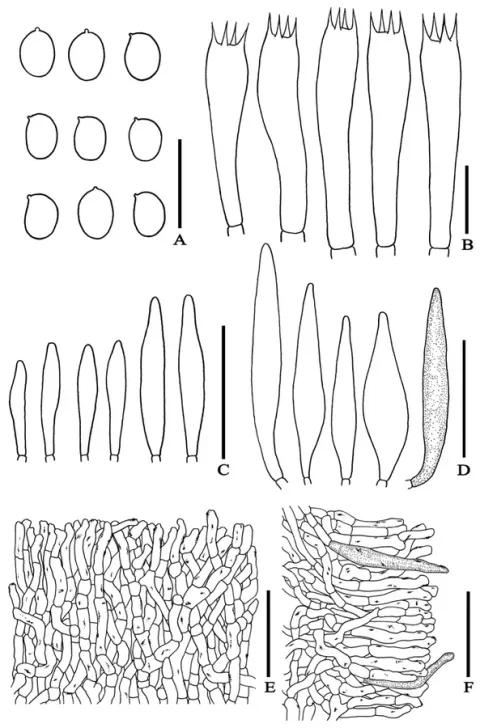
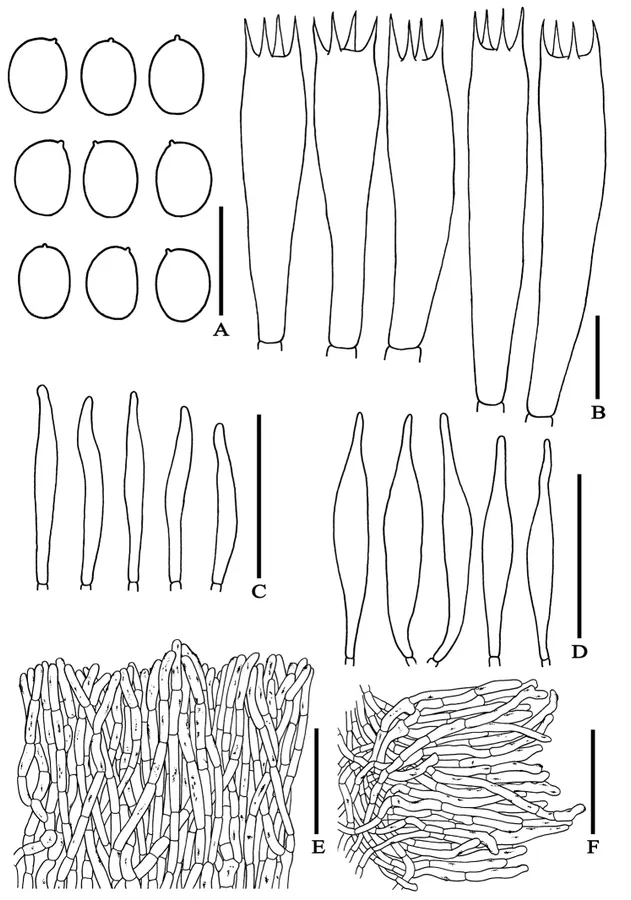
Microscopic features of Erythrophylloporus paucicarpus A basidiospores B basidia C cheilocystidia D pleurocystidia E pileipellis F stipitipellis. – Scale bars: 10 µm (A–B); 50 µm (C–F). All drawings were made from the type (OR1151).
- Jenis
- Pelat ilmiah
- Kredit
- Santhiti Vadthanarat, Mario Amalfi, Roy E. Halling, Victor Bandala, Saisamorn Lumyong, Olivier Raspé
- Lisensi
- CC BY 4.0
- Sumber media
- Buka entri sumber
Dokumentasi tambahan
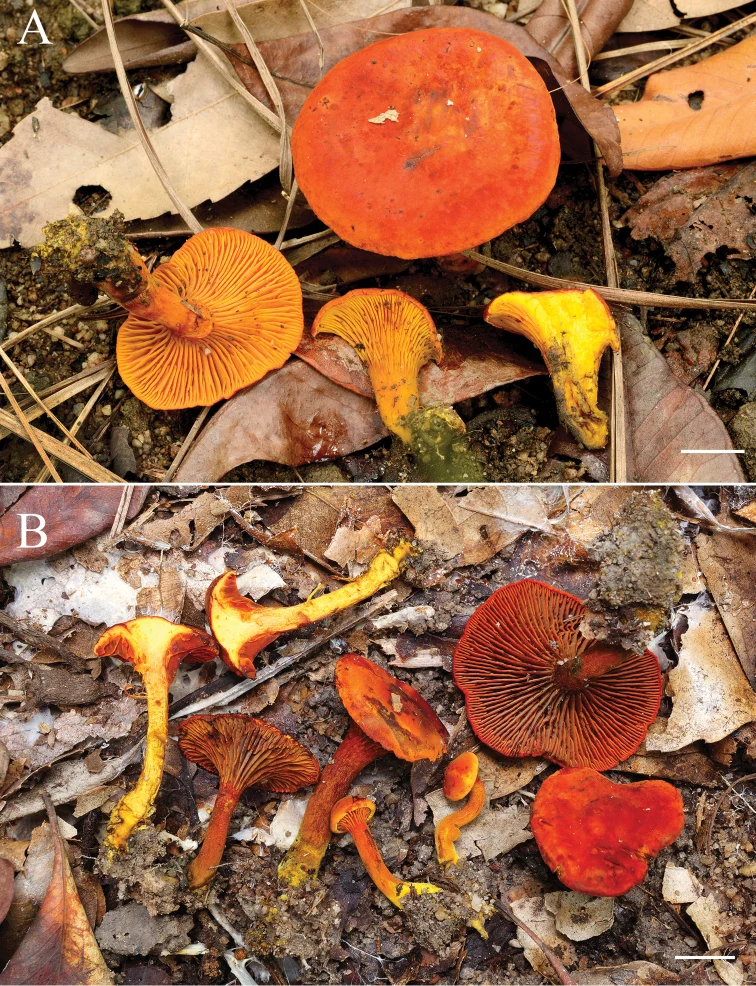
Pelat perbandingan tubuh buah. Erythrophylloporus paucicarpus ditampilkan pada panel A; panel lainnya memuat spesies pembanding. Pembagian panel mengikuti keterangan sumber.
Kredit dan penggunaan
Santhiti Vadthanarat, Mario Amalfi, Roy E. Halling, Victor Bandala, Saisamorn Lumyong, Olivier Raspé
Ukuran dan format gambar disesuaikan tanpa pemotongan, retus, atau penambahan skala. Lisensi sumber dipertahankan.
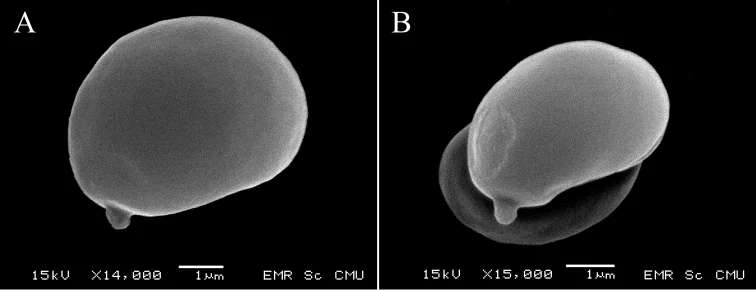
Pelat perbandingan basidiospora pada SEM. Erythrophylloporus paucicarpus ditampilkan pada panel A; panel lainnya memuat spesies pembanding. Pembagian panel mengikuti keterangan sumber.
Kredit dan penggunaan
Santhiti Vadthanarat, Mario Amalfi, Roy E. Halling, Victor Bandala, Saisamorn Lumyong, Olivier Raspé
Ukuran dan format gambar disesuaikan tanpa pemotongan, retus, atau penambahan skala. Lisensi sumber dipertahankan.
Sumber profil
- [1] Two new Erythrophylloporus species (Boletaceae) from Thailand, with two new combinations of American species — Erythrophylloporus paucicarpus
- [2] Catalogue of Life Base2026-09-11 — Erythrophylloporus paucicarpus
- [3] Dokumentasi visual — Erythrophylloporus paucicarpus
- [4] Dokumentasi visual — Erythrophylloporus paucicarpus
- [5] Dokumentasi visual — Erythrophylloporus paucicarpus
Rujukan halaman ini
Fungi. Erythrophylloporus paucicarpus. Rilis data fungi-2026-10-12-expansion-2. https://fungi-atlas.mgadib.chatgpt.site/jamur/erythrophylloporus-paucicarpus/.
Status: impor sumber; pemeriksaan editorial per profil belum selesai. Untuk klaim biologis, gunakan rujukan pada bagian terkait dan periksa konteks sumber aslinya.