Ciri dan struktur
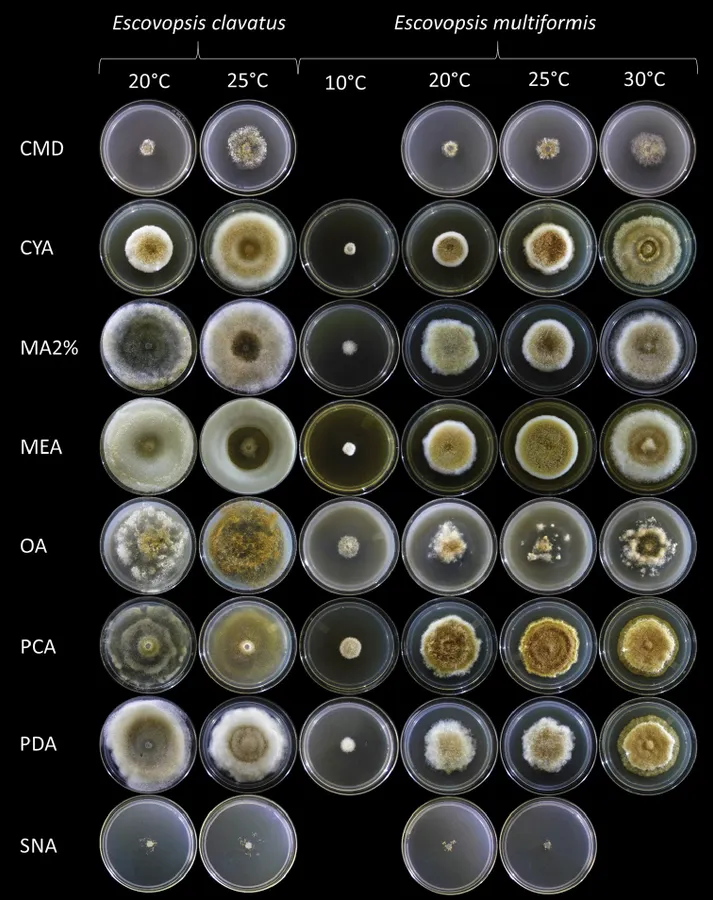
Colonies grow at 10, 20, 25 and 30 °C (Fig. 1). The best growth temperature was 30 °C. At this temperature, colonies reached 1.2–1.4 cm, 2.7–3 cm, 2.6–3 cm, 3.3–3.5 cm, 2.5–2.8 cm, 2.7–2.9 cm and 1.9–2.5 cm in radius on CMD, CYA, MA2%, MEA, OA, PCA and PDA, after 14 days, respectively. Colonies exhibit light-brown floccose mycelia (colony edge usually lighter or white). The colour shades and the character of the aerial mycelium vary on each culture medium (Fig. 1). Colonies present concentric rings with a hardened ring similar to a crust in the centre on CYA (Fig. 1) and the sporulation is more abundant on PCA and PDA. At 20 °C, on CMD, CYA, MA2%, MEA, OA, PCA, PDA and SNA, colonies attained 0.5–0.8 cm, 1.1–2.2 cm, 2–2.5 cm, 2.1–2.3 cm, 2–2.5 cm, 2.8 cm, 1.9–2.4 cm and 0–0.1 cm in radius, respectively. At 25 °C, colonies reached 1 cm, 2.1–2.3 cm, 2–2.4 cm, 2.5–2.6 cm, 2.2–2.7 cm, 2.8–3 cm, 1.8–2 cm and 0.1–0.2 cm in radius on CMD, CYA, MA2%, MEA, OA, PCA, PDA and SNA, respectively. Pustule-like structures were observed on OA and CMD at 20, 25 and 30 °C. At 10 °C, the colony growth was inconspicuous, reaching 0.2–0.3 cm, 0.2–0.4 cm, 0.3 cm, 0.6–0.8 cm, 0.8 cm and 0.3–0.5 cm in radius on CYA, MA2%, MEA, OA, PCA and PDA, respectively, after 14 days. At this temperature, growth started in these culture media after seven days and sporulation occurred only after the 12 th day. No growth was observed at 35 °C. Conidiophores arising from aerial hypha alternated or opposite (Fig. 3A), with the main axis of 41–293 μm in length, some without branching and most of them with one level of branching.
Habitat dan peran ekologis
BRAZIL. Santa Catarina, Florianópolis, (27°28'11.28"S, 48°22'39.48"W), elev. 119 m, fungus garden, 08, 2015. A. Rodrigues. Holotype: CBS H-23846 (dried culture on PDA). Ex-type strain LESF 847 (= CBS 145327). Isolated from fungus garden of Apterostigma sp. Escovopsis multiformis is closely related to E. clavatus. Different from E. clavatus that grow at 20 and 25 °C, E. multiformis grow at 10, 20, 25 and 30 °C. The optimum growth temperature of E. multiformis is 30 °C and that of E. clavatus is 25 °C. The conidiophores of E. multiformis are smaller and less branched than E. clavatus and the swollen cells are more frequent and larger than those found in E. clavatus. E. multiformis differs from other described species by the presence of conidiophores with a swollen cell, the presence of different vesicles shapes and because it is phylogenetically placed in a distinct clade.
- Habitat atau konteks temuan
- kultur yang didokumentasikan
- Substrat
- Informasi belum tersedia pada sumber rilis ini.
- Peran atau konteks
- Belum dikategorikan pada rilis ini.
Reproduksi
Colonies grow at 10, 20, 25 and 30 °C (Fig. 1). The best growth temperature was 30 °C. At this temperature, colonies reached 1.2–1.4 cm, 2.7–3 cm, 2.6–3 cm, 3.3–3.5 cm, 2.5–2.8 cm, 2.7–2.9 cm and 1.9–2.5 cm in radius on CMD, CYA, MA2%, MEA, OA, PCA and PDA, after 14 days, respectively. Colonies exhibit light-brown floccose mycelia (colony edge usually lighter or white). The colour shades and the character of the aerial mycelium vary on each culture medium (Fig. 1). Colonies present concentric rings with a hardened ring similar to a crust in the centre on CYA (Fig. 1) and the sporulation is more abundant on PCA and PDA. At 20 °C, on CMD, CYA, MA2%, MEA, OA, PCA, PDA and SNA, colonies attained 0.5–0.8 cm, 1.1–2.2 cm, 2–2.5 cm, 2.1–2.3 cm, 2–2.5 cm, 2.8 cm, 1.9–2.4 cm and 0–0.1 cm in radius, respectively.
Catatan identitas dan cakupan
- Nama diterima mengikuti Catalogue of Life Base2026-09-11; uraian mempertahankan konsep dan nama sumber aslinya.
- Preserve original treatment localities, hosts and substrate scope. Materials examined describe documented specimens, not the full global range.
- Impor dan terjemahan otomatis belum diperiksa editorial per profil. Struktur reproduktif yang disebutkan tidak membuktikan seluruh siklus hidup diketahui.
- Pengukuran pada uraian mengikuti spesimen, kultur, dan metode sumber; angka tidak diperluas ke semua populasi.
Catatan distribusi dalam narasi mengikuti sumbernya. Dokumentasi spesimen atau foto mengikuti catatan sumber. Bukti wilayah Indonesia dan penilaian konservasi tidak disimpulkan dari gambar.
Melihat dengan konteks
Colony macroscopic characters of Escovopsis clavatus and Escovopsis multiformis on CMD, CYA, MA2%, MEA, OA, PCA, PDA and SNA media after 14 days at 10, 20, 25 and 30 °C.
- Jenis
- Pelat ilmiah
- Kredit
- Quimi Vidaurre Montoya, Maria Jesus Sutta Martiarena, Danilo Augusto Polezel, Sérgio akazu, Andre Rodrigues
- Lisensi
- CC BY 4.0
- Sumber media
- Buka entri sumber
Dokumentasi tambahan
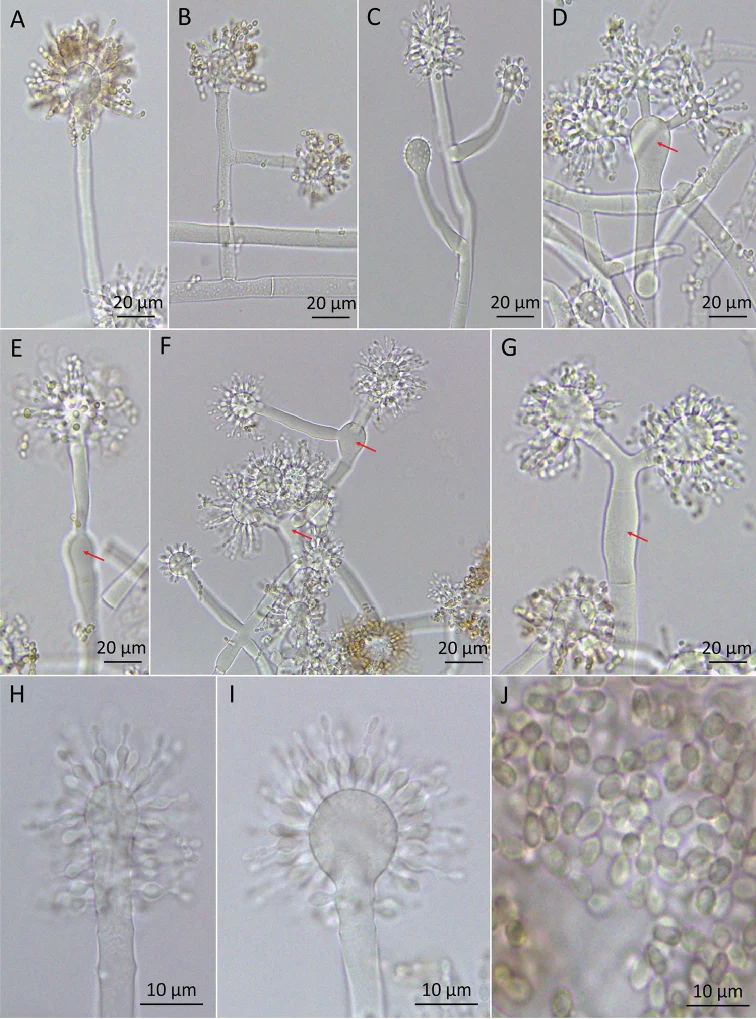
Escovopsis multiformis. A–C Conidiophores mono- and polycephalous without “swollen cells” D–G Conidiophores mono and polycephalous with “swollen cells” (red arrows) H, I Vesicles in various shapes J Conidia.
Kredit dan penggunaan
Quimi Vidaurre Montoya, Maria Jesus Sutta Martiarena, Danilo Augusto Polezel, Sérgio akazu, Andre Rodrigues
Ukuran dan format gambar disesuaikan tanpa pemotongan, retus, atau penambahan skala. Lisensi sumber dipertahankan.
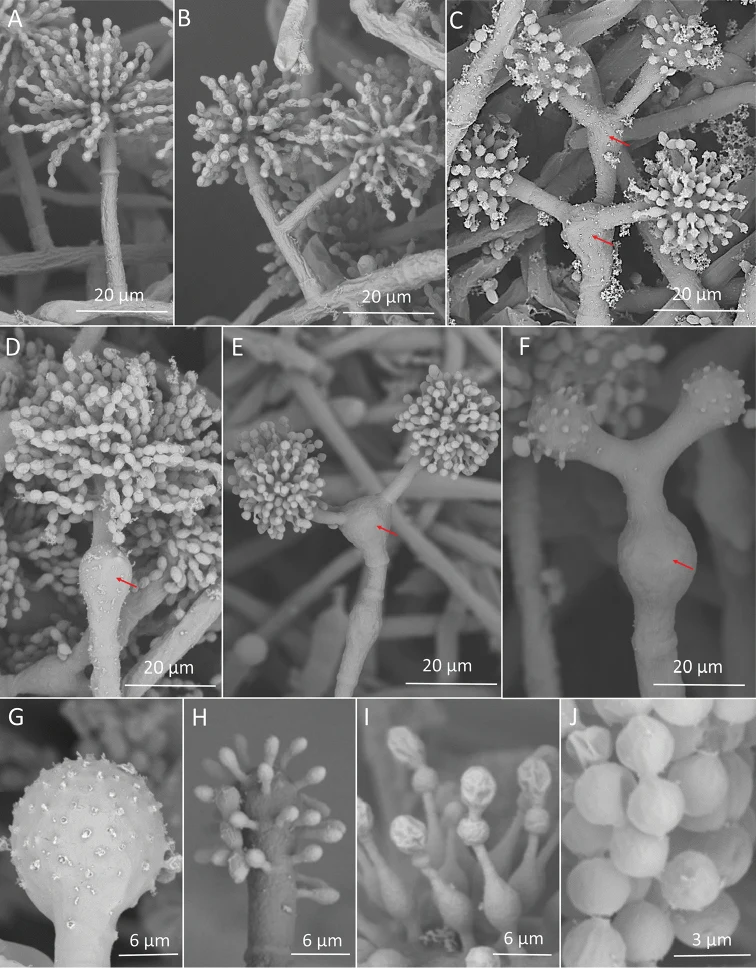
Escovopsis multiformis. SEM images A, B Conidiophores mono- and polycephalous without “swollen cells” C–F Conidiophores mono- and polycephalous with “swollen cells” (red arrows) G, H Vesicles I Phialides J Conidia.
Kredit dan penggunaan
Quimi Vidaurre Montoya, Maria Jesus Sutta Martiarena, Danilo Augusto Polezel, Sérgio akazu, Andre Rodrigues
Ukuran dan format gambar disesuaikan tanpa pemotongan, retus, atau penambahan skala. Lisensi sumber dipertahankan.
Sumber profil
- [1] More pieces to a huge puzzle: Two new Escovopsis species from fungus gardens of attine ants — Escovopsis multiformis
- [2] Catalogue of Life Base2026-09-11 — Escovopsis multiformis
- [3] Dokumentasi visual — Escovopsis multiformis
- [4] Dokumentasi visual — Escovopsis multiformis
- [5] Dokumentasi visual — Escovopsis multiformis
Rujukan halaman ini
Fungi. Escovopsis multiformis. Rilis data fungi-2026-10-12-expansion-2. https://fungi-atlas.mgadib.chatgpt.site/jamur/escovopsis-multiformis/.
Status: impor sumber; pemeriksaan editorial per profil belum selesai. Untuk klaim biologis, gunakan rujukan pada bagian terkait dan periksa konteks sumber aslinya.