Ciri dan struktur
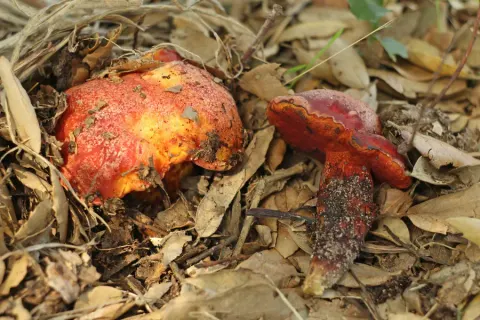
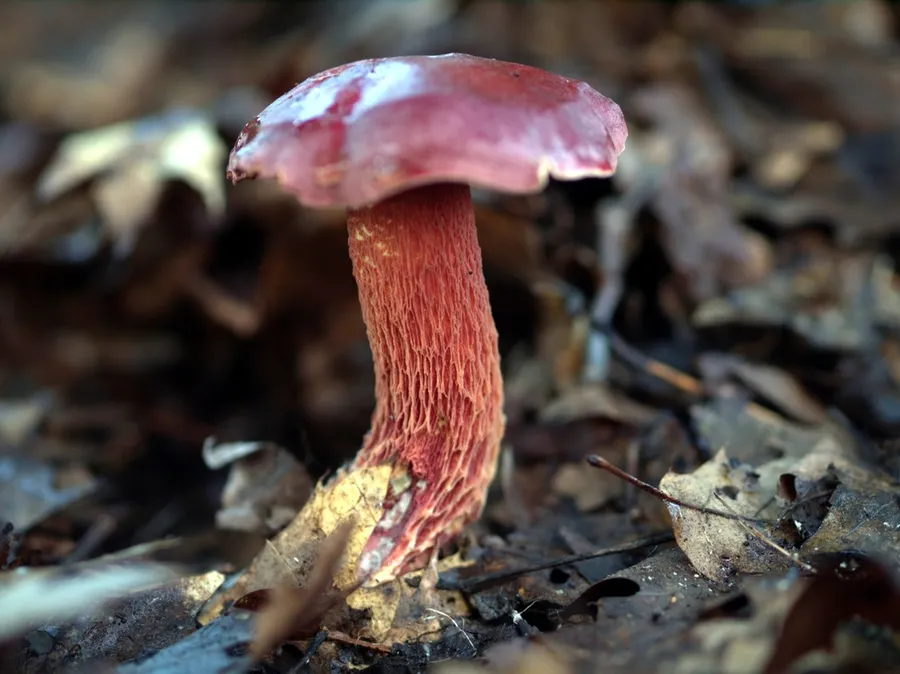
The shape of the cap of the young fruit body ranges from a half sphere to convex, later becoming broadly convex to flat or shallowly depressed, with a diameter of 5–15 cm. The edge of the cap is curved inward, although as it ages it can uncurl and turn upward. In moist conditions, the cap surface is sticky as a result of its cuticle, which is made of gelatinized hyphae. If the fruit body has dried out after a rain, the cap is especially shiny, sometimes appearing finely areolate (having a pattern of block-like areas similar to cracked, dried mud). Young mushrooms have a whitish bloom on the cap surface. The color is bright red initially, but fades with age. The flesh is up to 2.5 cm thick, and ranges in color from pallid to pale yellow to lemon yellow. The flesh has a variable staining reaction in response to bruising, so some specimens may turn deep blue almost immediately, while others turn blue weakly and slowly. Its taste and odor have been described as pleasant or sweet and somewhat like citrus, although the cuticle may taste acidic. The tubes comprising the pore surface (the hymenium) are 9–15 mm deep, yellow to olivaceous yellow (mustard yellow), turning dingy blue when bruised. The pores are small (2 to 3 per mm), circular, and until old age a deep red color that eventually becomes paler. The pore surface is often beaded with yellowish droplets when young (a distinguishing characteristic), and readily stains blue when bruised. The stipe is 4 to 12 cm long, and 1 to 2.5 cm thick at its apex. It is roughly equal in thickness throughout its length, though it may taper somewhat toward the top; some specimens may appear ventricose (swollen in the middle).
Habitat dan peran ekologis
Exsudoporus frostii adalah spesies mikoriza, Di Amerika Serikat, ia didistribusikan dari Maine south ke Georgia, membentang ke barat ke Tennessee and Michigan, dan di selatan Arizona. Di Meksiko, sering ditemukan di bawah Madrone. Ia juga telah dikumpulkan di Kosta Rika, di mana ia berhubungan dengan spesies ek Quercus copeyensis, Q. costaricensis, Q. rapurahuensis, dan Q. seemanii. Sebuah publikasi 1980 tentatif menunjukkan bahwa jamur juga ada di Italia, tetapi penulis kemudian menentukan bahwa dugaan E. frostii sebenarnya adalah Boletus siculus (sekarang sinonim menjadi E. permagnificus). Asosiasi mikoriza bersifat saling menguntungkan, karena jamur menyerap nutrisi mineral dari tanah dan menyalurkannya ke tanaman, sementara tanaman menyediakan jamur dengan gula, produk fotosintesis. Ciri khas dari mikorisa adalah adanya lapisan jaringan jamur yang menutupi akar-akar terminal, menyerap nutrisi dari tanaman tuan rumah. Jamur membentuk jaringan bawah tanah yang luas dari hifa yang memancarkan ke luar dari permukaan lapisan akar, secara efektif meningkatkan luas permukaan untuk penyerapan nutrisi. hifa juga menyerang antara sel-sel kortikal akar untuk membentuk Hartig net.
- Habitat atau konteks temuan
- Informasi belum tersedia pada sumber rilis ini.
- Substrat
- Informasi belum tersedia pada sumber rilis ini.
- Peran atau konteks
- Mitra tumbuhan
Reproduksi
The spore print of B. frostii is olive brown. The spores are thick walled, smooth, and spindle shaped, with dimensions of 11–15 by 4–5 μm. Longer spores up to 18 μm long may also be present. The cap cuticle, or pileipellis, is made of a tangled layer of gelatinized hyphae that are 3–6 μm wide. The spore-bearing cells, the basidia, are four spored and measure 26–35 by 10.5–11.5 μm. Cystidia are non-fertile cells interspersed among the basidia, and they are prevalent in the hymenial tissue of E. frostii. These hyaline (translucent) cells measure 30–53 long by 7.5–14 μm wide, and range in shape from somewhat like a spindle (tapering at each end, but with one end typically rounded) to subampullaceous—shaped somewhat like a swollen bottle.
Catatan identitas dan cakupan
- Nama diterima mengikuti Catalogue of Life Base2026-09-11; uraian mempertahankan konsep dan nama sumber aslinya.
- Original geographic, specimen and life-cycle scope retained; source import awaits individual editorial review.
- Impor dan terjemahan otomatis belum diperiksa editorial per profil. Struktur reproduktif yang disebutkan tidak membuktikan seluruh siklus hidup diketahui.
- Pengukuran pada uraian mengikuti spesimen, kultur, dan metode sumber; angka tidak diperluas ke semua populasi.
Catatan distribusi dalam narasi mengikuti sumbernya. Dokumentasi spesimen atau foto mengikuti catatan sumber. Bukti wilayah Indonesia dan penilaian konservasi tidak disimpulkan dari gambar.
Melihat dengan konteks
Dokumentasi Exsudoporus frostii menurut asosiasi foto pada record takson iNaturalist. Kredit: takomabibelot. Identitas mengikuti sumber; bukan penentuan spesimen independen.
- Jenis
- Fotografi
- Kredit
- (c) takomabibelot, some rights reserved (CC BY)
- Lisensi
- CC BY 4.0
- Sumber media
- Buka entri sumber
Dokumentasi tambahan
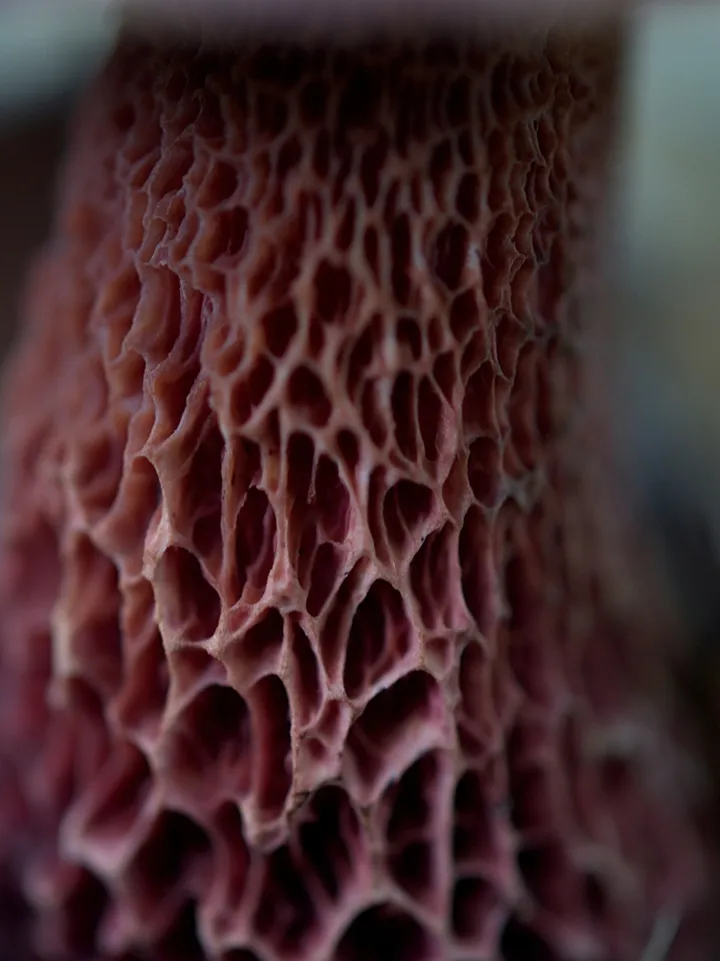
Foto yang diasosiasikan dengan Exsudoporus frostii pada iNaturalist. Identifikasi mengikuti sumber; bukan penentuan spesimen independen.
Kredit dan penggunaan
(c) takomabibelot, some rights reserved (CC BY)
Ukuran dan format gambar disesuaikan tanpa pemotongan, retus, atau penambahan skala. Lisensi sumber dipertahankan.
Sumber profil
- [1] Exsudoporus frostii — Wikipedia (en)
- [2] Catalogue of Life Base2026-09-11 — Exsudoporus frostii
- [3] Dokumentasi visual — Exsudoporus frostii
- [4] Dokumentasi visual — Exsudoporus frostii
Rujukan halaman ini
Fungi. Exsudoporus frostii. Rilis data fungi-2026-10-12-expansion-2. https://fungi-atlas.mgadib.chatgpt.site/jamur/exsudoporus-frostii/.
Status: impor sumber; pemeriksaan editorial per profil belum selesai. Untuk klaim biologis, gunakan rujukan pada bagian terkait dan periksa konteks sumber aslinya.