01 / Morfologi

Ciri dan struktur

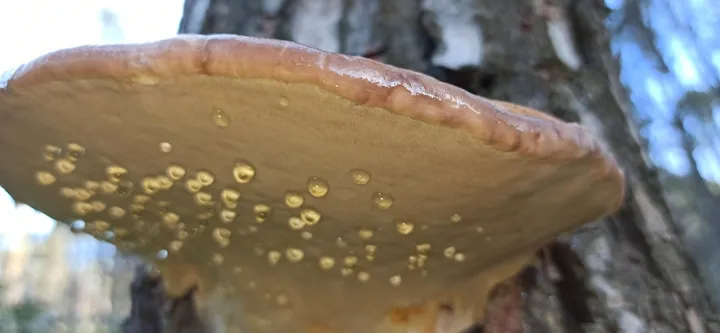
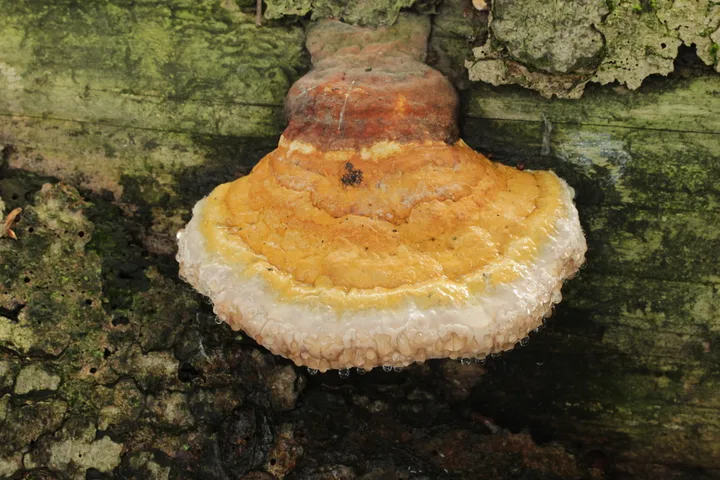
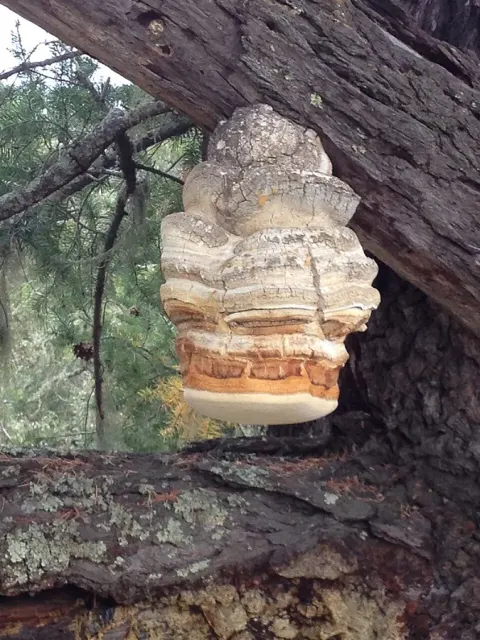
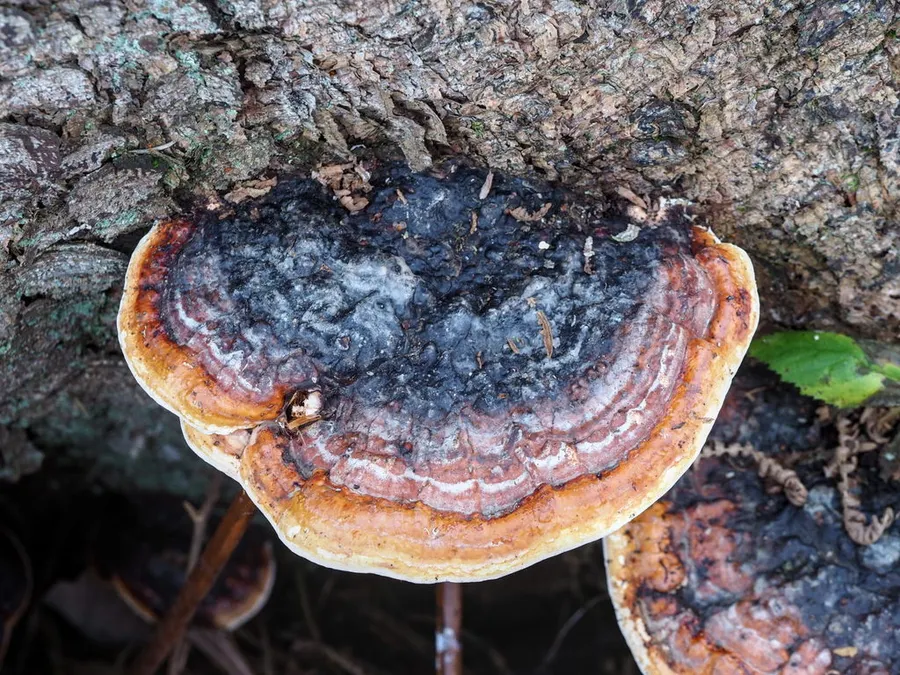
The cap is hoof-shaped or triangular, and sometimes shelflike. It is hard and tough, and up to 30 cm or more across and 15 cm thick. Its surface is more or less smooth, at first orange-yellow with a white margin, later dark reddish to brown and then frequently with an orange margin. The pore surface is pale yellow to leather-brown, 3–4 pores per mm. It grows as thick shelves on live and dead coniferous or (less commonly) deciduous trees. The spores are pale yellow and smooth. The species also grows as a layer of tubes on the bottom of fallen wood. The fruiting body of F. pinicola is called the conk. It is a woody, pileate fruiting body with pores lined with basidia on its underside. As in other polypores, the fruiting body is perennial with a new layer of pores produced each year on the bottom of the old pores. The pores are whitish when young and become somewhat brownish in age. Most of the stem decay (heart rot) in mature forests that results from this fungus does not interfere with the normal growth and physiological processes of live trees since the vascular tissue is not affected. It is classified as a brown rot, which primarily degrades cellulose in tree stands. The early stage of wood decay appears as yellowish to brownish discoloration with the advanced stage appearing as a brown and crumbly breaking into cubical pieces. Wood impacted by this fungus may become more brittle and prone to breakage in high winds, and cannot be used for pulp production. This species requires exposed wood of wounds for entry, continuing their decay after the tree dies. On dead trees, the fungus general affects the sapwood and then progresses into heartwood.

Sebagian uraian ditampilkan dalam bahasa sumber; terjemahannya belum tersedia atau belum lolos pemeriksaan.

Rujukan: [1]

Pengukuran mengikuti objek, spesimen atau kultur, dan metode yang disebutkan sumber. Baca uraian asli untuk konteks lengkap.

02 / Kehidupan

Habitat dan peran ekologis

The species is common throughout temperate Eurasia. that is suitable for excavation by woodpeckers. This fungus is normally found on dead pines, but can be found on all conifers. It can also be observed growing on large stem wounds, broken tops, and dead tissue of live trees. This stem decay creates canopy gaps, influences stand structure and succession, increases biodiversity, and enhances wildlife habitat. The fungus also performs essential nutrient cycling functions in these forests by decomposing stems, branches, roots, and boles of dead trees. Cavities created by the fungus in standing trees provide crucial habitat for many wildlife species including bears, voles, squirrels, and a number of bird species. The lack of disturbance in these areas and longevity of individual trees allows ample time for this slow-growing decay fungus to cause significant decay. There is a growing interest in acquiring methods to promote earlier development of stem decays in second-growth stands to achieve wildlife and other non-timber objectives.

Sebagian uraian ditampilkan dalam bahasa sumber; terjemahannya belum tersedia atau belum lolos pemeriksaan.

Rujukan: [1]

Habitat atau konteks temuan
hutan
Substrat
Informasi belum tersedia pada sumber rilis ini.
Peran atau konteks
Belum dikategorikan pada rilis ini.
Temukan hubungan serupa
03 / Siklus hidup

Reproduksi

The cap is hoof-shaped or triangular, and sometimes shelflike. It is hard and tough, and up to 30 cm or more across and 15 cm thick. Its surface is more or less smooth, at first orange-yellow with a white margin, later dark reddish to brown and then frequently with an orange margin. The pore surface is pale yellow to leather-brown, 3–4 pores per mm. It grows as thick shelves on live and dead coniferous or (less commonly) deciduous trees. The spores are pale yellow and smooth. The species also grows as a layer of tubes on the bottom of fallen wood. The fruiting body of F. pinicola is called the conk. It is a woody, pileate fruiting body with pores lined with basidia on its underside. As in other polypores, the fruiting body is perennial with a new layer of pores produced each year on the bottom of the old pores.

Sebagian uraian ditampilkan dalam bahasa sumber; terjemahannya belum tersedia atau belum lolos pemeriksaan.

Rujukan: [1]

Sinonim menurut acuan taksonomi rilis: Antrodia serpens var. tuber; Antrodia tuber; Boletus fomentarius var. ungulatus; Boletus semiovatus; Boletus ungulatus; Coriolus helveolus; Fomes albus; Fomes cinnamomeus; Fomes lychneus; Fomes marginatus; Fomes marginatus f. paludosus; Fomes pini-halepensis; Fomes pinicola; Fomes pinicola var. marginatus; Fomes subungulatus; Fomes thomsonii; Fomitopsis marginata; Fomitopsis pinicola f. effusa; Fomitopsis pinicola f. paludosa; Fomitopsis subungulata; Friesia rubra; Ganoderma rubrum; Ischnoderma helveolum; Leptodon strigosum; Mensularia alba; Mensularia marginata; Piptoporus helveolus; Placodes cinnamomeus; Placodes helveolus; Placodes marginatus; Placodes marginatus var. pinicola; Placodes pinicola; Placodes ungulatus; Polyporus helveolus; Polyporus marginatus; Polyporus marginatus var. pinicola; Polyporus pinicola; Polyporus semiovatus; Polyporus thomsonii; Pseudofomes pinicola; Pyrenium ungulatum; Scindalma cinnamomeum; Scindalma marginatum; Scindalma semiovatum; Scindalma thomsonii; Scindalma ungulatum; Trametes marginata; Trametes pinicola; Ungularia parvula; Ungulina marginata; Ungulina marginata f. effusa; Ungulina marginata f. paludosa; Ungulina marginata f. przibramensis; Ungulina marginata f. resupinata; Ungulina pinicola; Ungulina ungulata
04 / Batas informasi

Catatan identitas dan cakupan

  • Nama diterima mengikuti Catalogue of Life Base2026-09-11; uraian mempertahankan konsep dan nama sumber aslinya.
  • Original geographic, specimen and life-cycle scope retained; source import awaits individual editorial review.
  • Impor dan terjemahan otomatis belum diperiksa editorial per profil. Struktur reproduktif yang disebutkan tidak membuktikan seluruh siklus hidup diketahui.
  • Pengukuran pada uraian mengikuti spesimen, kultur, dan metode sumber; angka tidak diperluas ke semua populasi.

Catatan distribusi dalam narasi mengikuti sumbernya. Dokumentasi spesimen atau foto mengikuti catatan sumber. Bukti wilayah Indonesia dan penilaian konservasi tidak disimpulkan dari gambar.

05 / Dokumentasi

Melihat dengan konteks

Dokumentasi Fomitopsis pinicola menurut asosiasi foto pada record takson iNaturalist. Kredit: Gilles San Martin. Identitas mengikuti sumber; bukan penentuan spesimen independen.

Jenis
Fotografi
Kredit
(c) Gilles San Martin, some rights reserved (CC BY-SA), uploaded by Gilles San Martin
Sumber media
Buka entri sumber

Gambar menunjukkan objek menurut identifikasi sumber, bukan verifikasi independen spesimen oleh Fungi. Tidak ada skala baru yang ditambahkan.

Dokumentasi tambahan

06 / Rujukan

Sumber profil

  1. [1] Fomitopsis pinicola — Wikipedia (en)Bagian sumber: Frozen revision 1367800051
    Tanggal penghimpunan sumber: 2026-10-12
    Teks sumber: CC BY-SA4.0 · Wikipedia contributors
  2. [2] Catalogue of Life Base2026-09-11 — Fomitopsis pinicolaBagian sumber: ColDP NameUsage.tsv ID 6JCCY; accepted species; source 2073
    Tanggal penghimpunan sumber: 2026-10-12
  3. [3] Dokumentasi visual — Fomitopsis pinicolaBagian sumber: Identitas mengikuti sumber dokumentasi; bukan penentuan spesimen independen.
    Tanggal penghimpunan sumber: 2026-10-17
    Media sumber: CC BY-SA 4.0 · (c) Gilles San Martin, some rights reserved (CC BY-SA), uploaded by Gilles San Martin
  4. [4] Dokumentasi visual — Fomitopsis pinicolaBagian sumber: Identitas mengikuti sumber dokumentasi; bukan penentuan spesimen independen.
    Tanggal penghimpunan sumber: 2026-10-17
    Teks sumber: CC BY 4.0 · (c) Gonzalo Ganda Álvarez, some rights reserved (CC BY), uploaded by Gonzalo Ganda Álvarez
  5. [5] Dokumentasi visual — Fomitopsis pinicolaBagian sumber: Identitas mengikuti sumber dokumentasi; bukan penentuan spesimen independen.
    Tanggal penghimpunan sumber: 2026-10-17
    Teks sumber: CC BY-SA 4.0 · (c) Björn Sothmann, some rights reserved (CC BY-SA), uploaded by Björn Sothmann

Adaptasi teks: CC BY-SA 4.0. Wikipedia contributors — Fomitopsis pinicola — Wikipedia (en)

Uraian asli dan riwayat sumber

Riwayat atau halaman sumber

Ringkasan sumber

The cap is hoof-shaped or triangular, and sometimes shelflike. It is hard and tough, and up to 30 cm or more across and 15 cm thick. Its surface is more or less smooth, at first orange-yellow with a white margin, later dark reddish to brown and then frequently with an orange margin. The pore surface is pale yellow to leather-brown, 3–4 pores per mm. It grows as thick shelves on live and dead coniferous or (less commonly) deciduous trees. The spores are pale yellow and smooth. The species also grows as a layer of tubes on the bottom of fallen wood.

Revisi sumber

Morfologi sumber

The cap is hoof-shaped or triangular, and sometimes shelflike. It is hard and tough, and up to 30 cm or more across and 15 cm thick. Its surface is more or less smooth, at first orange-yellow with a white margin, later dark reddish to brown and then frequently with an orange margin. The pore surface is pale yellow to leather-brown, 3–4 pores per mm. It grows as thick shelves on live and dead coniferous or (less commonly) deciduous trees. The spores are pale yellow and smooth. The species also grows as a layer of tubes on the bottom of fallen wood. The fruiting body of F. pinicola is called the conk. It is a woody, pileate fruiting body with pores lined with basidia on its underside. As in other polypores, the fruiting body is perennial with a new layer of pores produced each year on the bottom of the old pores. The pores are whitish when young and become somewhat brownish in age. Most of the stem decay (heart rot) in mature forests that results from this fungus does not interfere with the normal growth and physiological processes of live trees since the vascular tissue is not affected. It is classified as a brown rot, which primarily degrades cellulose in tree stands. The early stage of wood decay appears as yellowish to brownish discoloration with the advanced stage appearing as a brown and crumbly breaking into cubical pieces. Wood impacted by this fungus may become more brittle and prone to breakage in high winds, and cannot be used for pulp production. This species requires exposed wood of wounds for entry, continuing their decay after the tree dies. On dead trees, the fungus general affects the sapwood and then progresses into heartwood.

Revisi sumber

Ekologi sumber

The species is common throughout temperate Eurasia. that is suitable for excavation by woodpeckers. This fungus is normally found on dead pines, but can be found on all conifers. It can also be observed growing on large stem wounds, broken tops, and dead tissue of live trees. This stem decay creates canopy gaps, influences stand structure and succession, increases biodiversity, and enhances wildlife habitat. The fungus also performs essential nutrient cycling functions in these forests by decomposing stems, branches, roots, and boles of dead trees. Cavities created by the fungus in standing trees provide crucial habitat for many wildlife species including bears, voles, squirrels, and a number of bird species. The lack of disturbance in these areas and longevity of individual trees allows ample time for this slow-growing decay fungus to cause significant decay. There is a growing interest in acquiring methods to promote earlier development of stem decays in second-growth stands to achieve wildlife and other non-timber objectives.

Revisi sumber

Struktur reproduksi sumber

The cap is hoof-shaped or triangular, and sometimes shelflike. It is hard and tough, and up to 30 cm or more across and 15 cm thick. Its surface is more or less smooth, at first orange-yellow with a white margin, later dark reddish to brown and then frequently with an orange margin. The pore surface is pale yellow to leather-brown, 3–4 pores per mm. It grows as thick shelves on live and dead coniferous or (less commonly) deciduous trees. The spores are pale yellow and smooth. The species also grows as a layer of tubes on the bottom of fallen wood. The fruiting body of F. pinicola is called the conk. It is a woody, pileate fruiting body with pores lined with basidia on its underside. As in other polypores, the fruiting body is perennial with a new layer of pores produced each year on the bottom of the old pores.

Revisi sumber

Rujukan halaman ini

Fungi. Fomitopsis pinicola. Rilis data fungi-2026-10-12-expansion-2. https://fungi-atlas.mgadib.chatgpt.site/jamur/fomitopsis-pinicola/.

Status: impor sumber; pemeriksaan editorial per profil belum selesai. Untuk klaim biologis, gunakan rujukan pada bagian terkait dan periksa konteks sumber aslinya.