01 / Morfologi

Ciri dan struktur

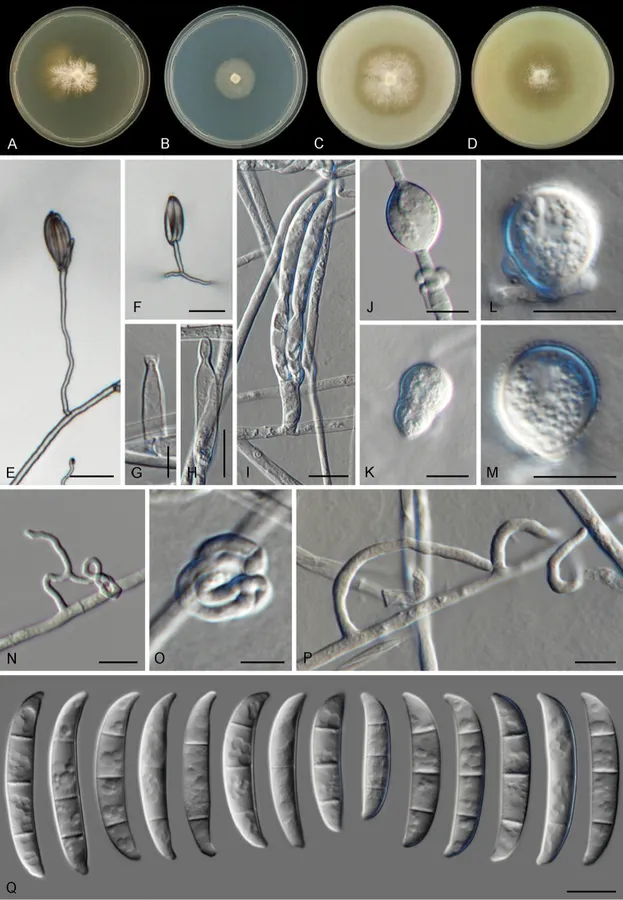
Different from F. circinatum, F. pseudocircinatum O’Donnell & Nirenberg and F. sterilihyphosum Britz, Marasas & M.J. Wingf. by the absence of aerial conidia (microconidia) and the presence of chlamydospores. Different from F. buharicum Jacz. ex Babajan & Teterevn.-Babajan and F. sublunatum by its shorter, less septate and less curved conidia and by the presence of sterile hyphal coils. Colonies on PDA growing in the dark with an average radial growth rate of 2.1–4.8 mm/d, 4.4–5.8 mm/d and 4.6–6.3 mm/d at 24, 27 and 30 °C, respectively; reaching 11–28 mm diam. in 7 d at 24 °C and a maximum of 23–37 mm diam. in 7 d at 30 °C. Minimum temperature for growth 12 °C, maximum 36 °C, optimal 27–33 °C. Colony surface white to cream coloured, flat and highly irregular in shape, velvety to felty, with scant and short aerial mycelium; colony margins highly irregular to rhizoid, with abundant white to grey submerged mycelium. Reverse white, straw to yellow diffusible pigment produced between 21–33 °C, scarcely produced and turning luteous to orange at 36 °C. Colonies on CMA and OA incubated in the dark reaching 40–48 mm diam. in 7 d at 24 °C. Colony surface white to cream coloured, flat or slightly elevated at the centre, velvety to dusty; aerial mycelium abundant, short and dense, concentrated on the colony centre; margins membranous and regular, buff to honey coloured, without aerial mycelium. Reverse ochreous without diffusible pigments. Sporulation scant from conidiophores formed on the aerial mycelium, sporodochia not formed. Conidiophores on the aerial mycelium straight or flexuous, smooth- and thin-walled, simple, mostly reduced to conidiogenous cells borne laterally on hyphae or up to 50 μm tall, bearing terminal single or paired monophialides; phialides subulate to subcylindrical, smooth- and thin-walled, 15.5–22 μm long, (3.5–)4–5 μm at the widest point, with inconspicuous periclinal thickening and a short- flared collarette; conidia clustering in discrete false heads at the tip of monophialides, lunate to falcate, curved or somewhat straight, tapering gently toward the basal part, robust; apical cell often equal in length or slightly shorter than the adjacent cell, blunt to conical; basal cell papillate to distinctly notched, (1–2–)3-septate, hyaline, thin- and smooth-walled.

Sebagian uraian ditampilkan dalam bahasa sumber; terjemahannya belum tersedia atau belum lolos pemeriksaan.

Rujukan: [1]

Pengukuran mengikuti objek, spesimen atau kultur, dan metode yang disebutkan sumber. Baca uraian asli untuk konteks lengkap.

02 / Kehidupan

Habitat dan peran ekologis

Colonies on PDA growing in the dark with an average radial growth rate of 2.1–4.8 mm/d, 4.4–5.8 mm/d and 4.6–6.3 mm/d at 24, 27 and 30 °C, respectively; reaching 11–28 mm diam. in 7 d at 24 °C and a maximum of 23–37 mm diam. in 7 d at 30 °C. Minimum temperature for growth 12 °C, maximum 36 °C, optimal 27–33 °C. Colony surface white to cream coloured, flat and highly irregular in shape, velvety to felty, with scant and short aerial mycelium; colony margins highly irregular to rhizoid, with abundant white to grey submerged mycelium. Reverse white, straw to yellow diffusible pigment produced between 21–33 °C, scarcely produced and turning luteous to orange at 36 °C. Colonies on CMA and OA incubated in the dark reaching 40–48 mm diam. in 7 d at 24 °C. Colony surface white to cream coloured, flat or slightly elevated at the centre, velvety to dusty; aerial mycelium abundant, short and dense, concentrated on the colony centre; margins membranous and regular, buff to honey coloured, without aerial mycelium. Reverse ochreous without diffusible pigments. Sporulation scant from conidiophores formed on the aerial mycelium, sporodochia not formed. Conidiophores on the aerial mycelium straight or flexuous, smooth- and thin-walled, simple, mostly reduced to conidiogenous cells borne laterally on hyphae or up to 50 μm tall, bearing terminal single or paired monophialides; phialides subulate to subcylindrical, smooth- and thin-walled, 15.5–22 μm long, (3.5–)4–5 μm at the widest point, with inconspicuous periclinal thickening and a short- flared collarette; conidia clustering in discrete false heads at the tip of monophialides, lunate to falcate, curved or somewhat straight, tapering gently toward the basal part, robust; apical cell often equal in length or slightly shorter than the adjacent cell, blunt to conical; basal cell papillate to distinctly notched, (1–2–)3-septate, hyaline, thin- and smooth-walled.

Sebagian uraian ditampilkan dalam bahasa sumber; terjemahannya belum tersedia atau belum lolos pemeriksaan.

Rujukan: [1]

Habitat atau konteks temuan
kultur yang didokumentasikan
Substrat
Informasi belum tersedia pada sumber rilis ini.
Peran atau konteks
Belum dikategorikan pada rilis ini.
Temukan hubungan serupa
03 / Siklus hidup

Reproduksi

Different from F. circinatum, F. pseudocircinatum O’Donnell & Nirenberg and F. sterilihyphosum Britz, Marasas & M.J. Wingf. by the absence of aerial conidia (microconidia) and the presence of chlamydospores. Different from F. buharicum Jacz. ex Babajan & Teterevn.-Babajan and F. sublunatum by its shorter, less septate and less curved conidia and by the presence of sterile hyphal coils. Colonies on PDA growing in the dark with an average radial growth rate of 2.1–4.8 mm/d, 4.4–5.8 mm/d and 4.6–6.3 mm/d at 24, 27 and 30 °C, respectively; reaching 11–28 mm diam. in 7 d at 24 °C and a maximum of 23–37 mm diam. in 7 d at 30 °C. Minimum temperature for growth 12 °C, maximum 36 °C, optimal 27–33 °C.

Sebagian uraian ditampilkan dalam bahasa sumber; terjemahannya belum tersedia atau belum lolos pemeriksaan.

Rujukan: [1]

04 / Batas informasi

Catatan identitas dan cakupan

  • Nama diterima mengikuti Catalogue of Life Base2026-09-11; uraian mempertahankan konsep dan nama sumber aslinya.
  • Preserve original treatment localities, hosts and substrate scope. Materials examined describe documented specimens, not the full global range.
  • Impor dan terjemahan otomatis belum diperiksa editorial per profil. Struktur reproduktif yang disebutkan tidak membuktikan seluruh siklus hidup diketahui.
  • Pengukuran pada uraian mengikuti spesimen, kultur, dan metode sumber; angka tidak diperluas ke semua populasi.

Catatan distribusi dalam narasi mengikuti sumbernya. Dokumentasi spesimen atau foto mengikuti catatan sumber. Bukti wilayah Indonesia dan penilaian konservasi tidak disimpulkan dari gambar.

05 / Dokumentasi

Melihat dengan konteks

Fusarium convolutans sp. nov. A–D Colonies on PDA, SNA, OA and CMA, respectively, after 7 d at 24 °C in the dark E–I Conidiophores, phialides and conidia J–M Chlamydospores N–P Sterile hyphal projections Q Conidia. Scale bars: 20 μm (E, F); 5 μm (G–I); 10 μm (J–Q).

Jenis
Pelat ilmiah
Kredit
Marcelo Sandoval-Denis, Wijnand J. Swart, Pedro W. Crous
Lisensi
CC BY 4.0
Sumber media
Buka entri sumber

Gambar menunjukkan objek menurut identifikasi sumber, bukan verifikasi independen spesimen oleh Fungi. Tidak ada skala baru yang ditambahkan.

06 / Rujukan

Sumber profil

  1. [1] New Fusarium species from the Kruger National Park, South Africa — Fusarium convolutansBagian sumber: PMC5993860_section_10
    Tanggal penghimpunan sumber: 2026-10-12
    Teks sumber: CC BY 4.0 · Sandoval-Denis, Marcelo & Swart, Wijnand J. & Crous, Pedro W.
  2. [2] Catalogue of Life Base2026-09-11 — Fusarium convolutansBagian sumber: ColDP NameUsage.tsv ID 6JSRS; accepted species; source 2073
    Tanggal penghimpunan sumber: 2026-10-12
  3. [3] Dokumentasi visual — Fusarium convolutansBagian sumber: Individual media record; identification follows the source, not independent determination
    Tanggal penghimpunan sumber: 2026-10-12
    Media sumber: CC BY 4.0 · Marcelo Sandoval-Denis, Wijnand J. Swart, Pedro W. Crous

Adaptasi teks: CC BY 4.0. Sandoval-Denis, Marcelo & Swart, Wijnand J. & Crous, Pedro W. — New Fusarium species from the Kruger National Park, South Africa — Fusarium convolutans

Uraian asli dan riwayat sumber

Riwayat atau halaman sumber

Ringkasan sumber

Different from F. circinatum, F. pseudocircinatum O’Donnell & Nirenberg and F. sterilihyphosum Britz, Marasas & M.J. Wingf. by the absence of aerial conidia (microconidia) and the presence of chlamydospores. Different from F. buharicum Jacz. ex Babajan & Teterevn.-Babajan and F. sublunatum by its shorter, less septate and less curved conidia and by the presence of sterile hyphal coils. Colonies on PDA growing in the dark with an average radial growth rate of 2.1–4.8 mm/d, 4.4–5.8 mm/d and 4.6–6.3 mm/d at 24, 27 and 30 °C, respectively; reaching 11–28 mm diam. in 7 d at 24 °C and a maximum of 23–37 mm diam. in 7 d at 30 °C.

Revisi sumber

Morfologi sumber

Different from F. circinatum, F. pseudocircinatum O’Donnell & Nirenberg and F. sterilihyphosum Britz, Marasas & M.J. Wingf. by the absence of aerial conidia (microconidia) and the presence of chlamydospores. Different from F. buharicum Jacz. ex Babajan & Teterevn.-Babajan and F. sublunatum by its shorter, less septate and less curved conidia and by the presence of sterile hyphal coils. Colonies on PDA growing in the dark with an average radial growth rate of 2.1–4.8 mm/d, 4.4–5.8 mm/d and 4.6–6.3 mm/d at 24, 27 and 30 °C, respectively; reaching 11–28 mm diam. in 7 d at 24 °C and a maximum of 23–37 mm diam. in 7 d at 30 °C. Minimum temperature for growth 12 °C, maximum 36 °C, optimal 27–33 °C. Colony surface white to cream coloured, flat and highly irregular in shape, velvety to felty, with scant and short aerial mycelium; colony margins highly irregular to rhizoid, with abundant white to grey submerged mycelium. Reverse white, straw to yellow diffusible pigment produced between 21–33 °C, scarcely produced and turning luteous to orange at 36 °C. Colonies on CMA and OA incubated in the dark reaching 40–48 mm diam. in 7 d at 24 °C. Colony surface white to cream coloured, flat or slightly elevated at the centre, velvety to dusty; aerial mycelium abundant, short and dense, concentrated on the colony centre; margins membranous and regular, buff to honey coloured, without aerial mycelium. Reverse ochreous without diffusible pigments. Sporulation scant from conidiophores formed on the aerial mycelium, sporodochia not formed. Conidiophores on the aerial mycelium straight or flexuous, smooth- and thin-walled, simple, mostly reduced to conidiogenous cells borne laterally on hyphae or up to 50 μm tall, bearing terminal single or paired monophialides; phialides subulate to subcylindrical, smooth- and thin-walled, 15.5–22 μm long, (3.5–)4–5 μm at the widest point, with inconspicuous periclinal thickening and a short- flared collarette; conidia clustering in discrete false heads at the tip of monophialides, lunate to falcate, curved or somewhat straight, tapering gently toward the basal part, robust; apical cell often equal in length or slightly shorter than the adjacent cell, blunt to conical; basal cell papillate to distinctly notched, (1–2–)3-septate, hyaline, thin- and smooth-walled.

Revisi sumber

Ekologi sumber

Colonies on PDA growing in the dark with an average radial growth rate of 2.1–4.8 mm/d, 4.4–5.8 mm/d and 4.6–6.3 mm/d at 24, 27 and 30 °C, respectively; reaching 11–28 mm diam. in 7 d at 24 °C and a maximum of 23–37 mm diam. in 7 d at 30 °C. Minimum temperature for growth 12 °C, maximum 36 °C, optimal 27–33 °C. Colony surface white to cream coloured, flat and highly irregular in shape, velvety to felty, with scant and short aerial mycelium; colony margins highly irregular to rhizoid, with abundant white to grey submerged mycelium. Reverse white, straw to yellow diffusible pigment produced between 21–33 °C, scarcely produced and turning luteous to orange at 36 °C. Colonies on CMA and OA incubated in the dark reaching 40–48 mm diam. in 7 d at 24 °C. Colony surface white to cream coloured, flat or slightly elevated at the centre, velvety to dusty; aerial mycelium abundant, short and dense, concentrated on the colony centre; margins membranous and regular, buff to honey coloured, without aerial mycelium. Reverse ochreous without diffusible pigments. Sporulation scant from conidiophores formed on the aerial mycelium, sporodochia not formed. Conidiophores on the aerial mycelium straight or flexuous, smooth- and thin-walled, simple, mostly reduced to conidiogenous cells borne laterally on hyphae or up to 50 μm tall, bearing terminal single or paired monophialides; phialides subulate to subcylindrical, smooth- and thin-walled, 15.5–22 μm long, (3.5–)4–5 μm at the widest point, with inconspicuous periclinal thickening and a short- flared collarette; conidia clustering in discrete false heads at the tip of monophialides, lunate to falcate, curved or somewhat straight, tapering gently toward the basal part, robust; apical cell often equal in length or slightly shorter than the adjacent cell, blunt to conical; basal cell papillate to distinctly notched, (1–2–)3-septate, hyaline, thin- and smooth-walled.

Revisi sumber

Struktur reproduksi sumber

Different from F. circinatum, F. pseudocircinatum O’Donnell & Nirenberg and F. sterilihyphosum Britz, Marasas & M.J. Wingf. by the absence of aerial conidia (microconidia) and the presence of chlamydospores. Different from F. buharicum Jacz. ex Babajan & Teterevn.-Babajan and F. sublunatum by its shorter, less septate and less curved conidia and by the presence of sterile hyphal coils. Colonies on PDA growing in the dark with an average radial growth rate of 2.1–4.8 mm/d, 4.4–5.8 mm/d and 4.6–6.3 mm/d at 24, 27 and 30 °C, respectively; reaching 11–28 mm diam. in 7 d at 24 °C and a maximum of 23–37 mm diam. in 7 d at 30 °C. Minimum temperature for growth 12 °C, maximum 36 °C, optimal 27–33 °C.

Revisi sumber

Rujukan halaman ini

Fungi. Fusarium convolutans. Rilis data fungi-2026-10-12-expansion-2. https://fungi-atlas.mgadib.chatgpt.site/jamur/fusarium-convolutans/.

Status: impor sumber; pemeriksaan editorial per profil belum selesai. Untuk klaim biologis, gunakan rujukan pada bagian terkait dan periksa konteks sumber aslinya.