01 / Morfologi

Ciri dan struktur

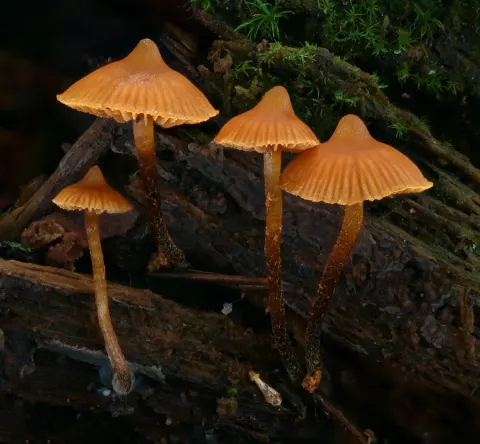
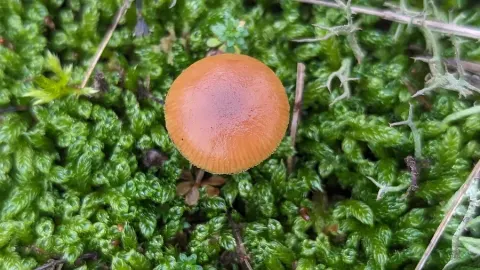
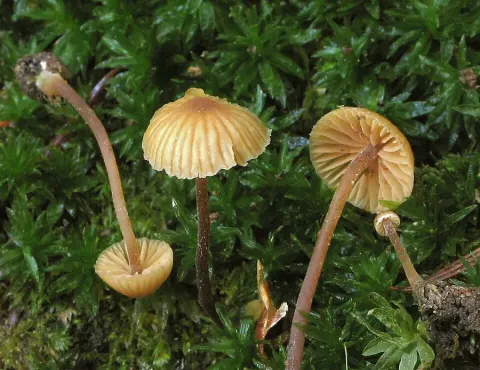
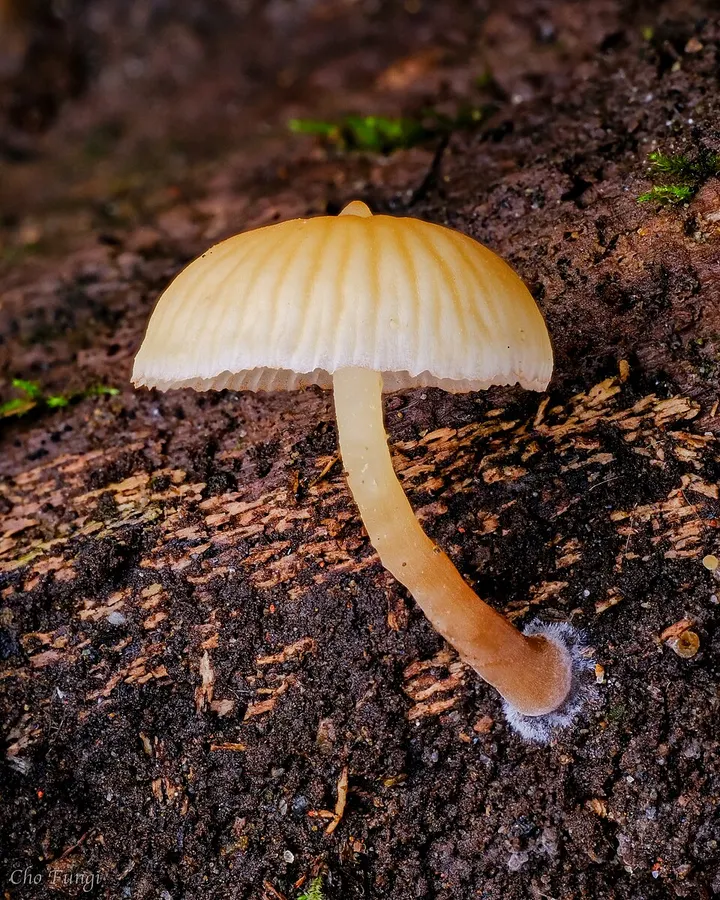
The cap is initially egg-shaped in young specimens, but changes shape as it matures, becoming convex and later more or less flat with a central depression. At the center of the cap is a roughly spherical umbo – a nipple-like protrusion. The cap is hygrophanous, meaning it changes color depending on its state of hydration: the color is tawny in moist specimens, changing to ochre with dark brown edges when dried. The cap diameter is typically 1.5 to 4 cm, with a surface that is smooth, and almost gelatinous in consistency. The edge of the cap is thin and wavy, and is often split open. The gills are broadly adnate (attached to the stalk slightly above the bottom of the gill, with most of the gill fused to the stem) to slightly decurrent (running down the length of the stem). Interspersed between the gills are shorter gills, called lamellulae, that start from the cap, but do not reach the stem. The gills are broad (up to 4 mm) and thick at the base (1 mm), and when mature can develop veins that run between the gills on the undersurface of the cap. The stem is 0.4 to 2.5 cm long, 0.15 to 0.3 cm thick, and usually attached centrally to the underside of the cap, although it may sometimes be slightly off-center. Stems are solid, cylindrical, and may be pruinose (dusted with a very fine layer of powder). Berkeley's original description noted a resemblance to a small Marasmius peronatus, a mushroom today known as Gymnopus peronatus. The spores are ellipsoid to almond-shaped, with dimensions of 7.2–9.7 by 4.5–5.8 μm. The basidia (spore-bearing cells) are cylindrical to slightly club-shaped, four-spored, and measure 30–45 by 5.5–6 μm.

Sebagian uraian ditampilkan dalam bahasa sumber; terjemahannya belum tersedia atau belum lolos pemeriksaan.

Rujukan: [1]

Pengukuran mengikuti objek, spesimen atau kultur, dan metode yang disebutkan sumber. Baca uraian asli untuk konteks lengkap.

02 / Kehidupan

Habitat dan peran ekologis

Spesies ini tumbuh di atas kayu mati di daerah tropis seperti Indonesia (Java and Sumatra), dan dekat India (Sri Lanka), di mana ia subur di beberapa daerah. Tidak ditemukan di Amerika Utara. Di Jerman, telah ditemukan tumbuh di rumah kaca, dan dikenal dalam bahasa setempat sebagai Gewächshaus-Häubling, yang berarti " rumah kaca Galerina". In one instance, the mushroom was discovered fruiting in dense groups in pots of orchids standing on moist conifer sawdust.

Sebagian uraian ditampilkan dalam bahasa sumber; terjemahannya belum tersedia atau belum lolos pemeriksaan.

Rujukan: [1]

Habitat atau konteks temuan
Informasi belum tersedia pada sumber rilis ini.
Substrat
kayu
Peran atau konteks
Belum dikategorikan pada rilis ini.
Temukan hubungan serupa
03 / Siklus hidup

Reproduksi

The spores are ellipsoid to almond-shaped, with dimensions of 7.2–9.7 by 4.5–5.8 μm. The basidia (spore-bearing cells) are cylindrical to slightly club-shaped, four-spored, and measure 30–45 by 5.5–6 μm. The sterigmata (projections of the basidia that attach the spores) are 5–6 μm long. The pleurocystidia (cystidia located in the gill face) are thin-walled, with long, somewhat cylindrical necks, and may range in color from translucent (hyaline) to pale brownish-yellow. They are typically 40 by 10.5 μm, although they may occasionally be larger—up to 142 by 18 by 8 μm. Cystidia in the gill edge—the cheilocystidia—are similar in appearance to the pleurocystidia. The hyphae of G. sulciceps have clamp connections—short branches connecting one cell to the previous cell to allow passage of the products of nuclear division.

Sebagian uraian ditampilkan dalam bahasa sumber; terjemahannya belum tersedia atau belum lolos pemeriksaan.

Rujukan: [1]

Sinonim menurut acuan taksonomi rilis: Chamaeceras sulciceps; Marasmius sulciceps
04 / Batas informasi

Catatan identitas dan cakupan

  • Nama diterima mengikuti Catalogue of Life Base2026-09-11; uraian mempertahankan konsep dan nama sumber aslinya.
  • Original geographic, specimen and life-cycle scope retained; source import awaits individual editorial review.
  • Impor dan terjemahan otomatis belum diperiksa editorial per profil. Struktur reproduktif yang disebutkan tidak membuktikan seluruh siklus hidup diketahui.
  • Pengukuran pada uraian mengikuti spesimen, kultur, dan metode sumber; angka tidak diperluas ke semua populasi.

Catatan distribusi dalam narasi mengikuti sumbernya. Dokumentasi spesimen atau foto mengikuti catatan sumber. Bukti wilayah Indonesia dan penilaian konservasi tidak disimpulkan dari gambar.

05 / Dokumentasi

Melihat dengan konteks

Dokumentasi Galerina sulciceps dari Wikimedia Commons. For more information about this, see the observation page at Mushroom Observer. Identifikasi mengikuti record berkas sumber.

Jenis
Fotografi
Kredit
This image was created by user Cho Fungi (eric6717) at Mushroom Observer , a source for mycological images. You can contact this user here .
Sumber media
Buka entri sumber

Gambar menunjukkan objek menurut identifikasi sumber, bukan verifikasi independen spesimen oleh Fungi. Tidak ada skala baru yang ditambahkan.

06 / Rujukan

Sumber profil

  1. [1] Galerina sulciceps — Wikipedia (en)Bagian sumber: Frozen revision 1364291090
    Tanggal penghimpunan sumber: 2026-10-12
    Teks sumber: CC BY-SA4.0 · Wikipedia contributors
  2. [2] Catalogue of Life Base2026-09-11 — Galerina sulcicepsBagian sumber: ColDP NameUsage.tsv ID 3F4LZ; accepted species; source 2073
    Tanggal penghimpunan sumber: 2026-10-12
  3. [3] Dokumentasi visual — Galerina sulcicepsBagian sumber: Individual media record; identification follows the source, not independent determination
    Tanggal penghimpunan sumber: 2026-10-12
    Media sumber: CC BY-SA 3.0 · This image was created by user Cho Fungi (eric6717) at Mushroom Observer , a source for mycological images. You can contact this user here .

Adaptasi teks: CC BY-SA 4.0. Wikipedia contributors — Galerina sulciceps — Wikipedia (en)

Uraian asli dan riwayat sumber

Riwayat atau halaman sumber

Ringkasan sumber

Galerina sulciceps is a dangerously toxic species of fungus in the family Hymenogastraceae, of the order Agaricales. It is distributed in tropical Indonesia and India, but has reportedly been found fruiting in European greenhouses on occasion. More toxic than the deathcap (Amanita phalloides), G. sulciceps has been shown to contain the toxins alpha- (α-), beta- (β-) and gamma- (γ-) amanitin; a series of poisonings in Indonesia in the 1930s resulted in 14 deaths from the consumption of this species.

Revisi sumber

Morfologi sumber

The cap is initially egg-shaped in young specimens, but changes shape as it matures, becoming convex and later more or less flat with a central depression. At the center of the cap is a roughly spherical umbo – a nipple-like protrusion. The cap is hygrophanous, meaning it changes color depending on its state of hydration: the color is tawny in moist specimens, changing to ochre with dark brown edges when dried. The cap diameter is typically 1.5 to 4 cm, with a surface that is smooth, and almost gelatinous in consistency. The edge of the cap is thin and wavy, and is often split open. The gills are broadly adnate (attached to the stalk slightly above the bottom of the gill, with most of the gill fused to the stem) to slightly decurrent (running down the length of the stem). Interspersed between the gills are shorter gills, called lamellulae, that start from the cap, but do not reach the stem. The gills are broad (up to 4 mm) and thick at the base (1 mm), and when mature can develop veins that run between the gills on the undersurface of the cap. The stem is 0.4 to 2.5 cm long, 0.15 to 0.3 cm thick, and usually attached centrally to the underside of the cap, although it may sometimes be slightly off-center. Stems are solid, cylindrical, and may be pruinose (dusted with a very fine layer of powder). Berkeley's original description noted a resemblance to a small Marasmius peronatus, a mushroom today known as Gymnopus peronatus. The spores are ellipsoid to almond-shaped, with dimensions of 7.2–9.7 by 4.5–5.8 μm. The basidia (spore-bearing cells) are cylindrical to slightly club-shaped, four-spored, and measure 30–45 by 5.5–6 μm.

Revisi sumber

Ekologi sumber

This species grows on dead wood in tropical locales like Indonesia (Java and Sumatra), and near India (Sri Lanka), where it is prolific in some areas. It is not found in North America. In Germany, it has been found growing in greenhouses, and is known in the vernacular as the Gewächshaus-Häubling, meaning "greenhouse Galerina". In one instance, the mushroom was discovered fruiting in dense groups in pots of orchids standing on moist conifer sawdust.

Revisi sumber

Struktur reproduksi sumber

The spores are ellipsoid to almond-shaped, with dimensions of 7.2–9.7 by 4.5–5.8 μm. The basidia (spore-bearing cells) are cylindrical to slightly club-shaped, four-spored, and measure 30–45 by 5.5–6 μm. The sterigmata (projections of the basidia that attach the spores) are 5–6 μm long. The pleurocystidia (cystidia located in the gill face) are thin-walled, with long, somewhat cylindrical necks, and may range in color from translucent (hyaline) to pale brownish-yellow. They are typically 40 by 10.5 μm, although they may occasionally be larger—up to 142 by 18 by 8 μm. Cystidia in the gill edge—the cheilocystidia—are similar in appearance to the pleurocystidia. The hyphae of G. sulciceps have clamp connections—short branches connecting one cell to the previous cell to allow passage of the products of nuclear division.

Revisi sumber

Rujukan halaman ini

Fungi. Galerina sulciceps. Rilis data fungi-2026-10-12-expansion-2. https://fungi-atlas.mgadib.chatgpt.site/jamur/galerina-sulciceps/.

Status: impor sumber; pemeriksaan editorial per profil belum selesai. Untuk klaim biologis, gunakan rujukan pada bagian terkait dan periksa konteks sumber aslinya.