Ciri dan struktur
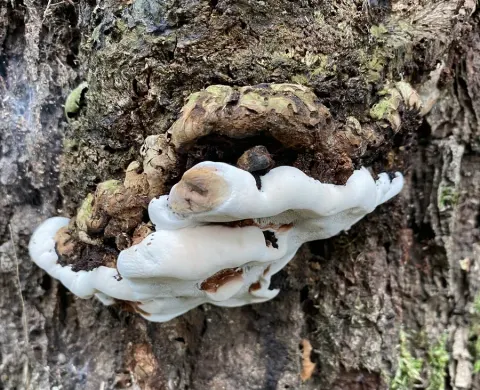
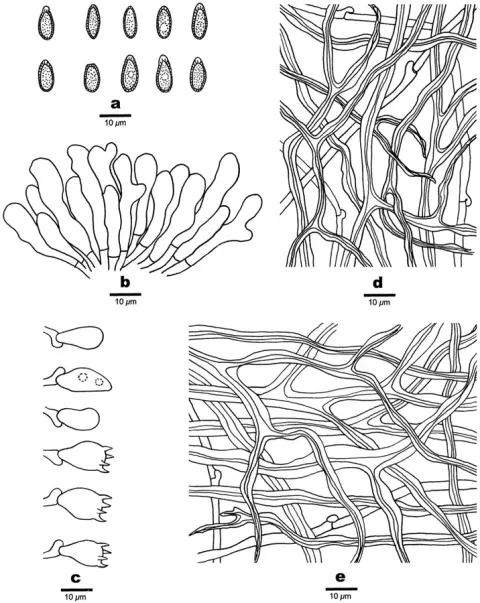
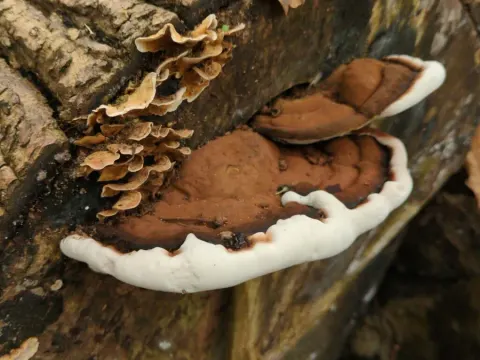
Basidiome. Sessile, dimidiate. Pileus shape. Semicircular to dimidiate or conks, up to 7–12 cm in length and 4–8 cm in width, up to 1.5 cm thick. Pileus surface. Dark brown (9F5) at the base, slightly brownish red (10C8) at center, reddish gray (10B8) extending to the margin, light yellow (1A5) to yellow (2A6) under basidiocarp with grayish yellow (4C7) to brown (6D7 to 6F6) close to tube layer on upper surface of pileus glabrous, weakly to strongly laccate, glossy and shiny, smooth, spathulate, shallow sulcate several layers thick, consistency furrows, thicker at the base than the margin, covered by a thin and hard crust, and light in weight when dried. Context trimitic, irregular cuticle cells, mostly light yellow (1A5) to yellow (2A6) close to crust, grayish yellow (4C7), brown (6D7 to 6F6) to dark brown (9F5), near the tubes, dense context layer, thick near the base, tough to break when dried. Hymenophore. Grayish yellow (4C7). Basidiospores. Mostly oblong ellipsoid and broadly ellipsoid with double wall (ganodermoid) at maturity, (7.3–)7.6–10.1(10.8) × (10.1)10.6–13.3(13.9) μm (x̄ = 9.1 × 12.2 μm, n = 50) (including myxosporium), (5.4–)5.6–8.3(8.6) × (8.3)8.4–12.5(12.9) μm (x̄ = 7.1 × 10.6 μm, n = 50) μm (excluding outer myxosporium), light brown (6D6–6D8), reddish brown (9F6) to dark brown (9F8), usually with one end tapering, and usually overlaid by a hyaline myxosporium. Tubes. 2–7 mm long, up to 80–170 µm wide, and sulcate at different levels. Stipe. Lateral, up to 1.5 cm thick, dark brown (9F5). Margin. reddish gray (10B8), up to 0.3–0.7 cm thick, round, tough and hard, thicker towards the margin.
Habitat dan peran ekologis
Solitary on living Dipterocarpus species in deciduous forests. In our study of the seven different agar media, mycelial growth (mm), growth rates (mm/day), and mycelial density were screened as an indication of favorable growth of Thai G. tropicum (Table 3). After 10 days of incubation, the agar surface was fully colonized with a white (6A1) to pale orange (6A2–6A3) mycelium. The best mycelium colony diameter was observed on PDA, MEA, and YPD media, following YMA, RBA, YEA, and CZA, respectively. Mycelial morphology and colony color characteristics differed on each agar media (Fig. 3). For instance, the morphological characteristics of G. tropicum growth on CZA medium were expressed as a very scanty, cotton colony (Fig. 3A). The colony on YEA medium was similar to that of CZA, although YEA exhibited greater density and biomass (Fig. 3E). Mycelial morphological characteristics on MEA and YPD were similar; both were expressed as an abundant (5+) massive cottony colony with orange white to pale orange (6A1–6A3) colony (Fig. 3B, G). The PDA medium, by contrast, showed a somewhat abundant (4+) white cotton colony (Fig. 3C), which was a slightly dark golden yellow (5A7) colony after 18 days of incubation (Fig. 2E, F).
- Habitat atau konteks temuan
- hutan; kultur yang didokumentasikan
- Substrat
- Informasi belum tersedia pada sumber rilis ini.
- Peran atau konteks
- Belum dikategorikan pada rilis ini.
Reproduksi
Basidiome. Sessile, dimidiate. Pileus shape. Semicircular to dimidiate or conks, up to 7–12 cm in length and 4–8 cm in width, up to 1.5 cm thick. Pileus surface. Dark brown (9F5) at the base, slightly brownish red (10C8) at center, reddish gray (10B8) extending to the margin, light yellow (1A5) to yellow (2A6) under basidiocarp with grayish yellow (4C7) to brown (6D7 to 6F6) close to tube layer on upper surface of pileus glabrous, weakly to strongly laccate, glossy and shiny, smooth, spathulate, shallow sulcate several layers thick, consistency furrows, thicker at the base than the margin, covered by a thin and hard crust, and light in weight when dried. Context trimitic, irregular cuticle cells, mostly light yellow (1A5) to yellow (2A6) close to crust, grayish yellow (4C7), brown (6D7 to 6F6) to dark brown (9F5), near the tubes, dense context layer, thick near the base, tough to break when dried.
Catatan identitas dan cakupan
- Nama diterima mengikuti Catalogue of Life Base2026-09-11; uraian mempertahankan konsep dan nama sumber aslinya.
- Preserve original treatment localities, hosts and substrate scope. Materials examined describe documented specimens, not the full global range.
- Impor dan terjemahan otomatis belum diperiksa editorial per profil. Struktur reproduktif yang disebutkan tidak membuktikan seluruh siklus hidup diketahui.
- Pengukuran pada uraian mengikuti spesimen, kultur, dan metode sumber; angka tidak diperluas ke semua populasi.
Catatan distribusi dalam narasi mengikuti sumbernya. Dokumentasi spesimen atau foto mengikuti catatan sumber. Bukti wilayah Indonesia dan penilaian konservasi tidak disimpulkan dari gambar.
Melihat dengan konteks
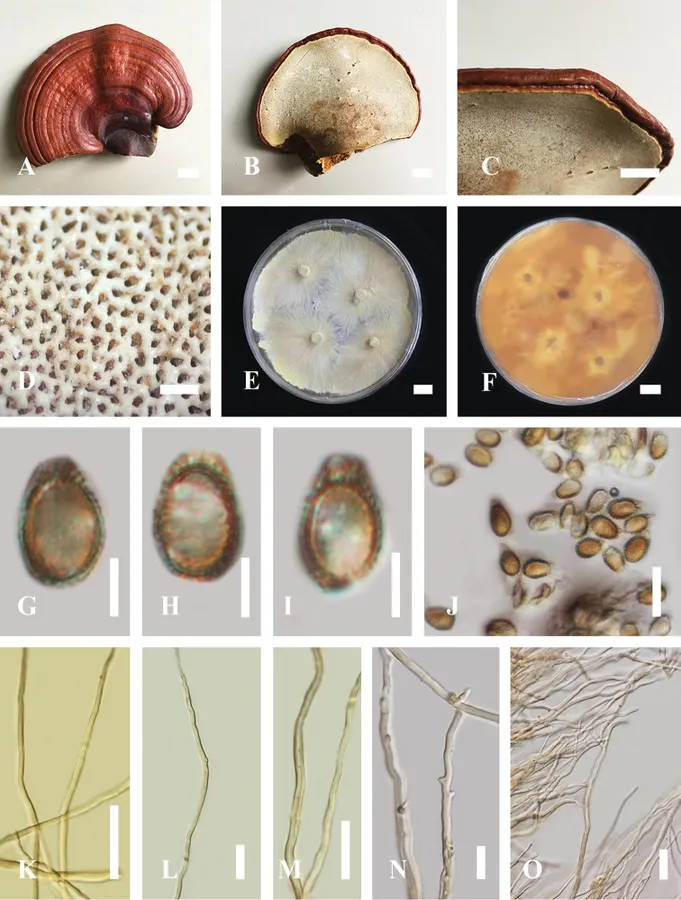
Morphology of Ganoderma tropicum strain KUMCC18-0046 A, B Mature basidiocarps C Margin D Pore characteristics E, F Culture after incubation at 25 °C for 21 days G, J Basidiospore in KOH K, L Generative hyphae of context in KOH M Skeletal hyphae N Skeletal hyphae and binding hyphae O Sparing branch hyphae. Scale bars: 1 cm (A–C); 500 µm (D); 1 cm (E, F); 5 µm (G–I); 15 µm (J); 20 µm (K, L, O); 10 µm (M, N).
- Jenis
- Pelat ilmiah
- Kredit
- Thatsanee Luangharn, Samantha C. Karunarathna, Peter E. Mortimer, Kevin D. Hyde, Naritsada Thongklang, Jianchu Xu
- Lisensi
- CC BY 4.0
- Sumber media
- Buka entri sumber
Dokumentasi tambahan
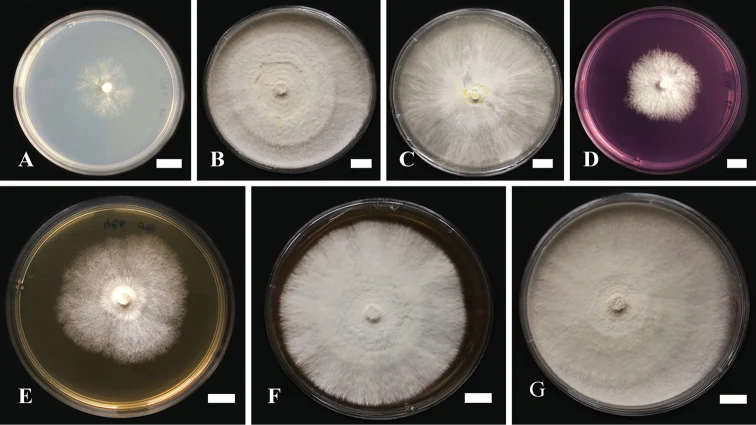
Characteristics of Ganoderma tropicum strain KUMCC18-0046 mycelial cultures were incubated at 25 °C for 10 days on different agar media A Czapek’s agar (CZA) B Malt extract agar (MEA) C Potato dextrose agar (PDA) D Rose Bengal agar (RBA) E Yeast extract agar (YEA) F Yeast malt extract agar (YMA) G Yeast extract peptone dextrose agar (YPD). Scale bars: 1 cm.
Kredit dan penggunaan
Thatsanee Luangharn, Samantha C. Karunarathna, Peter E. Mortimer, Kevin D. Hyde, Naritsada Thongklang, Jianchu Xu
Ukuran dan format gambar disesuaikan tanpa pemotongan, retus, atau penambahan skala. Lisensi sumber dipertahankan.
Sumber profil
- [1] A new record of Ganoderma tropicum (Basidiomycota, Polyporales) for Thailand and first assessment of optimum conditions for mycelia production — Ganoderma tropicum
- [2] Catalogue of Life Base2026-09-11 — Ganoderma tropicum
- [3] Dokumentasi visual — Ganoderma tropicum
- [4] Dokumentasi visual — Ganoderma tropicum
Rujukan halaman ini
Fungi. Ganoderma tropicum. Rilis data fungi-2026-10-12-expansion-2. https://fungi-atlas.mgadib.chatgpt.site/jamur/ganoderma-tropicum/.
Status: impor sumber; pemeriksaan editorial per profil belum selesai. Untuk klaim biologis, gunakan rujukan pada bagian terkait dan periksa konteks sumber aslinya.