Ciri dan struktur
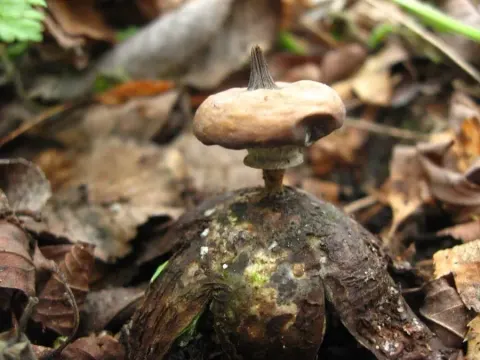
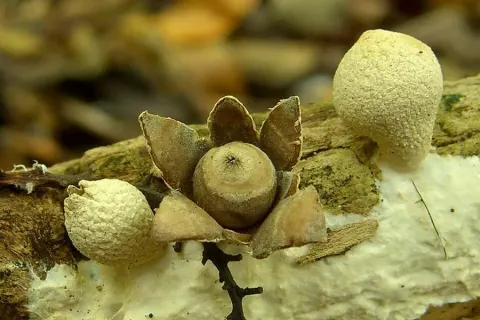
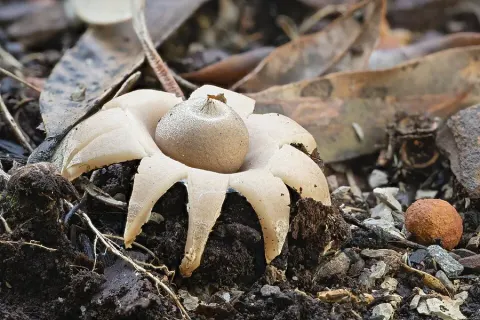
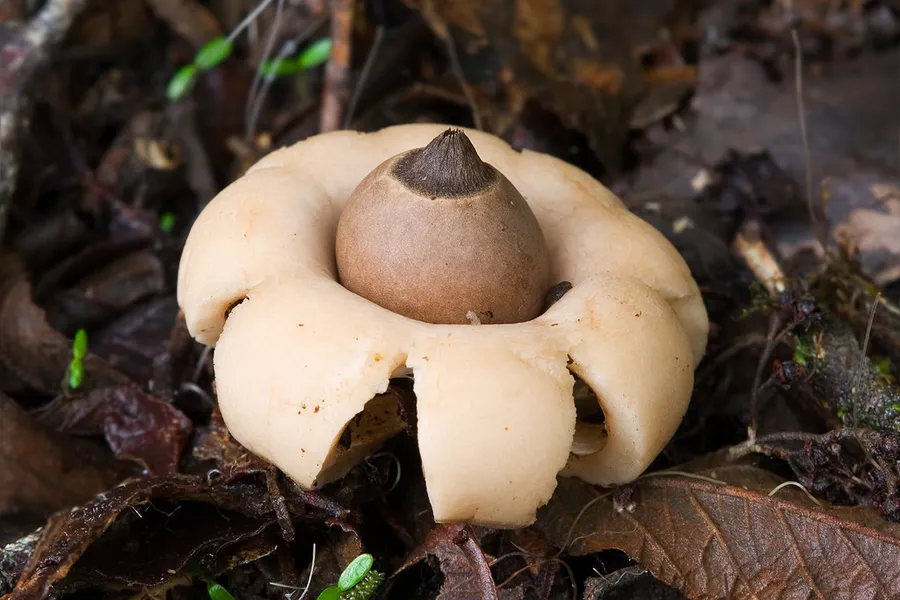
The immature fruiting body is 0.6 to 2.5 cm in diameter and 0.8 to 1.5 cm tall. Initially, the fruiting body is egg-shaped—similar in appearance to puffballs—and has strands of mycelia (rhizomorphs) at the base that attach it to the growing surface. The 'skin,' or peridium, is composed of two separate layers: the outer layer (exoperidium), which is a golden tan to yellowish-brown color, separates away from the inner basidiocarp and splits into five to eight rays that curve backward (recurve) to the base. The mushroom is 2 to 5 cm in diameter after the rays have expanded. Unlike some other members of the genus Geastrum (like G. fornicatum), the arms do not push the basidiocarp off the ground; rather, it lies flat. The inner spore-bearing basidiocarp is 0.5 to 2 cm broad, and has a central pore surrounded by a circular dull-brown apical disc; the disc is distinctly ridged or depressed. The inside of the interior sphere is white when young, but matures into a mass of brown, powdery spores mixed with thick-walled fibres known as capillitium. The flesh is bitter.
Habitat dan peran ekologis
Geastrum saccatum is saprobic, and grows scattered or clustered together in leaf litter of humus, usually in late summer and fall. It has a cosmopolitan distribution, and is well adapted to tropical regions. The species has been collected in North America (Canada, the United States and Mexico), Central America (the Congo and Panama), South America (Argentina, Uruguay, and Brazil), Cuba, Africa (Tanzania, West Africa, and South Africa), Asia (China and India), and Tobago and Toowoomba, QLD, Australia. In North America, it is found September–December on the west coast and July–October elsewhere.
- Habitat atau konteks temuan
- Informasi belum tersedia pada sumber rilis ini.
- Substrat
- Informasi belum tersedia pada sumber rilis ini.
- Peran atau konteks
- Pengurai
Reproduksi
The immature fruiting body is 0.6 to 2.5 cm in diameter and 0.8 to 1.5 cm tall. Initially, the fruiting body is egg-shaped—similar in appearance to puffballs—and has strands of mycelia (rhizomorphs) at the base that attach it to the growing surface. The 'skin,' or peridium, is composed of two separate layers: the outer layer (exoperidium), which is a golden tan to yellowish-brown color, separates away from the inner basidiocarp and splits into five to eight rays that curve backward (recurve) to the base. The mushroom is 2 to 5 cm in diameter after the rays have expanded. Unlike some other members of the genus Geastrum (like G. fornicatum), the arms do not push the basidiocarp off the ground; rather, it lies flat.
Catatan identitas dan cakupan
- Nama diterima mengikuti Catalogue of Life Base2026-09-11; uraian mempertahankan konsep dan nama sumber aslinya.
- Original geographic, specimen and life-cycle scope retained; source import awaits individual editorial review.
- Impor dan terjemahan otomatis belum diperiksa editorial per profil. Struktur reproduktif yang disebutkan tidak membuktikan seluruh siklus hidup diketahui.
- Pengukuran pada uraian mengikuti spesimen, kultur, dan metode sumber; angka tidak diperluas ke semua populasi.
Catatan distribusi dalam narasi mengikuti sumbernya. Dokumentasi spesimen atau foto mengikuti catatan sumber. Bukti wilayah Indonesia dan penilaian konservasi tidak disimpulkan dari gambar.
Melihat dengan konteks
Dokumentasi Geastrum saccatum menurut asosiasi foto pada record takson iNaturalist. Kredit: JJ Harrison. Identitas mengikuti sumber; bukan penentuan spesimen independen.
- Jenis
- Fotografi
- Kredit
- (c) JJ Harrison, some rights reserved (CC BY-SA)
- Lisensi
- CC BY-SA 4.0
- Sumber media
- Buka entri sumber
Dokumentasi tambahan
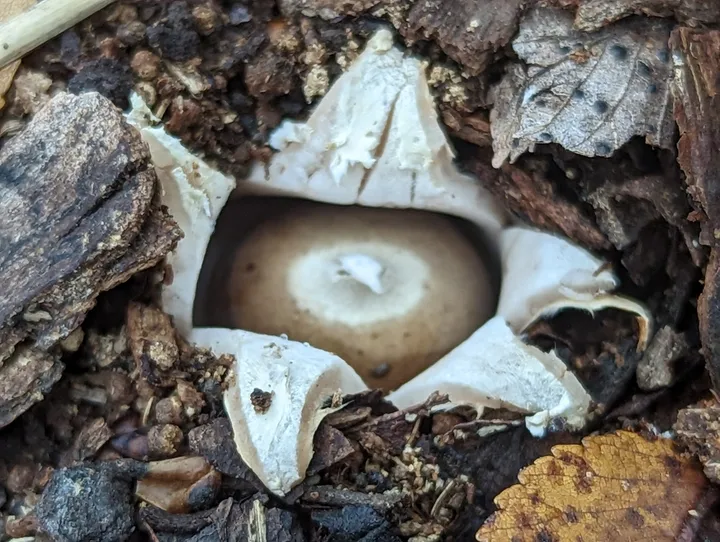
Foto yang diasosiasikan dengan Geastrum saccatum pada iNaturalist. Identifikasi mengikuti sumber; bukan penentuan spesimen independen.
Kredit dan penggunaan
(c) Alan Rockefeller, some rights reserved (CC BY), uploaded by Alan Rockefeller
Ukuran dan format gambar disesuaikan tanpa pemotongan, retus, atau penambahan skala. Lisensi sumber dipertahankan.
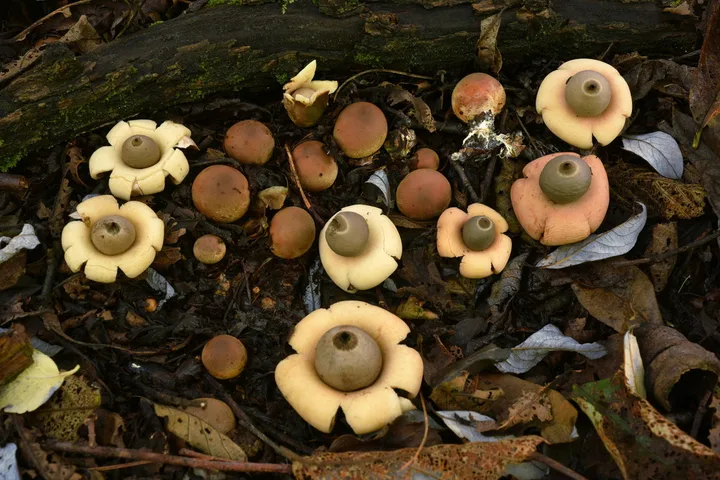
Foto yang diasosiasikan dengan Geastrum saccatum pada iNaturalist. Identifikasi mengikuti sumber; bukan penentuan spesimen independen.
Kredit dan penggunaan
(c) Alan Rockefeller, some rights reserved (CC BY), uploaded by Alan Rockefeller
Ukuran dan format gambar disesuaikan tanpa pemotongan, retus, atau penambahan skala. Lisensi sumber dipertahankan.
Sumber profil
- [1] Geastrum saccatum — Wikipedia (en)
- [2] Catalogue of Life Base2026-09-11 — Geastrum saccatum
- [3] Dokumentasi visual — Geastrum saccatum
- [4] Dokumentasi visual — Geastrum saccatum
- [5] Dokumentasi visual — Geastrum saccatum
Rujukan halaman ini
Fungi. Geastrum saccatum. Rilis data fungi-2026-10-12-expansion-2. https://fungi-atlas.mgadib.chatgpt.site/jamur/geastrum-saccatum/.
Status: impor sumber; pemeriksaan editorial per profil belum selesai. Untuk klaim biologis, gunakan rujukan pada bagian terkait dan periksa konteks sumber aslinya.