Ciri dan struktur
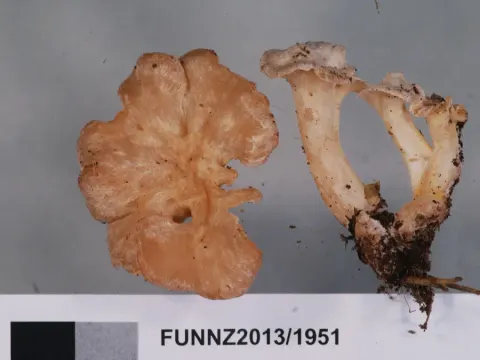
The fruit bodies are 4 - 10 cm high with a cap that is 6 - 12 cm across and is orange to salmon pink, turning wine-coloured when bruised or cut. The surface is smooth and the cap margins are inrolled in young mushrooms. The spore-bearing surface under the cap are gill-like ridges that are up to 3 mm deep. These ridges fork 1–3 times along their length and are buff, turning dark purple when bruised or cut. The stipe is 0.8 - 2 cm in diameter and 4 - 10 cm high, cream when young and darkening to a clay colour when more mature. It stains wine-coloured when bruised or cut. The dark purple bruising distinguishes it from edible chanterelles to which it has a superficial resemblance in shape.
Habitat dan peran ekologis
In the United States it is found in the Great Smoky Mountains National Park in the Appalachian Mountains in North Carolina, where it grows in maple-hemlock forest. It also grows in the subtropical cloud forests in Mexico, having been found in the provinces of Oaxaca, Veracruz and Guerrero. It is mycorrhizal. Mushrooms appear singly or in scattered groups of up to 30 in August and September. It is considered "Near threatened" by the Global Fungal Red List Initiative, as it is estimated that there are only 2000 mature individuals of this species. Its edibility is unknown.
- Habitat atau konteks temuan
- hutan
- Substrat
- Informasi belum tersedia pada sumber rilis ini.
- Peran atau konteks
- Mitra tumbuhan
Reproduksi
The fruit bodies are 4 - 10 cm high with a cap that is 6 - 12 cm across and is orange to salmon pink, turning wine-coloured when bruised or cut. The surface is smooth and the cap margins are inrolled in young mushrooms. The spore-bearing surface under the cap are gill-like ridges that are up to 3 mm deep. These ridges fork 1–3 times along their length and are buff, turning dark purple when bruised or cut. The stipe is 0.8 - 2 cm in diameter and 4 - 10 cm high, cream when young and darkening to a clay colour when more mature. It stains wine-coloured when bruised or cut.
Catatan identitas dan cakupan
- Nama diterima mengikuti Catalogue of Life Base2026-09-11; uraian mempertahankan konsep dan nama sumber aslinya.
- Original geographic, specimen and life-cycle scope retained; source import awaits individual editorial review.
- Impor dan terjemahan otomatis belum diperiksa editorial per profil. Struktur reproduktif yang disebutkan tidak membuktikan seluruh siklus hidup diketahui.
- Pengukuran pada uraian mengikuti spesimen, kultur, dan metode sumber; angka tidak diperluas ke semua populasi.
Catatan distribusi dalam narasi mengikuti sumbernya. Dokumentasi spesimen atau foto mengikuti catatan sumber. Bukti wilayah Indonesia dan penilaian konservasi tidak disimpulkan dari gambar.
Melihat dengan konteks
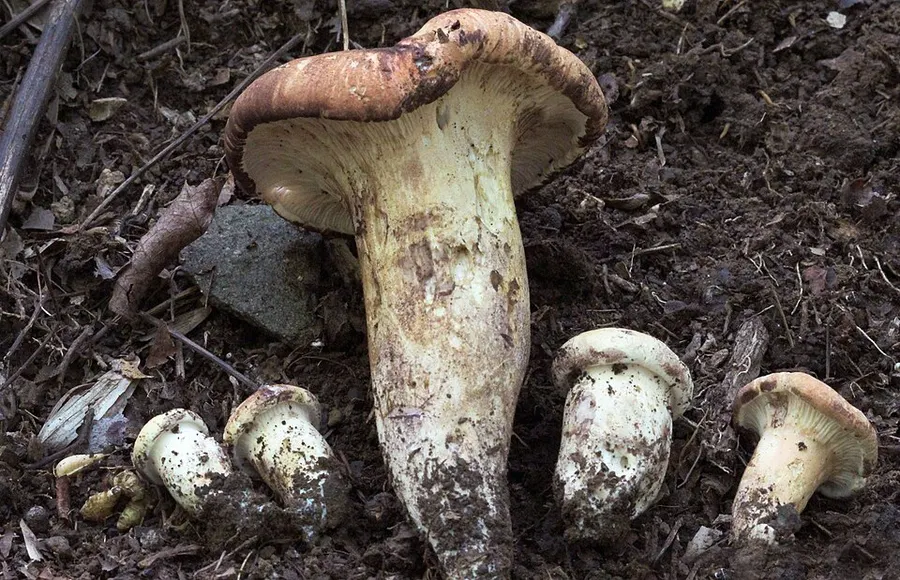
Dokumentasi Gloeocantharellus purpurascens dari Wikimedia Commons. Fruit bodies of the agaric fungus Gloeocantharellus purpurascens . Photographed at Jake’s Creek Trail, Great Smokey Mountains, Elkmont, Tennessee, USA. Identifikasi mengikuti record berkas sumber.
- Jenis
- Fotografi
- Kredit
- Christine Braaten (wintersbefore)
- Lisensi
- CC BY-SA 3.0
- Sumber media
- Buka entri sumber
Sumber profil
- [1] Gloeocantharellus purpurascens — Wikipedia (en)
- [2] Catalogue of Life Base2026-09-11 — Gloeocantharellus purpurascens
- [3] Dokumentasi visual — Gloeocantharellus purpurascens
Rujukan halaman ini
Fungi. Gloeocantharellus purpurascens. Rilis data fungi-2026-10-12-expansion-2. https://fungi-atlas.mgadib.chatgpt.site/jamur/gloeocantharellus-purpurascens/.
Status: impor sumber; pemeriksaan editorial per profil belum selesai. Untuk klaim biologis, gunakan rujukan pada bagian terkait dan periksa konteks sumber aslinya.