Ciri dan struktur
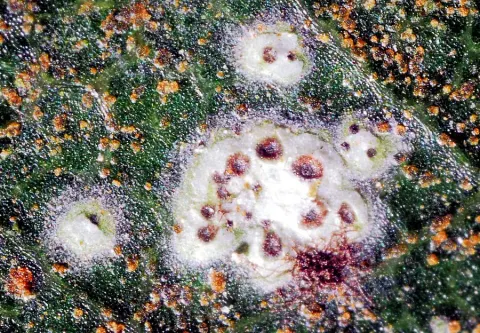
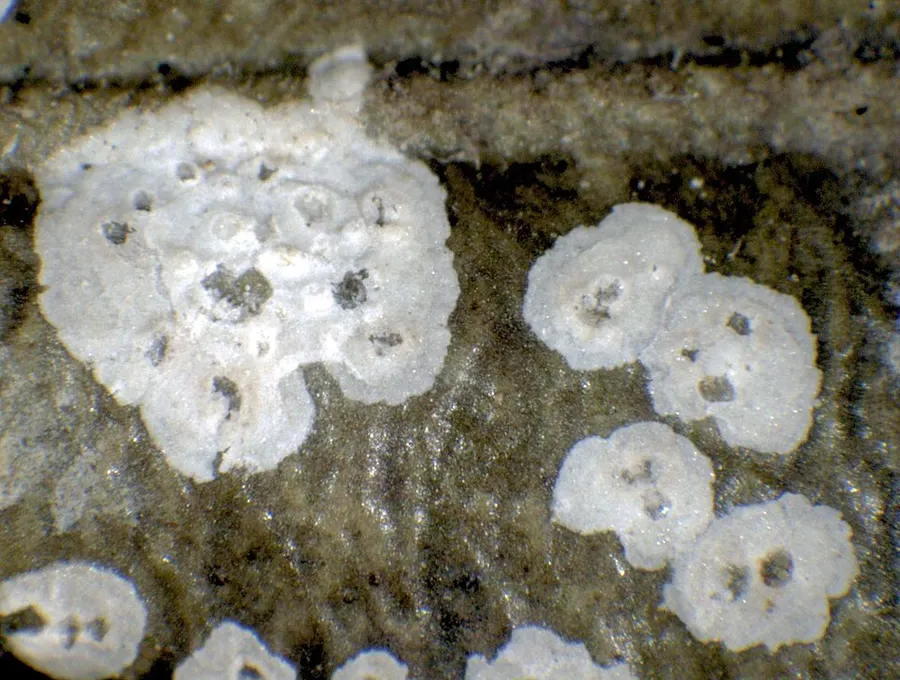
The thallus forms very small, angular-rounded to lobe-like patches about 0.3–1.5 mm in diameter. It is made of small, blister-like segments (-) that appear raised and rounded due to heavy crystal coverage, giving it a silvery to whitish-grey appearance, with thin greenish zones sometimes visible at the margins. Hyphophores (structures for asexual reproduction) are produced at or near the thallus edges. The small scales emerge from slightly swollen crystalline bulges and stand at an angle, ranging from triangular to irregularly (fringed) in shape, about 0.07–0.1 mm long and 0.1–0.2 mm broad. The scales are bluish-grey when young, typically becoming whitish and sometimes translucent with age. Sanders and Llop described the scales in Portuguese material as membranous and narrowing to a point at the tip, and noted that hyphophores can be hard to detect without higher magnification; they bear characteristic diahyphal propagules, bundles of short conidial chains with photobiont cells intermixed. The photosynthetic partner () is a unicellular green alga. In material collected on Tenerife, transmission electron microscopy of algal cells within the thallus showed a pyrenoid structure consistent with the genus Heveochlorella (also treated by some authors as Jaagichlorella). The authors caution that identifying photobionts in minute foliicolous lichens can be complicated by surface-dwelling "epibiontic" algae on leaves, which can contaminate DNA sequences from whole thalli; in G. minus, one clean sequence pointed instead to Chloroidium, conflicting with the pyrenoid evidence. In the type material, apothecia were scarce and immature, but Sanders and Llop found apothecia to be often abundant in Portuguese collections.
Habitat dan peran ekologis
Ferraro and colleagues reported Gyalectidium minus from the Canary Islands (including Tenerife and Gomera) and from southern Italy. On Tenerife it has been recorded from the Anaga laurisilva forest, where it occurs as a predominant element of an extratropical foliicolous lichen community. In the Italian locality (Campania), it was recorded as restricted to leaves of Buxus sempervirens, while Gyalectidium puntilloi in the same site occurred on leaves of Hedera helix and Laurus nobilis. Sanders and Llop reported the species from continental Portugal in 2019 and treated this as the first confirmed foliicolous lichen community from mainland Portugal; in the single known Italian locality, G. minus has been considered a threatened species. In Portugal, G. minus was found in the Peninha area of the Serra de Sintra, in a fog-prone Atlantic-influenced woodland. It grew abundantly on leaves of the introduced Australian tree Pittosporum undulatum. At this site it often occurred alone on leaves, but common associates included Bacidina apiahica, Fellhanera seroexspectata and Fellhaneropsis myrtillicola; less frequent companions included Byssoloma croceum, Fellhanera bouteillei, Phylloblastia fortuita and Porina hoehneliana.
- Habitat atau konteks temuan
- hutan
- Substrat
- Informasi belum tersedia pada sumber rilis ini.
- Peran atau konteks
- Pembentuk liken
Reproduksi
The thallus forms very small, angular-rounded to lobe-like patches about 0.3–1.5 mm in diameter. It is made of small, blister-like segments (-) that appear raised and rounded due to heavy crystal coverage, giving it a silvery to whitish-grey appearance, with thin greenish zones sometimes visible at the margins. Hyphophores (structures for asexual reproduction) are produced at or near the thallus edges. The small scales emerge from slightly swollen crystalline bulges and stand at an angle, ranging from triangular to irregularly (fringed) in shape, about 0.07–0.1 mm long and 0.1–0.2 mm broad. The scales are bluish-grey when young, typically becoming whitish and sometimes translucent with age. Sanders and Llop described the scales in Portuguese material as membranous and narrowing to a point at the tip, and noted that hyphophores can be hard to detect without higher magnification; they bear characteristic diahyphal propagules, bundles of short conidial chains with photobiont cells intermixed.
Catatan identitas dan cakupan
- Nama diterima mengikuti Catalogue of Life Base2026-09-11; uraian mempertahankan konsep dan nama sumber aslinya.
- Original geographic, specimen and life-cycle scope retained; source import awaits individual editorial review.
- Impor dan terjemahan otomatis belum diperiksa editorial per profil. Struktur reproduktif yang disebutkan tidak membuktikan seluruh siklus hidup diketahui.
- Pengukuran pada uraian mengikuti spesimen, kultur, dan metode sumber; angka tidak diperluas ke semua populasi.
Catatan distribusi dalam narasi mengikuti sumbernya. Dokumentasi spesimen atau foto mengikuti catatan sumber. Bukti wilayah Indonesia dan penilaian konservasi tidak disimpulkan dari gambar.
Melihat dengan konteks
Dokumentasi Gyalectidium minus dari Wikimedia Commons. The leaf0dwelling crustose lichen Gyalectidium minus ; photographed in Italy Identifikasi mengikuti record berkas sumber.
- Jenis
- Fotografi
- Kredit
- Pier Luigi Nimis
- Lisensi
- CC BY-SA 4.0
- Sumber media
- Buka entri sumber
Sumber profil
- [1] Gyalectidium minus — Wikipedia (en)
- [2] Catalogue of Life Base2026-09-11 — Gyalectidium minus
- [3] Dokumentasi visual — Gyalectidium minus
Rujukan halaman ini
Fungi. Gyalectidium minus. Rilis data fungi-2026-10-12-expansion-2. https://fungi-atlas.mgadib.chatgpt.site/jamur/gyalectidium-minus/.
Status: impor sumber; pemeriksaan editorial per profil belum selesai. Untuk klaim biologis, gunakan rujukan pada bagian terkait dan periksa konteks sumber aslinya.