Ciri dan struktur
Diagnosis: This species is distinguished from closed species by a deep rose-red pileus that is pale color outward, light pink to fresh lamellae, with a deep reddish brown and smooth stipe that is longitudinally striped, grows at the base of Tilia sp., uncoralloid cheilocystidia, two- or four-spored basidia, and a bit bigger basidiospores.
Habitat dan peran ekologis
Note: Morphologically, the rose-red to dark red pileus and stipe make Gymnopus tiliicola closed to Gymnopus erythropus. Gymnopus tiliicola differs from Gymnopus erythropus in a lighter color and striped pileus, light pink to fresh and denser lamellae. Besides, Gymnopus tiliicola grows at the base of Tilia sp., while Gymnopus erythropus grows on the deciduous layer or rotten branches. In regard to microfeatures, Gymnopus tiliicola differs from Gymnopus erythropus by a weakly coralloid pileipellis, uncoralloid cheilocystidia, bigger basidiospores, and two- or four-spored basidia.
- Habitat atau konteks temuan
- Informasi belum tersedia pada sumber rilis ini.
- Substrat
- Informasi belum tersedia pada sumber rilis ini.
- Peran atau konteks
- Belum dikategorikan pada rilis ini.
Reproduksi
Diagnosis: This species is distinguished from closed species by a deep rose-red pileus that is pale color outward, light pink to fresh lamellae, with a deep reddish brown and smooth stipe that is longitudinally striped, grows at the base of Tilia sp., uncoralloid cheilocystidia, two- or four-spored basidia, and a bit bigger basidiospores.
Catatan identitas dan cakupan
- Nama diterima mengikuti Catalogue of Life Base2026-09-11; uraian mempertahankan konsep dan nama sumber aslinya.
- Preserve original treatment localities, hosts and substrate scope. Materials examined describe documented specimens, not the full global range.
- Impor dan terjemahan otomatis belum diperiksa editorial per profil. Struktur reproduktif yang disebutkan tidak membuktikan seluruh siklus hidup diketahui.
- Pengukuran pada uraian mengikuti spesimen, kultur, dan metode sumber; angka tidak diperluas ke semua populasi.
Catatan distribusi dalam narasi mengikuti sumbernya. Dokumentasi spesimen atau foto mengikuti catatan sumber. Bukti wilayah Indonesia dan penilaian konservasi tidak disimpulkan dari gambar.
Melihat dengan konteks
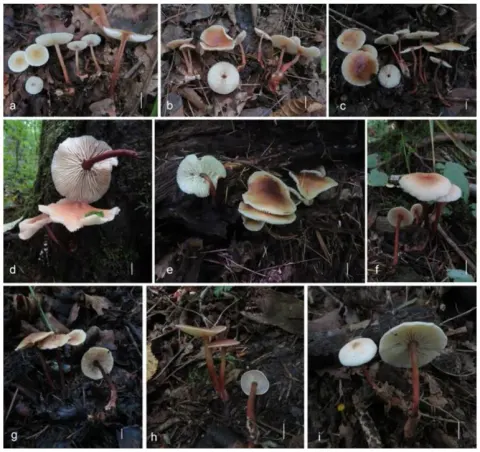
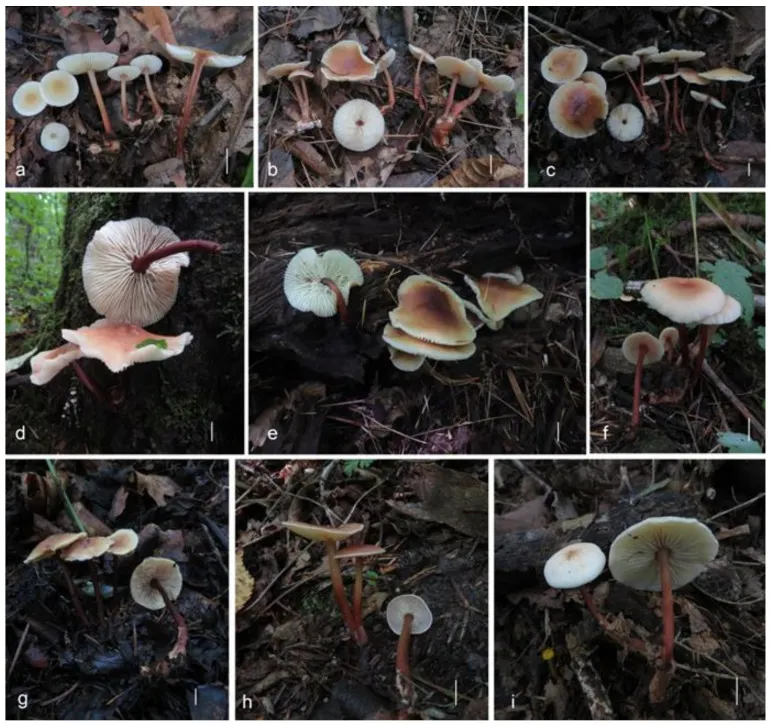
Fresh basidiomata of Gymnopus species: (a) Gymnopus longisterigmaticus (Holotype, HMJAU 60288), (b) Gymnopus longus (Holotype, HMJAU 60291), (c) Gymnopus macrosporus (Holotype, HMJAU 60294), (d) Gymnopus tiliicola (Holotype, HMJAU 60304), (e) Gymnopus globulosus (Holotype, HMJAU 60308), (f) Gymnopus changbaiensis (HMJAU 60300), (g) Gymnopus striatus (Holotype, HMJAU 60297), (h) Gymnopus erythropus (HMJAU 60315), and (i) Gymnopus tomentosus (Holotype, HMJAU 60303). Scale bars = 1 cm.
- Jenis
- Pelat ilmiah
- Kredit
- © 2022 by the authors.
- Lisensi
- CC BY 4.0
- Sumber media
- Buka entri sumber
Dokumentasi tambahan
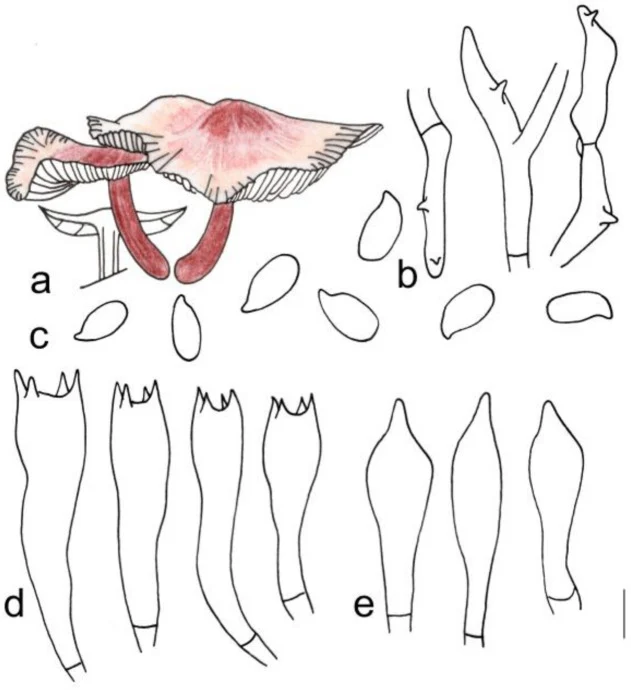
Morphological characteristics of Gymnopus tiliicola (HMJAU 60304, holotype): (a) basidiomata, (b) pileipellis, (c) basidiospores, (d) basidia, and (e) cheilocystidia. Scale bars: 1 cm (a), 25 µm (b), and 5 µm (c – e).
Kredit dan penggunaan
© 2022 by the authors.
Ukuran dan format gambar disesuaikan tanpa pemotongan, retus, atau penambahan skala. Lisensi sumber dipertahankan.
Sumber profil
- [1] Morphological and Molecular Evidence Reveal Eight New Species of Gymnopus from Northeast China — Gymnopus tiliicola
- [2] Catalogue of Life Base2026-09-11 — Gymnopus tiliicola
- [3] Dokumentasi visual — Gymnopus tiliicola
- [4] Dokumentasi visual — Gymnopus tiliicola
Rujukan halaman ini
Fungi. Gymnopus tiliicola. Rilis data fungi-2026-10-12-expansion-2. https://fungi-atlas.mgadib.chatgpt.site/jamur/gymnopus-tiliicola/.
Status: impor sumber; pemeriksaan editorial per profil belum selesai. Untuk klaim biologis, gunakan rujukan pada bagian terkait dan periksa konteks sumber aslinya.