Ciri dan struktur
Cap 0.8–3.6 cm in diameter, umbonate or campanulate, sometimes slightly tomentose or adpressed subtomentose, at high magnification, margin smooth, tacky when moist, not generally hygrophanous, but often with hygrophanous spots, uniformly colored or variably bicolored, at center yellow brown to cinnamon to umber, but with orange elements, at margin pinkish buff to clay buff, usually very thin, without traces of any veil. Lamellae initially whitish then becoming darker and brown with maturity, emarginate, maximum depth 2 mm, number of lamellae {L} 26–42, droplets present and visible, white fimbriate edge present. Stem 1.0–4.0 × 0.15–0.5 cm, whitish lengthily fibrillose on whitish-pale ground, then sordid buff or yellowish, cylindrical, occasionally clavate, stem Q (4.7–)5.5–7, pruinose, particularly at apex. Context firm, stem interior stuffed, flesh not discoloring from base. Smell raphanoid, sometimes weakly. Taste mild or slightly bitter. Spore deposit clay buff. Spores amygdaloid, not or weakly papillate, on ave. 10.0–12.0 × 6.0–7.0 µm, ave. Q = 1.6–1.9, pale brown to yellow-brown to brown, guttulate, almost smooth to weakly ornamented (O1 O2 (O3)), perispore not or somewhat loosening (P0 P1), indistinctly to weakly dextrinoid (D1 D2). Basidia 28–38(-43) × 7–9(–11) µm, ave. Q = 3.2–4.4, mostly four-spored. Cheilocystidia clavate-stipitate, occasionally spathulate-stipitate or clavate-lageniform, occasionally characteristically with a median wall thickening, geniculate or septate, on ave. 45–61 × 7–8.5 (apex) × 4–5 (middle) × 4.5–5.5 (base) µm, with yellow contents, ratios A/M = 1.61–1.95, A/B = 1.62–1.98, B/M = 0.97–1.18.
Habitat dan peran ekologis
Hebeloma aurantioumbrinum is one of the five most commonly recorded Hebeloma in Greenland with 10.5% of the records considered here. It is common and widely distributed in arctic areas in Europe (Beker et al. 2016). From alpine areas, it is known from North America (Cripps et al. 2019), but not from the well-investigated alpine mountains in Europe (Beker et al. 2016). Circumpolar, arctic-alpine. Forty collections with a number of hosts recorded, including: Salix herbacea (11), S. arctica (5), S. glauca (5), S. arctophila (3), Salix sp. (5), Bistorta vivipara (8, but never as the only possible associate). The localities are also scattered between wet and dry places, but favoring wet areas with S. herbacea, without having a preference for specific soil conditions. Beker et al. (2016) also found a preference for Salix, including S. polaris.
- Habitat atau konteks temuan
- Informasi belum tersedia pada sumber rilis ini.
- Substrat
- Informasi belum tersedia pada sumber rilis ini.
- Peran atau konteks
- Belum dikategorikan pada rilis ini.
Reproduksi
Cap 0.8–3.6 cm in diameter, umbonate or campanulate, sometimes slightly tomentose or adpressed subtomentose, at high magnification, margin smooth, tacky when moist, not generally hygrophanous, but often with hygrophanous spots, uniformly colored or variably bicolored, at center yellow brown to cinnamon to umber, but with orange elements, at margin pinkish buff to clay buff, usually very thin, without traces of any veil. Lamellae initially whitish then becoming darker and brown with maturity, emarginate, maximum depth 2 mm, number of lamellae {L} 26–42, droplets present and visible, white fimbriate edge present. Stem 1.0–4.0 × 0.15–0.5 cm, whitish lengthily fibrillose on whitish-pale ground, then sordid buff or yellowish, cylindrical, occasionally clavate, stem Q (4.7–)5.5–7, pruinose, particularly at apex.
Catatan identitas dan cakupan
- Nama diterima mengikuti Catalogue of Life Base2026-09-11; uraian mempertahankan konsep dan nama sumber aslinya.
- Preserve original treatment localities, hosts and substrate scope. Materials examined describe documented specimens, not the full global range.
- Impor dan terjemahan otomatis belum diperiksa editorial per profil. Struktur reproduktif yang disebutkan tidak membuktikan seluruh siklus hidup diketahui.
- Pengukuran pada uraian mengikuti spesimen, kultur, dan metode sumber; angka tidak diperluas ke semua populasi.
Catatan distribusi dalam narasi mengikuti sumbernya. Dokumentasi spesimen atau foto mengikuti catatan sumber. Bukti wilayah Indonesia dan penilaian konservasi tidak disimpulkan dari gambar.
Melihat dengan konteks
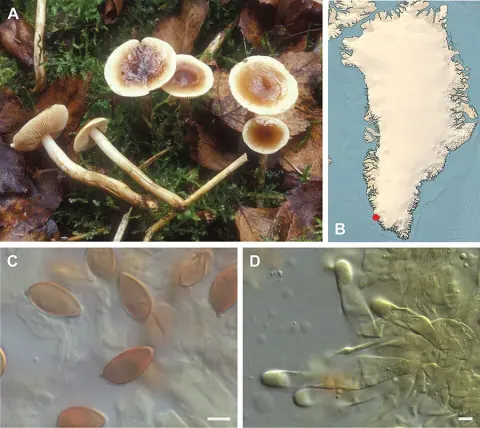
Hebeloma aurantioumbrinum A SAE-2016.146, photograph S.A. Elborne B distribution of cited collections C spores ×1600 and D cheilocystidia ×1000 of SAE-2016.146 in Melzer’s reagent. Scale bars: 5 µm; microphotographs H.K.J. Beker.
- Jenis
- Pelat ilmiah
- Kredit
- Ursula Eberhardt, Henry J. Beker, Torbjørn Borgen, Henning Knudsen, Nicole Schütz, Steen A. Elborne
- Lisensi
- CC BY 4.0
- Sumber media
- Buka entri sumber
Dokumentasi tambahan
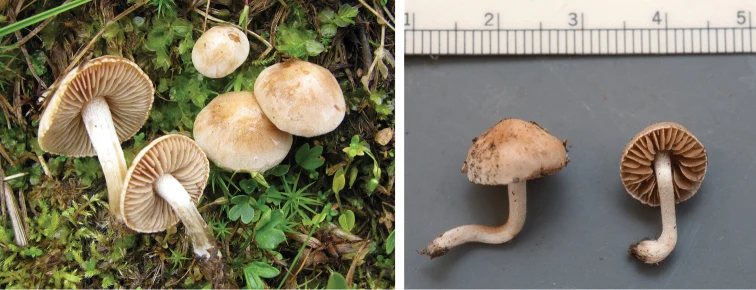
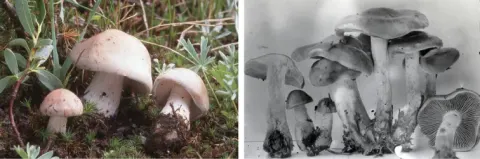
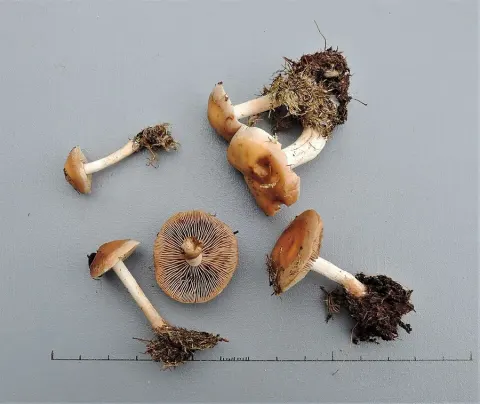
Hebeloma aurantioumbrinum, CLC3093 and CLC1822.
Kredit dan penggunaan
Cathy L. Cripps, Ursula Eberhardt, Nicole Schütz, Henry J. Beker, Vera S. Evenson, Egon Horak
Ukuran dan format gambar disesuaikan tanpa pemotongan, retus, atau penambahan skala. Lisensi sumber dipertahankan.
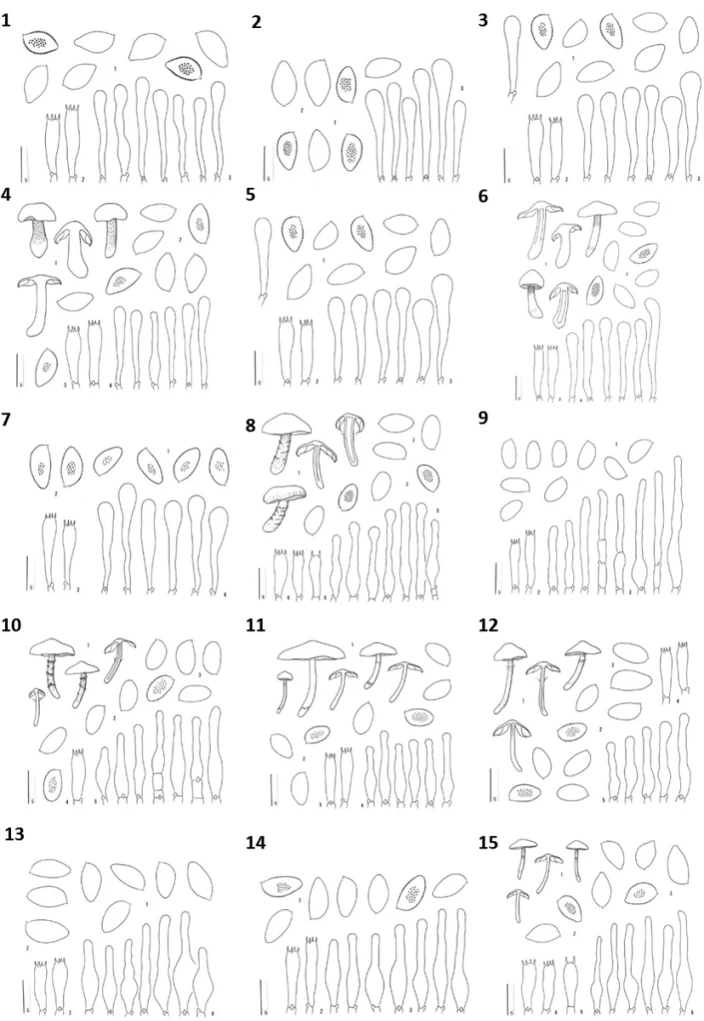
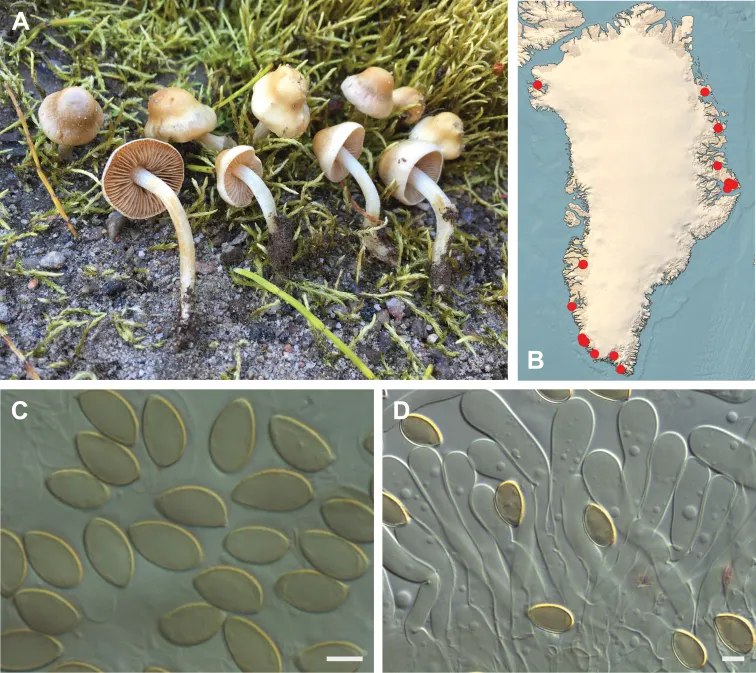
Ilustrasi perbandingan struktur mikroskopis Hebeloma. Hebeloma aurantioumbrinum ditampilkan pada panel 2; panel lain juga memuat spesies pembanding. Pembagian panel mengikuti sumber.
Kredit dan penggunaan
Cathy L. Cripps, Ursula Eberhardt, Nicole Schütz, Henry J. Beker, Vera S. Evenson, Egon Horak
Ukuran dan format gambar disesuaikan tanpa pemotongan, retus, atau penambahan skala. Lisensi sumber dipertahankan.
Sumber profil
- [1] A survey of Hebeloma (Hymenogastraceae) in Greenland — Hebeloma aurantioumbrinum
- [2] Catalogue of Life Base2026-09-11 — Hebeloma aurantioumbrinum
- [3] Dokumentasi visual — Hebeloma aurantioumbrinum
- [4] Dokumentasi visual — Hebeloma aurantioumbrinum
- [5] Dokumentasi visual — Hebeloma aurantioumbrinum
Rujukan halaman ini
Fungi. Hebeloma aurantioumbrinum. Rilis data fungi-2026-10-12-expansion-2. https://fungi-atlas.mgadib.chatgpt.site/jamur/hebeloma-aurantioumbrinum/.
Status: impor sumber; pemeriksaan editorial per profil belum selesai. Untuk klaim biologis, gunakan rujukan pada bagian terkait dan periksa konteks sumber aslinya.