Ciri dan struktur
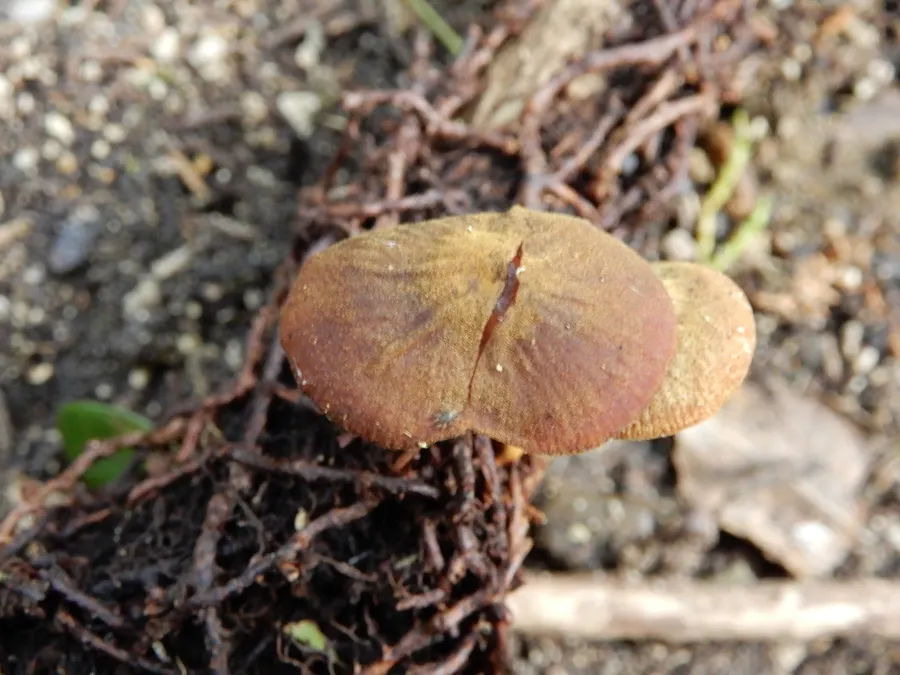
Pileus-20 mm, convex when young soon becoming plane or depressed, centre flat to subumbonate; dark red-brown with conspicuous yellow felty or velvety tomentum; dry, velvety to hairy, sometimes with low radially arranged veins at disc, membranous, tough, margin not striate. Lamellae (L 10-18, -3) crowded, broadly adnate to emarginate (decurrent with short tooth), ventricose; pale yellow turning yellow-brown, edge albofimbriate. Stipe-35 x -3 mm, cylindric or gradually enlarged into pileus, central; yellow-brown, with obvious orange tomentum over entire length; dry, entirely velvety to hairy, pruinose in upper portion, hollow, tough, single and cespitose, in groups. Context dark brown, gelatinous. Odour and taste acidulous or not distinctive. Spore print white. Spores 7-10 x 4 -5 µm, elliptic, sometimes subcylindric to suballantoid, smooth, hyaline, amyloid, germ pore none. Basidia 25-40 x 5-7 µm, 4-spored. Cheilocystidia-60 x-6 µm, conspicuously branched, with irregular, numerous rod-like projections, membranes thick-walled, hyaline or yellow-brown. Pleurocystidia none. Caulocystidia like cheilocystidia but larger, membrane brown (KOH). Cuticle a palisade of erect, fasciculate, cylindric or subfusoid terminal cells (pilocystidia), membranes thick-walled, apex rounded, rarely with antler-like projections, intermixed with clavate to subovate thick-walled, strongly refractive cells. Structure of subcutis like H. neovelutinus (HONGO). Clamp connections numerous.
Habitat dan peran ekologis
On rotten wood in broad-leaved forest (dominated by Nothofagus sp., Weinmannia sp., Schefflera sp., Aristotelia sp. and Fuchsia sp.) or on soil (buried wood ?).-New Zealand.
- Habitat atau konteks temuan
- hutan
- Substrat
- tanah
- Peran atau konteks
- Belum dikategorikan pada rilis ini.
Reproduksi
Pileus-20 mm, convex when young soon becoming plane or depressed, centre flat to subumbonate; dark red-brown with conspicuous yellow felty or velvety tomentum; dry, velvety to hairy, sometimes with low radially arranged veins at disc, membranous, tough, margin not striate. Lamellae (L 10-18, -3) crowded, broadly adnate to emarginate (decurrent with short tooth), ventricose; pale yellow turning yellow-brown, edge albofimbriate. Stipe-35 x -3 mm, cylindric or gradually enlarged into pileus, central; yellow-brown, with obvious orange tomentum over entire length; dry, entirely velvety to hairy, pruinose in upper portion, hollow, tough, single and cespitose, in groups. Context dark brown, gelatinous.
Catatan identitas dan cakupan
- Nama diterima mengikuti Catalogue of Life Base2026-09-11; uraian mempertahankan konsep dan nama sumber aslinya.
- Historical description as cited by BiotaNZ. Preserve explicit New Zealand/locality, host and specimen qualifiers. Distribution is the cited source scope, not a current global range.
- Impor dan terjemahan otomatis belum diperiksa editorial per profil. Struktur reproduktif yang disebutkan tidak membuktikan seluruh siklus hidup diketahui.
- Pengukuran pada uraian mengikuti spesimen, kultur, dan metode sumber; angka tidak diperluas ke semua populasi.
Catatan distribusi dalam narasi mengikuti sumbernya. Dokumentasi spesimen atau foto mengikuti catatan sumber. Bukti wilayah Indonesia dan penilaian konservasi tidak disimpulkan dari gambar.
Melihat dengan konteks
Dokumentasi Heimiomyces atrofulvus menurut asosiasi foto pada record takson iNaturalist. Kredit: Grey Smith. Identitas mengikuti sumber; bukan penentuan spesimen independen.
- Jenis
- Fotografi
- Kredit
- (c) Grey Smith, some rights reserved (CC BY), uploaded by Grey Smith
- Lisensi
- CC BY 4.0
- Sumber media
- Buka entri sumber
Sumber profil
- [1] Horak, E. 1980: Xeromphalina and Heimiomyces in Indomalaya and Autralasia. Sydowia 32: 131-153. — Heimiomyces atrofulvus
- [2] Catalogue of Life Base2026-09-11 — Heimiomyces atrofulvus
- [3] Dokumentasi visual — Heimiomyces atrofulvus
Rujukan halaman ini
Fungi. Heimiomyces atrofulvus. Rilis data fungi-2026-10-12-expansion-2. https://fungi-atlas.mgadib.chatgpt.site/jamur/heimiomyces-atrofulvus/.
Status: impor sumber; pemeriksaan editorial per profil belum selesai. Untuk klaim biologis, gunakan rujukan pada bagian terkait dan periksa konteks sumber aslinya.