01 / Morfologi

Ciri dan struktur

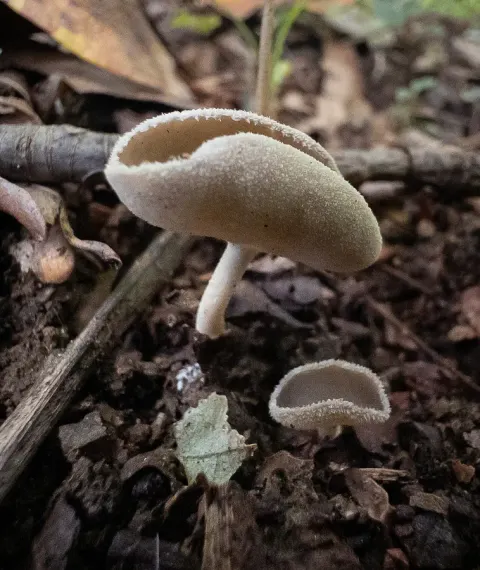
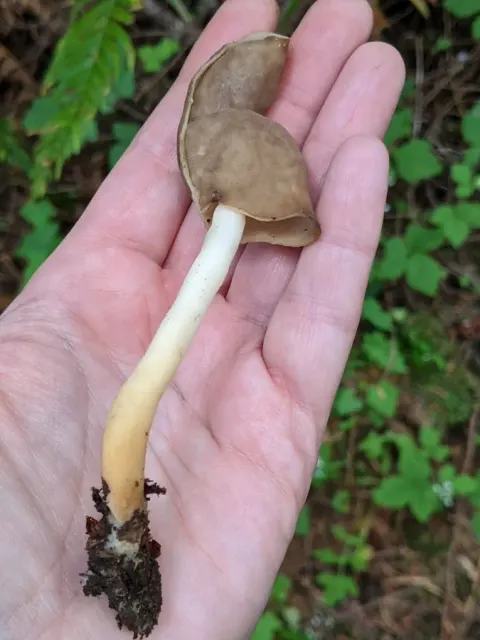
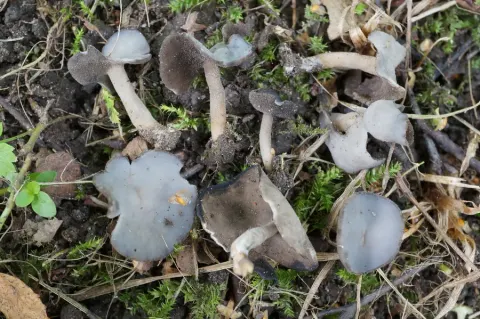
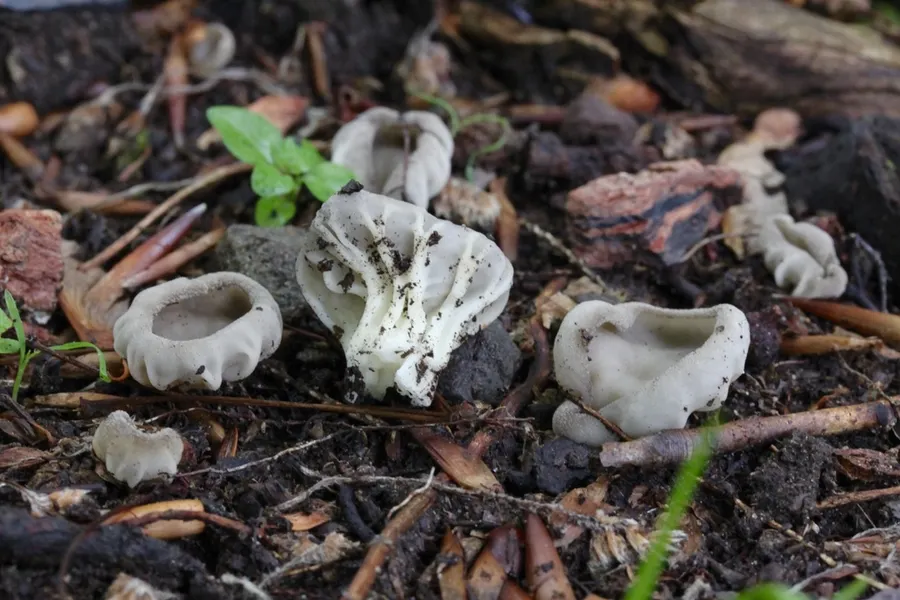
The apothecia of Helvella costifera are regularly stalked cup-shaped fruiting bodies (stipitate-cupulate), measuring 1.5–4 cm across and 1–4 cm tall. The inner spore-bearing surface, or hymenium, appears greyish when fresh and dries to a dark greyish-brown. Externally, the cup (receptacle) is slightly downy (subpubescent) and matches the hymenium’s colour in fresh specimens, later becoming pale greyish-brown on drying. A distinct, hollow stipe supports the cup and bears five to six prominent, blunt-edged ribs of yellowish-white that extend onto the underside of the cup. These ribs branch into two forks (dichotomously) near the apex without interconnecting and remain whitish even in dried specimens. Under the microscope, the outer tissue layer (excipulum) consists of prism-shaped to angular cells, with the outermost cell walls lightly pigmented brown. The spore-bearing asci are pleurorhynchous—arising from a hook-shaped basal cell (crozier)—and measure 230–270 × 12–15 μm, each enclosing eight spores. The ascospores are broadly ellipsoid, 14.2–16.6 × 10.6–13.6 μm, smooth and transparent. Interspersed among the asci are sterile supportive filaments called paraphyses, which are straight, septate and 2.0–3.2 μm wide at the base, gradually swelling to about 4.5 μm at their tips.

Sebagian uraian ditampilkan dalam bahasa sumber; terjemahannya belum tersedia atau belum lolos pemeriksaan.

Rujukan: [1]

Pengukuran mengikuti objek, spesimen atau kultur, dan metode yang disebutkan sumber. Baca uraian asli untuk konteks lengkap.

02 / Kehidupan

Habitat dan peran ekologis

Spesies ini telah ditemukan di Cina, dan Amerika Utara (termasuk Meksiko). Di Eropa, hal ini telah didokumentasikan dari Spanyol, Denmark, Norwegia, dan Swedia.

Rujukan: [1]

Habitat atau konteks temuan
Informasi belum tersedia pada sumber rilis ini.
Substrat
Informasi belum tersedia pada sumber rilis ini.
Peran atau konteks
Belum dikategorikan pada rilis ini.
Temukan hubungan serupa
03 / Siklus hidup

Reproduksi

The apothecia of Helvella costifera are regularly stalked cup-shaped fruiting bodies (stipitate-cupulate), measuring 1.5–4 cm across and 1–4 cm tall. The inner spore-bearing surface, or hymenium, appears greyish when fresh and dries to a dark greyish-brown. Externally, the cup (receptacle) is slightly downy (subpubescent) and matches the hymenium’s colour in fresh specimens, later becoming pale greyish-brown on drying. A distinct, hollow stipe supports the cup and bears five to six prominent, blunt-edged ribs of yellowish-white that extend onto the underside of the cup. These ribs branch into two forks (dichotomously) near the apex without interconnecting and remain whitish even in dried specimens.

Sebagian uraian ditampilkan dalam bahasa sumber; terjemahannya belum tersedia atau belum lolos pemeriksaan.

Rujukan: [1]

Sinonim menurut acuan taksonomi rilis: Acetabula ancilis var. costata; Acetabula costifera; Discina costata; Paxina costifera; Peziza costata
04 / Batas informasi

Catatan identitas dan cakupan

  • Nama diterima mengikuti Catalogue of Life Base2026-09-11; uraian mempertahankan konsep dan nama sumber aslinya.
  • Original geographic, specimen and life-cycle scope retained; source import awaits individual editorial review.
  • Impor dan terjemahan otomatis belum diperiksa editorial per profil. Struktur reproduktif yang disebutkan tidak membuktikan seluruh siklus hidup diketahui.
  • Pengukuran pada uraian mengikuti spesimen, kultur, dan metode sumber; angka tidak diperluas ke semua populasi.

Catatan distribusi dalam narasi mengikuti sumbernya. Dokumentasi spesimen atau foto mengikuti catatan sumber. Bukti wilayah Indonesia dan penilaian konservasi tidak disimpulkan dari gambar.

05 / Dokumentasi

Melihat dengan konteks

Dokumentasi Helvella costifera menurut asosiasi foto pada record takson iNaturalist. Kredit: Fluff Berger. Identitas mengikuti sumber; bukan penentuan spesimen independen.

Jenis
Fotografi
Kredit
(c) Fluff Berger, some rights reserved (CC BY-SA), uploaded by Fluff Berger
Sumber media
Buka entri sumber

Gambar menunjukkan objek menurut identifikasi sumber, bukan verifikasi independen spesimen oleh Fungi. Tidak ada skala baru yang ditambahkan.

06 / Rujukan

Sumber profil

  1. [1] Helvella costifera — Wikipedia (en)Bagian sumber: Frozen revision 1286964771
    Tanggal penghimpunan sumber: 2026-10-12
    Teks sumber: CC BY-SA4.0 · Wikipedia contributors
  2. [2] Catalogue of Life Base2026-09-11 — Helvella costiferaBagian sumber: ColDP NameUsage.tsv ID 3KJX4; accepted species; source 2073
    Tanggal penghimpunan sumber: 2026-10-12
  3. [3] Dokumentasi visual — Helvella costiferaBagian sumber: Individual media record; identification follows the source, not independent determination
    Tanggal penghimpunan sumber: 2026-10-12
    Media sumber: CC BY-SA 4.0 · (c) Fluff Berger, some rights reserved (CC BY-SA), uploaded by Fluff Berger

Adaptasi teks: CC BY-SA 4.0. Wikipedia contributors — Helvella costifera — Wikipedia (en)

Uraian asli dan riwayat sumber

Riwayat atau halaman sumber

Ringkasan sumber

Helvella costifera is a species of fungus in the family Helvellaceae. It produces distinctive cup-shaped fruiting bodies supported by a ribbed stalk. The fungus features greyish to greyish-brown caps with prominent yellowish-white ribs that extend from the hollow stalk and branch into forks on the cup's undersurface. First described scientifically in 1953, H. costifera has a widespread distribution across Europe, Asia, and North America, including China, Spain, Scandinavia, and Mexico.

Revisi sumber

Morfologi sumber

The apothecia of Helvella costifera are regularly stalked cup-shaped fruiting bodies (stipitate-cupulate), measuring 1.5–4 cm across and 1–4 cm tall. The inner spore-bearing surface, or hymenium, appears greyish when fresh and dries to a dark greyish-brown. Externally, the cup (receptacle) is slightly downy (subpubescent) and matches the hymenium’s colour in fresh specimens, later becoming pale greyish-brown on drying. A distinct, hollow stipe supports the cup and bears five to six prominent, blunt-edged ribs of yellowish-white that extend onto the underside of the cup. These ribs branch into two forks (dichotomously) near the apex without interconnecting and remain whitish even in dried specimens. Under the microscope, the outer tissue layer (excipulum) consists of prism-shaped to angular cells, with the outermost cell walls lightly pigmented brown. The spore-bearing asci are pleurorhynchous—arising from a hook-shaped basal cell (crozier)—and measure 230–270 × 12–15 μm, each enclosing eight spores. The ascospores are broadly ellipsoid, 14.2–16.6 × 10.6–13.6 μm, smooth and transparent. Interspersed among the asci are sterile supportive filaments called paraphyses, which are straight, septate and 2.0–3.2 μm wide at the base, gradually swelling to about 4.5 μm at their tips.

Revisi sumber

Ekologi sumber

This species has been found in China, and North America (including Mexico). In Europe, it has been documented from Spain, Denmark, Norway, and Sweden.

Revisi sumber

Struktur reproduksi sumber

The apothecia of Helvella costifera are regularly stalked cup-shaped fruiting bodies (stipitate-cupulate), measuring 1.5–4 cm across and 1–4 cm tall. The inner spore-bearing surface, or hymenium, appears greyish when fresh and dries to a dark greyish-brown. Externally, the cup (receptacle) is slightly downy (subpubescent) and matches the hymenium’s colour in fresh specimens, later becoming pale greyish-brown on drying. A distinct, hollow stipe supports the cup and bears five to six prominent, blunt-edged ribs of yellowish-white that extend onto the underside of the cup. These ribs branch into two forks (dichotomously) near the apex without interconnecting and remain whitish even in dried specimens.

Revisi sumber

Rujukan halaman ini

Fungi. Helvella costifera. Rilis data fungi-2026-10-12-expansion-2. https://fungi-atlas.mgadib.chatgpt.site/jamur/helvella-costifera/.

Status: impor sumber; pemeriksaan editorial per profil belum selesai. Untuk klaim biologis, gunakan rujukan pada bagian terkait dan periksa konteks sumber aslinya.