01 / Morfologi

Ciri dan struktur

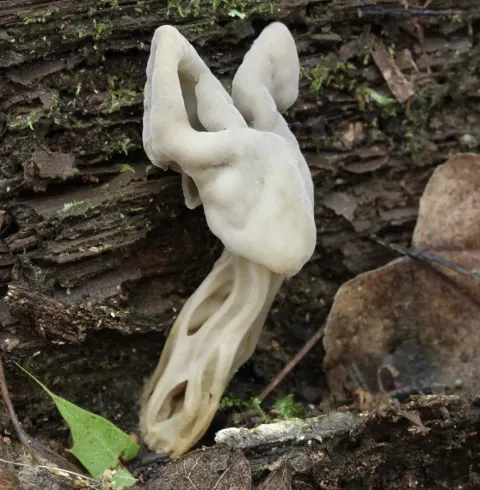
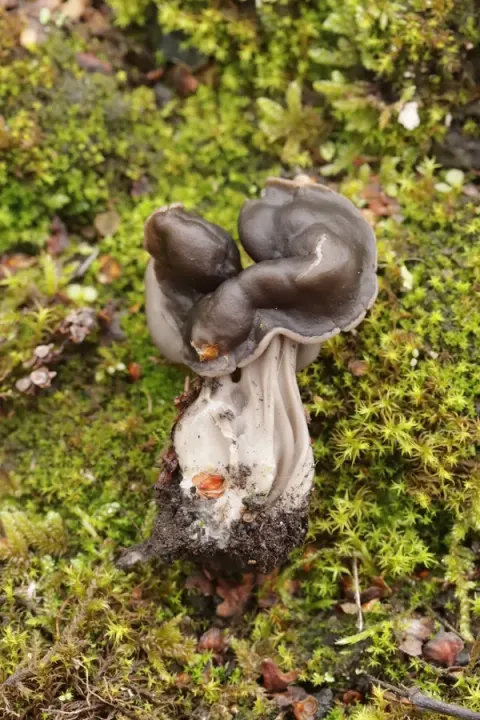
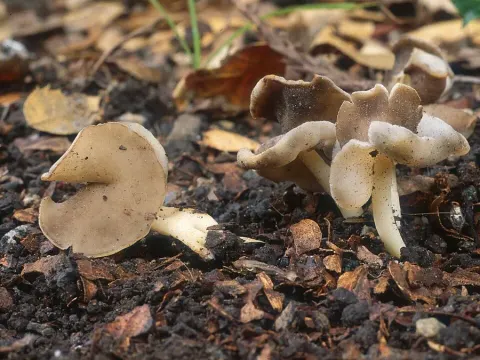
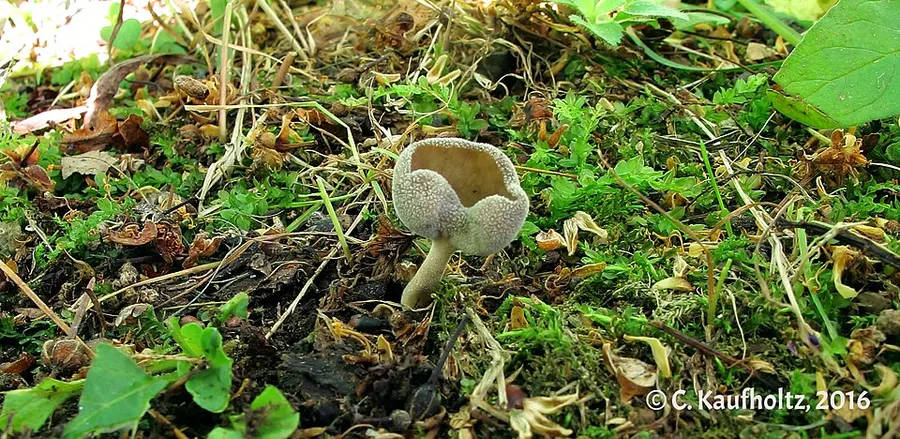
The fruiting body of Helvella fbrosa is delicate and small, with the cap (apothecium) measuring 5–20 mm across. When young, the apothecium resembles a cup that has been squashed from above; as it matures, it flattens into a plate-like form and its margin often splits into radial fragments. The spore-bearing surface, or hymenium, is smooth and varies in colour from grey through dark grey to brownish-grey, while the exterior (sterile surface) is covered in fine hairs, giving it a downy (pubescent) texture and a grey to grey-brown hue. The stalk, or stipe, typically stands 10–35 mm tall—usually exceeding the width of the apothecium—and is 2–6 mm thick. It is more or less cylindrical, sometimes curving slightly at the base, and bears a similar downy covering; its colour is generally grey, though creamy white forms are occasionally encountered. Under the microscope, the spore-bearing cells known as asci are cylindrical, measure 245–310 μm by 12–14 micrometres (μm), and each contains eight spores. These asci are single-walled (uniseriate), arise from a hooked basal cell (a crozier), and do not react to iodine stains (inamyloid). The ascospores are smooth, transparent, ellipsoid structures about 16–20 μm long and 10–12.7 μm wide, each containing a prominent central oil droplet and staining readily with certain dyes (cyanophilic). Among the asci are sterile supportive filaments called paraphyses; these are similar in length to the asci, septate (with cross-walls), bear hook-like structures at the base, and display a club-shaped thickening near the tip. Their colour ranges from transparent to brownish.

Sebagian uraian ditampilkan dalam bahasa sumber; terjemahannya belum tersedia atau belum lolos pemeriksaan.

Rujukan: [1]

Pengukuran mengikuti objek, spesimen atau kultur, dan metode yang disebutkan sumber. Baca uraian asli untuk konteks lengkap.

02 / Kehidupan

Habitat dan peran ekologis

Helvella fibrosa has a worldwide distribution. It is relatively common in deciduous and mixed forests of Europe, where it grows in humid habitats. Some countries in which the presence of this species has been confirmed with DNA analysis include Denmark, Finland, Iceland, Norway, and Sweden. H. macropus is a relative with which it has been confused many times.

Sebagian uraian ditampilkan dalam bahasa sumber; terjemahannya belum tersedia atau belum lolos pemeriksaan.

Rujukan: [1]

Habitat atau konteks temuan
hutan
Substrat
Informasi belum tersedia pada sumber rilis ini.
Peran atau konteks
Belum dikategorikan pada rilis ini.
Temukan hubungan serupa
03 / Siklus hidup

Reproduksi

The fruiting body of Helvella fbrosa is delicate and small, with the cap (apothecium) measuring 5–20 mm across. When young, the apothecium resembles a cup that has been squashed from above; as it matures, it flattens into a plate-like form and its margin often splits into radial fragments. The spore-bearing surface, or hymenium, is smooth and varies in colour from grey through dark grey to brownish-grey, while the exterior (sterile surface) is covered in fine hairs, giving it a downy (pubescent) texture and a grey to grey-brown hue. The stalk, or stipe, typically stands 10–35 mm tall—usually exceeding the width of the apothecium—and is 2–6 mm thick. It is more or less cylindrical, sometimes curving slightly at the base, and bears a similar downy covering; its colour is generally grey, though creamy white forms are occasionally encountered.

Sebagian uraian ditampilkan dalam bahasa sumber; terjemahannya belum tersedia atau belum lolos pemeriksaan.

Rujukan: [1]

Sinonim menurut acuan taksonomi rilis: Cyathicula villosa; Cyathipodia villosa; Fuckelina villosa; Helvella dissingii; Helvella villosa; Leptopodia villosa; Macropodia fibrosa; Octospora villosa; Peziza fibrosa; Peziza macropus var. villosa; Sarcoscypha fibrosa
04 / Batas informasi

Catatan identitas dan cakupan

  • Nama diterima mengikuti Catalogue of Life Base2026-09-11; uraian mempertahankan konsep dan nama sumber aslinya.
  • Original geographic, specimen and life-cycle scope retained; source import awaits individual editorial review.
  • Impor dan terjemahan otomatis belum diperiksa editorial per profil. Struktur reproduktif yang disebutkan tidak membuktikan seluruh siklus hidup diketahui.
  • Pengukuran pada uraian mengikuti spesimen, kultur, dan metode sumber; angka tidak diperluas ke semua populasi.

Catatan distribusi dalam narasi mengikuti sumbernya. Dokumentasi spesimen atau foto mengikuti catatan sumber. Bukti wilayah Indonesia dan penilaian konservasi tidak disimpulkan dari gambar.

05 / Dokumentasi

Melihat dengan konteks

Dokumentasi Helvella fibrosa dari Wikimedia Commons. For more information about this, see the observation page at Mushroom Observer. Identifikasi mengikuti record berkas sumber.

Jenis
Fotografi
Kredit
This image was created by user Claude Kaufholtz-Couture (Claude Kaufholtz-Couture) at Mushroom Observer , a source for mycological images. You can contact this user here .
Sumber media
Buka entri sumber

Gambar menunjukkan objek menurut identifikasi sumber, bukan verifikasi independen spesimen oleh Fungi. Tidak ada skala baru yang ditambahkan.

06 / Rujukan

Sumber profil

  1. [1] Helvella fibrosa — Wikipedia (en)Bagian sumber: Frozen revision 1360241874
    Tanggal penghimpunan sumber: 2026-10-12
    Teks sumber: CC BY-SA4.0 · Wikipedia contributors
  2. [2] Catalogue of Life Base2026-09-11 — Helvella fibrosaBagian sumber: ColDP NameUsage.tsv ID 3KJXV; accepted species; source 2073
    Tanggal penghimpunan sumber: 2026-10-12
  3. [3] Dokumentasi visual — Helvella fibrosaBagian sumber: Individual media record; identification follows the source, not independent determination
    Tanggal penghimpunan sumber: 2026-10-12
    Media sumber: CC BY-SA 3.0 · This image was created by user Claude Kaufholtz-Couture (Claude Kaufholtz-Couture) at Mushroom Observer , a source for mycological images. You can contact this user here .

Adaptasi teks: CC BY-SA 4.0. Wikipedia contributors — Helvella fibrosa — Wikipedia (en)

Uraian asli dan riwayat sumber

Riwayat atau halaman sumber

Ringkasan sumber

Helvella fibrosa is a species of fungus in the family Helvellaceae of the order Pezizales. It was originally known as Octospora villosa when first scientifically described by the German botanist Karl Friedrich Wilhelm Wallroth in 1833, and was placed in a number of different genera throughout the decades, including Peziza, Fuckelina, and Cyathipodia. The current generic placement was proposed by Richard P. Korf in 2008.

Revisi sumber

Morfologi sumber

The fruiting body of Helvella fbrosa is delicate and small, with the cap (apothecium) measuring 5–20 mm across. When young, the apothecium resembles a cup that has been squashed from above; as it matures, it flattens into a plate-like form and its margin often splits into radial fragments. The spore-bearing surface, or hymenium, is smooth and varies in colour from grey through dark grey to brownish-grey, while the exterior (sterile surface) is covered in fine hairs, giving it a downy (pubescent) texture and a grey to grey-brown hue. The stalk, or stipe, typically stands 10–35 mm tall—usually exceeding the width of the apothecium—and is 2–6 mm thick. It is more or less cylindrical, sometimes curving slightly at the base, and bears a similar downy covering; its colour is generally grey, though creamy white forms are occasionally encountered. Under the microscope, the spore-bearing cells known as asci are cylindrical, measure 245–310 μm by 12–14 micrometres (μm), and each contains eight spores. These asci are single-walled (uniseriate), arise from a hooked basal cell (a crozier), and do not react to iodine stains (inamyloid). The ascospores are smooth, transparent, ellipsoid structures about 16–20 μm long and 10–12.7 μm wide, each containing a prominent central oil droplet and staining readily with certain dyes (cyanophilic). Among the asci are sterile supportive filaments called paraphyses; these are similar in length to the asci, septate (with cross-walls), bear hook-like structures at the base, and display a club-shaped thickening near the tip. Their colour ranges from transparent to brownish.

Revisi sumber

Ekologi sumber

Helvella fibrosa has a worldwide distribution. It is relatively common in deciduous and mixed forests of Europe, where it grows in humid habitats. Some countries in which the presence of this species has been confirmed with DNA analysis include Denmark, Finland, Iceland, Norway, and Sweden. H. macropus is a relative with which it has been confused many times.

Revisi sumber

Struktur reproduksi sumber

The fruiting body of Helvella fbrosa is delicate and small, with the cap (apothecium) measuring 5–20 mm across. When young, the apothecium resembles a cup that has been squashed from above; as it matures, it flattens into a plate-like form and its margin often splits into radial fragments. The spore-bearing surface, or hymenium, is smooth and varies in colour from grey through dark grey to brownish-grey, while the exterior (sterile surface) is covered in fine hairs, giving it a downy (pubescent) texture and a grey to grey-brown hue. The stalk, or stipe, typically stands 10–35 mm tall—usually exceeding the width of the apothecium—and is 2–6 mm thick. It is more or less cylindrical, sometimes curving slightly at the base, and bears a similar downy covering; its colour is generally grey, though creamy white forms are occasionally encountered.

Revisi sumber

Rujukan halaman ini

Fungi. Helvella fibrosa. Rilis data fungi-2026-10-12-expansion-2. https://fungi-atlas.mgadib.chatgpt.site/jamur/helvella-fibrosa/.

Status: impor sumber; pemeriksaan editorial per profil belum selesai. Untuk klaim biologis, gunakan rujukan pada bagian terkait dan periksa konteks sumber aslinya.