Ciri dan struktur
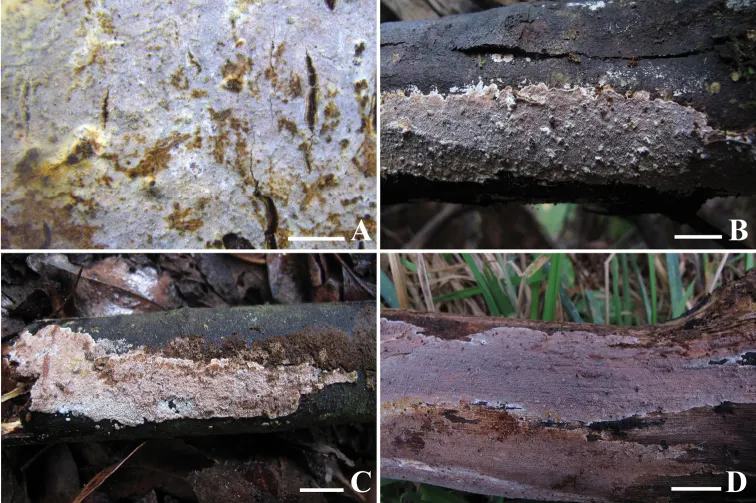
Heteroradulum australiense differs from other species in this genus by the generative hyphae having a mixture of simple septa and clamp connections. Basidiomes annual, resupinate, adnate, without odor or taste when fresh, leathery, covering 24.5 cm in widest dimension and up to 0.4 mm thick. Hymenophore odontioid, covered by irregularly arranged spines, up to 0.2 mm long, 3–5 per mm, pale red to reddish lilac when fresh, pale orange to brownish gray upon drying. Margin smooth, adnate, yellowish white, 0.5 mm wide. Hyphal system dimitic; generative hyphae with simple septa or clamp connections; skeletal hyphae IKI–, CB +; tissue unchanged in KOH. Subicular generative hyphae hyaline, thin to thick-walled, rarely branched, 2–4 μm in diam; skeletal hyphae hyaline to brownish, thick-walled, interwoven, occasionally branched, 2.5–4 μm in diam, sometimes irregularly inflated up to 6 μm. Subhymenial generative hyphae hyaline to brownish, thin-to slightly thick-walled, 2–3.5 μm in diam; skeletal hyphae brownish, thick-walled, encrusted by grainy crystals, subparallel and vertical along substrate, compact, 2–4.5 μm in diam. Clavate to subcylindrical cystidia abundant, septate with or without clamp connections, thin-walled, 24–56 × 3–8 μm. Skeletocystidia present as endings of subicular skeletal hyphae, distinctly thick-walled, heavily encrusted by grainy crystals, 4–7 μm in diam. Dendrohyphidia abundant, scattered among hymenial cells, covering the hymenial surface, branched, up to 54 μm long, 2–3 μm in diam. Basidia narrowly ovoid to obconical, longitudinally septate, four-celled, 29–34.5 × 10–13.5 μm, with enucleate stalk up to 14 × 4 μm.
Habitat dan peran ekologis
Heteroradulum australiense is characterized by pale red to reddish lilac basidiomes, a dimitic hyphal system, generative hyphae with simple septa or clamp connections, abundant skeletocystidia in the hymenium, and basidia with an enucleate stalk. Heteroradulum kmetii and H. spinulosum resemble H. australiense by odontoid hymenophores, a dimitic hyphal system and the presence of skeletocystidia (Malysheva and Spirin 2017). However, H. kmetii has longer spines (up to 1 mm long) and slightly larger basidiospores (14.3–22.3 × 6–9.2 μm), and generative hyphae always with clamp connections; and H. spinulosum differs by basidia with a shorter enucleate stalk (up to 6 μm long) and generative hyphae always with clamp connections (Malysheva and Spirin 2017). In regard to previously described Australian species against which H. australiense should be compared, the coriaceous, resupinate species of the Auriculariales are poorly sampled from Australia. May et al. (2003) listed records from Australia of a number of species of Eichleriella, Exidiopsis and Heterochaete that were originally described from the Northern Hemisphere. Such records remain suspect unless confirmed. Only two new species have been described on the basis of type materials from Australia that may fall within these three genera: Heterochaete cheesmanii Wakef. and Irpex depauperatus Massee.
- Habitat atau konteks temuan
- Informasi belum tersedia pada sumber rilis ini.
- Substrat
- Informasi belum tersedia pada sumber rilis ini.
- Peran atau konteks
- Belum dikategorikan pada rilis ini.
Reproduksi
Basidiomes annual, resupinate, adnate, without odor or taste when fresh, leathery, covering 24.5 cm in widest dimension and up to 0.4 mm thick. Hymenophore odontioid, covered by irregularly arranged spines, up to 0.2 mm long, 3–5 per mm, pale red to reddish lilac when fresh, pale orange to brownish gray upon drying. Margin smooth, adnate, yellowish white, 0.5 mm wide. Hyphal system dimitic; generative hyphae with simple septa or clamp connections; skeletal hyphae IKI–, CB +; tissue unchanged in KOH. Subicular generative hyphae hyaline, thin to thick-walled, rarely branched, 2–4 μm in diam; skeletal hyphae hyaline to brownish, thick-walled, interwoven, occasionally branched, 2.5–4 μm in diam, sometimes irregularly inflated up to 6 μm.
Catatan identitas dan cakupan
- Nama diterima mengikuti Catalogue of Life Base2026-09-11; uraian mempertahankan konsep dan nama sumber aslinya.
- Preserve original treatment localities, hosts and substrate scope. Materials examined describe documented specimens, not the full global range.
- Impor dan terjemahan otomatis belum diperiksa editorial per profil. Struktur reproduktif yang disebutkan tidak membuktikan seluruh siklus hidup diketahui.
- Pengukuran pada uraian mengikuti spesimen, kultur, dan metode sumber; angka tidak diperluas ke semua populasi.
Catatan distribusi dalam narasi mengikuti sumbernya. Dokumentasi spesimen atau foto mengikuti catatan sumber. Bukti wilayah Indonesia dan penilaian konservasi tidak disimpulkan dari gambar.
Melihat dengan konteks
Basidiomes of Heteroradulum australiense. A–B LWZ 20180515–26 (holotype) C LWZ 20180512–20 (paratype) D LWZ 20180512–25 (paratype). Scale bars: 2 mm (A); 1 cm (B–D).
- Jenis
- Pelat ilmiah
- Kredit
- Qian-Zhu Li, Shi-Liang Liu, Xue-Wei Wang, Tom W. May, Li-Wei Zhou
- Lisensi
- CC BY 4.0
- Sumber media
- Buka entri sumber
Dokumentasi tambahan
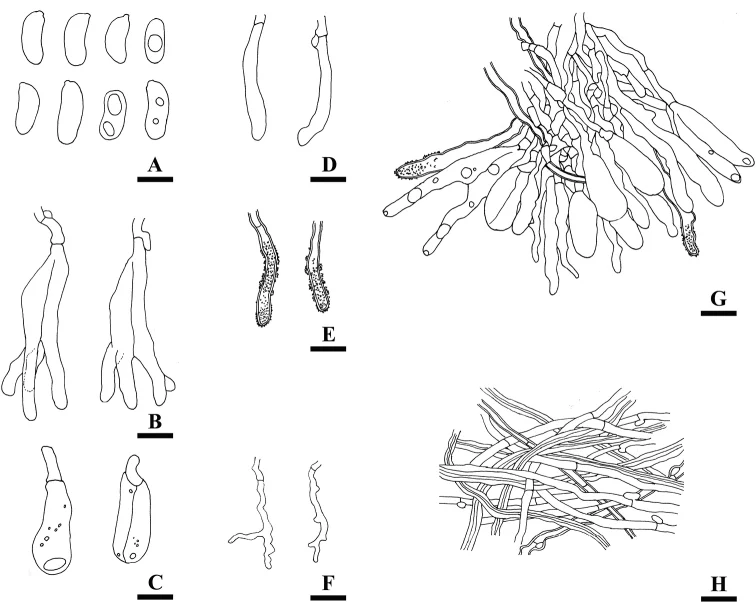
Microscopic structures of Heteroradulum australiense (drawn from the holotype, LWZ 20180515–26). A basidiospores B, C basidia and basidioles D cystidia E skeletocystidia F dendrohyphidia G hymenium H subicular hyphae. Scale bars: 10 μm (A–H).
Kredit dan penggunaan
Qian-Zhu Li, Shi-Liang Liu, Xue-Wei Wang, Tom W. May, Li-Wei Zhou
Ukuran dan format gambar disesuaikan tanpa pemotongan, retus, atau penambahan skala. Lisensi sumber dipertahankan.
Sumber profil
- [1] Redelimitation of Heteroradulum (Auriculariales, Basidiomycota) with H. australiense sp. nov. — Heteroradulum australiense
- [2] Catalogue of Life Base2026-09-11 — Heteroradulum australiense
- [3] Dokumentasi visual — Heteroradulum australiense
- [4] Dokumentasi visual — Heteroradulum australiense
Rujukan halaman ini
Fungi. Heteroradulum australiense. Rilis data fungi-2026-10-12-expansion-2. https://fungi-atlas.mgadib.chatgpt.site/jamur/heteroradulum-australiense/.
Status: impor sumber; pemeriksaan editorial per profil belum selesai. Untuk klaim biologis, gunakan rujukan pada bagian terkait dan periksa konteks sumber aslinya.